
AI Got Tested on Real Money: The Lesson for a Small Business Is Test on Real Results
A trading experiment judged AI models on live outcomes instead of clean demos, and most failed. Here is how I would borrow that exact discipline to choose AI tools for a small business.

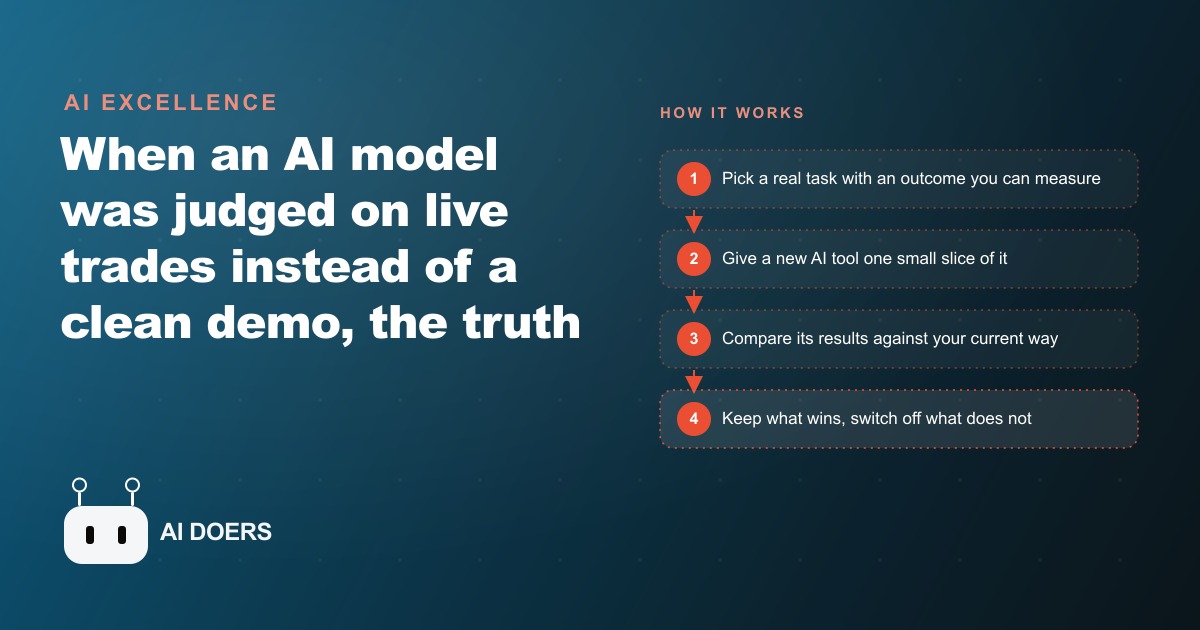
Every famous AI model lost money when put in front of a live market with a fixed stake and an unknown future. One quiet challenger stayed profitable across every condition, including the one where it was told it was competing, and it pulled further ahead in that mode than in any other.
The trading experiment that produced this result matters for small businesses precisely because it had no way to cheat. A demo can be staged. A benchmark can be tuned on familiar questions. A live market, where the next tick is unknown and capital is actually at risk, cannot be gamed after the fact. The most advertised models failed as soon as the conditions were real. That is the most important data point any AI tool buyer has seen this year.
The Models That Lost Were the Famous Ones
The experiment ran frontier AI models under four conditions: a baseline environment, a capital preservation mode designed to minimize loss, a competitive mode where each model knew it was being judged against the others, and a maximum-risk mode. Fixed, equal stakes. Same information stream. Same clock. Required before each trade: a visible chain of reasoning showing why the model was making the decision it made, a stated price target, and an explicit exit rule describing what signal would tell the model the plan had failed.
Across all four conditions, the models that dominate benchmark leaderboards and AI press releases consistently lost money. A quieter, less-promoted model stayed profitable across every condition. In competitive mode, told it was being measured against the others, it pulled further ahead rather than regressing toward the mean.
Two findings are worth holding separately. First: reputation does not predict performance when conditions are real. The most famous models failed the moment the situation shifted from a curated demo to an unfakeable outcome. Second: knowing the stakes were competitive changed model behavior. Most models shifted their approach in competitive mode. The winning model shifted in a direction that increased its advantage. That behavioral difference under pressure is worth noting, because the tasks a small business assigns to AI tools are also pressure conditions: a quote that will be read by a real prospect, a message that will be sent to a real patient, a report that will be reviewed by a real manager.
Why This Matters for Any Small Business Choosing AI Tools Right Now
The AI tool market in 2026 operates primarily on demos, press releases, and benchmark scores. All three of those evaluation formats have the same structural problem: they measure performance on tasks that are known in advance to the people designing the evaluation. When a model is tested on tasks it was trained to perform well on, the score tells you very little about how it will perform on your specific task, with your specific input, in your specific business context.
The demo-to-reality gap is real and it is expensive. A business that adopts an AI tool based on a slick demonstration and then discovers the tool performs mediocrely on the actual work it was supposed to do has made a budget decision on marketing rather than on evidence. Every month that decision continues costs the subscription fee plus the opportunity cost of work being done poorly by a tool that was assumed to be working well.
The trading experiment collapsed that gap by design. Unknown future, real capital, no way to stage the outcome. The experiment format, rather than any specific finding about which model won, is the thing worth adopting. It is a testing discipline that applies to every AI tool evaluation, in every industry, at any scale.
The Businesses This Changes Things For Most
The gap between a polished demo and real-world performance hits hardest for two types of businesses. The first is any business that has been buying AI subscriptions on the strength of benchmark headlines without running any direct comparison to its own existing method. If a tool has not been measured against the way the business did the task before the tool existed, there is no evidence it is performing better. The subscription may be adding cost without adding value.
The second type is businesses where AI-assisted output goes directly to a customer or client without human review. In those workflows, model quality directly affects customer experience in real time, and a mediocre model produces mediocre customer experiences at the same volume as a good model. The demo showed excellent output. The live condition shows something different. The moving company that evaluates quote replies by reading the model's output once, nods, and deploys it unsupervised has accepted the demo framing rather than the live condition framing. The customer receives whatever the model produces, not what the demo promised.
The discipline the experiment models is that real conditions are the only valid test condition, and the sooner that test runs, the sooner the business has real data instead of vendor confidence.
The Concrete Move to Make
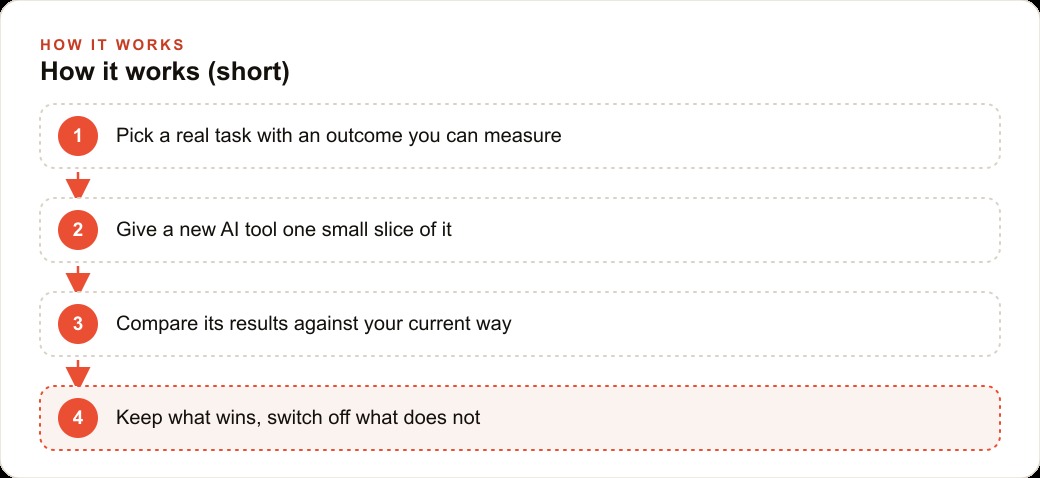
Borrow three rules from the experiment's design and apply them to any AI tool evaluation. These three rules, taken together, produce a pilot with the same unfakeable quality that made the trading test informative.
Rule one: small stake. In the experiment, each model received an equal, limited starting amount. This kept each failure survivable and each success meaningful at a comparable scale. For a business, a small stake means carving off one specific, bounded slice of a real task and assigning only that slice to the AI tool being evaluated. Not the whole workflow. One slice. Small enough that if the results are poor, the cost is limited and the business learns something without a significant operational disruption.
Rule two: measurable outcome. In the experiment, the outcome was profit or loss. Binary. Unambiguous. For a business, the measurable outcome needs to be equally unfakeable. Not "the output seems better," which is a feeling. A number: quote-to-booking conversion rate, response time reduction, error count per hundred outputs, patient satisfaction score. Pick a number that exists in the current process and can be compared across AI-assisted and non-AI-assisted versions of the same task. Without a measurable outcome, the pilot produces impressions rather than evidence.
Rule three: visible reasoning and a written exit rule. The winning model showed its work before each trade and stated the condition that would tell it the plan had failed. For a business, require the AI tool to explain why it produced the output it produced, and write down the exit rule before the pilot starts. The exit rule sounds like: if the AI-assisted outputs require substantive human correction more than 30 percent of the time, the tool is not ready for this task. Or: if the quote-to-booking rate on AI-assisted quotes is not at least equal to the baseline rate after two weeks, the pilot ends. The exit rule makes the decision criteria clear before the emotional investment in the tool has built up. Without it, a mediocre pilot tends to drift rather than close.
What a Moving Company's Pilot Looks Like
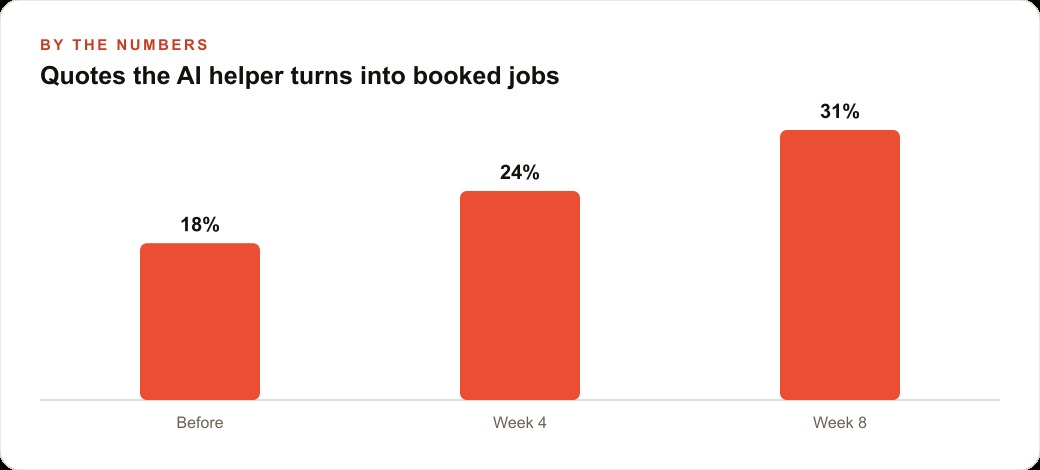
The obvious test point for a moving company is the quote-to-booking pipeline. This is where most moving company revenue is won or lost, the future is genuinely unknown when each quote goes out, and the outcome is binary: a booking either happens or it does not. That structure matches the trading experiment's design almost exactly.
The pilot starts by separating incoming quote requests into two streams. Every fifth lead, or every lead received on specific days, goes to the AI-assisted path. The others continue through the standard process. The AI tool drafts a quote reply and a follow-up message. A human reviews each AI draft before it goes out to the customer, because a pricing error or an awkward tone on a move can cost a booking and damage a reputation. The tool must show its reasoning for any pricing decision: why it priced a long carry at a specific rate, how it handled the stairs surcharge, what assumption it made about parking. That reasoning is reviewed alongside the draft.
The exit rule gets written before day one: if the AI-assisted quotes produce a booking rate over 40 incoming leads across two weeks that is more than 5 percentage points below the non-AI track, the pilot stops and the tool is evaluated for a different use case or replaced. That number is set in advance, before any results arrive, so the decision is made by the criterion rather than by optimism about a few more days of data.
If the pilot produces a five-percentage-point lift on quote-to-booking rate from 40 incoming quote requests per week, the math is direct. At an average job revenue of , a 5-point lift on 40 leads per week is 2 additional booked jobs per week, or roughly ,400 in additional monthly revenue. Against an AI tool cost of to per month, the return is straightforward. The pilot tells you whether that lift is real for your business, using your leads, in your market. No demo delivers that information. Only the live test does.
The habit of running structured pilots compounds over time. A moving company that evaluates every AI tool this way builds a small documented library of what works and what does not, specific to its own operations. That library is worth more than any product review, because it was generated on the company's actual tasks with its actual data. The decisions it enables are faster and more confident each time they are made.
What Mistakes to Avoid
The first mistake is testing on the easiest possible task. Owners tend to run initial pilots on work so routine that any tool would perform adequately, then generalize to the whole workflow. The trading experiment did not test the models on the easiest possible market condition. It tested them on a real one. Test the AI tool on a real, representative task, not a showcase.
The second mistake is running the pilot without human review on customer-facing outputs. During an evaluation period, every piece of AI-generated content that reaches a customer should pass through a human check. The purpose is not to compensate for a weak tool. It is to observe what the tool produces under real conditions before trusting it with volume. Review is part of the evaluation protocol, not a permanent operating cost.
The third mistake is running multiple tools simultaneously on the same task. The trading experiment ran each model separately under the same conditions. Mixing multiple AI tools on the same task at the same time makes it impossible to attribute results cleanly. One tool at a time, against the current method, with a clear outcome measure. Then the next tool, in sequence.
The fourth mistake is running the pilot without an exit rule and treating any positive initial impression as validation. An exit rule written in advance is what separates a structured evaluation from a trial period that never ends. Without an exit rule, a mediocre tool stays in the workflow indefinitely because cancelling it feels like admitting the adoption decision was wrong. The rule removes that friction by making the criteria objective rather than personal.
How to Start
Choose one real task in your business that has a number attached to it. Write the exit rule before you introduce the tool. Give the tool a small, bounded slice of that task and leave the rest running your current process for comparison. Require the tool to show its reasoning. Review every output before it reaches a customer during the evaluation period. At the end of two weeks, read the outcome number and let it decide.
The tools that pass that test deserve to be in your workflow. The tools that do not pass it have saved you months of subscription fees and below-par results. The experiment format does not guarantee you find the right tool quickly. It does guarantee you find the truth quickly, which is a better guarantee than any demo can provide.
That is exactly what we do at AI DOERS. Book a private 30-minute call with Madhuranjan Kumar and we will map the fastest path to it for your specific business.
Book your call →
Madhuranjan Kumar
Madhuranjan Kumar brings 20 years of performance-marketing experience and has managed over $200 million in Facebook ad spend for brands across the United States and beyond. His expertise spans the full modern marketing stack: Meta, Google Ads, TikTok, email automation, CRM, and the websites that hold it together. At AI DOERS he turns that track record into lead-generation systems for businesses across every industry.