
AI's Biggest Stand: What Anthropic Refusing the Pentagon Means for Your Business
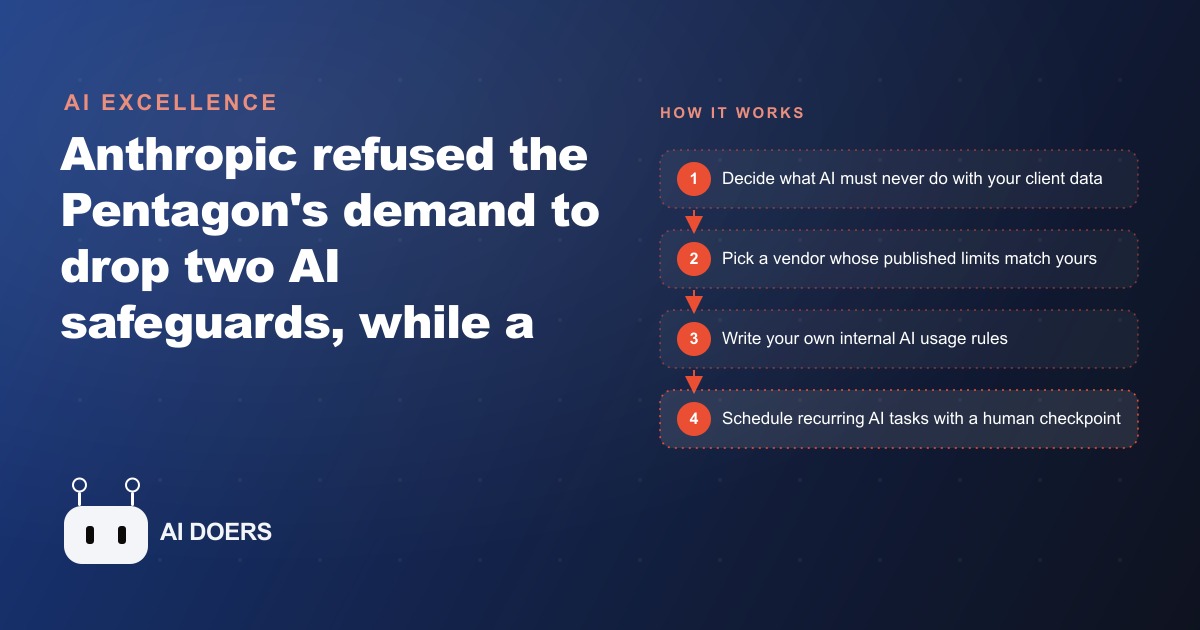
Anthropic refused to drop two hard limits even under threat, and the work simply rerouted to a vendor that would. For any business adopting AI, that is a lesson about choosing vendors with values you can trust and setting your own usage rules.

There is a difference between a company that publishes a values statement and a company that holds to it when a client powerful enough to threaten its entire revenue model demands it change. Last week, the AI industry got a live data point on that difference, and it matters for every business choosing which AI vendors to trust with real work.
I am Madhuranjan Kumar. I want to take apart what actually happened, why it matters beyond the specific geopolitical context, and what the practical takeaway is for a business owner evaluating AI vendors and setting internal rules for how those tools are used.
Stated limits and tested limits are different products, and now you have a data point on both
Anthropic, the maker of Claude, had an arrangement to operate inside classified government systems under a broad all-lawful-use standard with two named exceptions: no mass surveillance of US citizens and no fully autonomous weapons systems that could act without a human in the decision loop. When the administration pushed to remove those exceptions entirely, Anthropic refused. The threat that followed was significant: labeling Anthropic a supply chain risk, a designation typically reserved for foreign adversaries and one that would force any organization with government contracts to cut ties with Anthropic immediately.
Anthropic held the line on both exceptions. The contract did not proceed on the broader terms. Within days, a competing model accepted the all-lawful-use standard and gained access to the same classified systems.
The reason this matters beyond the defense context is the distinction it surfaces for any business making vendor decisions. Most companies evaluate AI vendors on features, price, and integration ease. Those are the right starting criteria. What this week added to the evaluation list is evidence about the gap between a vendor's stated policy and its actual behavior under pressure from a commercially significant client. A policy page and a tested limit are different products. Before this story, it was not possible to know from public evidence whether Anthropic's stated limits would hold under serious commercial and political pressure. Now there is a data point.
For the majority of businesses, the specific content of those limits is not directly relevant. What is relevant is the existence of a limit that held when tested. A vendor that maintained a limit under this kind of pressure is making a different implicit claim about the reliability of its other stated policies than a vendor that has never been publicly tested. The absence of public evidence of testing is not the same as the presence of reliable limits. This distinction matters more as the work you route through AI tools becomes more sensitive.
The work reroutes when one vendor holds the line, and that is the feature and the risk simultaneously
The second thing this story demonstrates is that when one capable vendor holds a limit, the demand does not disappear. It reroutes. The task the administration wanted done is now being done by a different system on different vendor infrastructure, because that vendor accepted terms the first one would not. This is simultaneously the feature and the risk of vendor limit-holding.
The feature: a vendor that holds limits provides a genuine constraint on what work can be routed through its systems. For a business that needs those limits for its own compliance or liability reasons, that is real value. A healthcare organization that needs assurance its vendor will not process patient data in ways the organization's policies prohibit gets a different level of assurance from a vendor that has held limits under pressure than from one that has only stated them.
The risk: limits only function as guardrails in practice if every capable vendor in the market holds them. When a capable vendor steps in to fill work that another vendor declined, the limit on the second vendor becomes a competitive positioning decision, not a meaningful restriction on what can be done in aggregate. The absence of some major AI companies from public statements about maintaining similar limits is the uncomfortable part of this story for anyone thinking about it carefully.
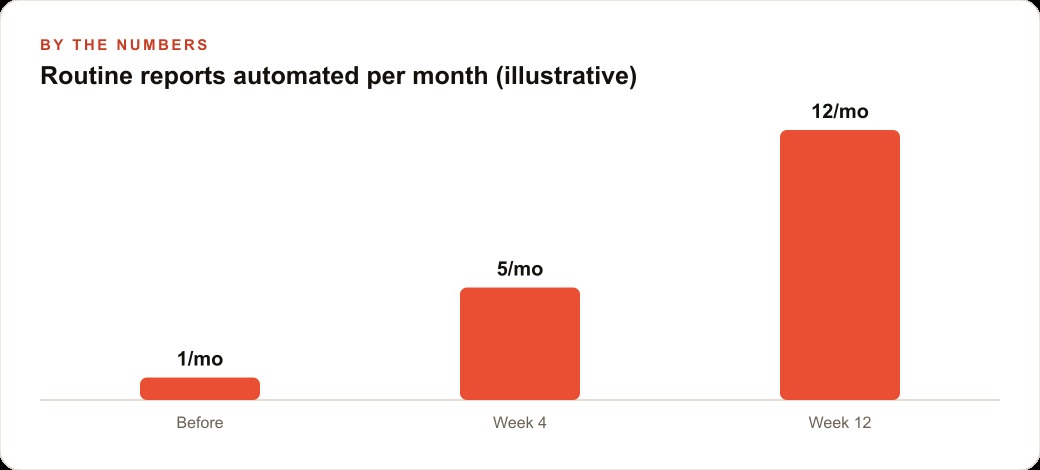
This dynamic is also a preview of the governance challenge as agents gain more autonomy. The same week this story ran, agents gained the ability to control their own virtual machines and run for hours at a time recording every action they take. A major code editor announced that agents could be set for runs of three, five, or ten hours, working through a large task and reporting back when done. A leading productivity platform previewed recurring agent tasks in its standard software suite. A widely used collaboration tool shipped agents running continuously across multiple communication channels.
The pattern is consistent and meaningful: agents are gaining the ability to operate for longer periods, on more sensitive data, with less continuous human attention. As that autonomy increases, the governance question about what rules your vendor operates under becomes progressively more consequential. A scheduled agent that processes client communications overnight, updates financial records, and drafts correspondence for morning review is doing something qualitatively different from a chatbot that answers questions. The rules that govern what it can and cannot do matter in a different way.
The same week, agents gained hours of autonomous unattended operation
The news cycle that week was not just about limits held. It was equally about capabilities expanded. A cloud AI system unified research, design, code generation, and deployment into one environment that picks the best model for each task automatically, routing complex reasoning to the strongest available model and farming out image generation, search, and other specialized tasks to models built specifically for those outputs. A widely used code editor announced that agents could now control their own virtual computers and record video of every action, reviewable after the fact.
A new image generation model arrived with faster output, web search grounding, and stronger text rendering, available free across multiple consumer and developer platforms. A team trained a model on eleven million hours of software use video that can navigate websites, run complex application sequences, and perform learned computer operation without explicit programming for each specific task. Each of these capabilities has immediate implications for businesses that adopt them.
Together, they reinforce the same pattern: the timeline on which autonomous agents with significant capability become widely accessible is shorter than most organizational governance frameworks assume. The gap between what a major AI company ships under a controlled research program and what is broadly available in the open market keeps shrinking. The appropriate response is not to slow adoption but to build the governance layer before it is urgently needed rather than after.
Anthropic's own Claude platform added scheduled tasks to Co-work and a remote-control feature that pings your phone for permission before executing a consequential action. The agent proceeds if no response is received within a permission window, but the notification is sent. That design pattern is the right template for how autonomous operation and human oversight can coexist: the agent prepares and acts on the routine, and a human has an explicit checkpoint at any action with meaningful consequences. That pattern is worth emulating in your own internal usage rules, not because the technology requires it, but because it is the right distribution of decision authority between a person and a system.
The practical business question is simpler than the geopolitical one: what does your vendor actually refuse to do?
For a business owner evaluating AI vendors, the question is not primarily about defense contracts or national security policy. It is: what does this vendor refuse to do with my data, and has that refusal ever been publicly tested? If the answer to the second part is yes, and the limit held, that is a meaningful signal. If the answer is no test has occurred, the vendor's stated limits are a prediction about behavior rather than evidence of it.
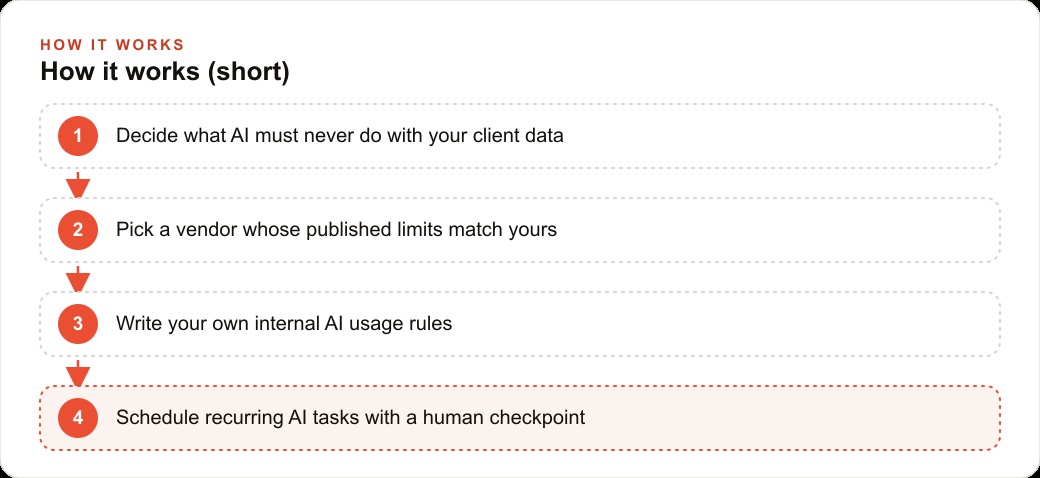
The practical due diligence for vendor selection on this dimension involves three things. First, read the vendor's stated data handling policy, terms of service, and published limit statements. Not the summary, but the actual document. Look for specific commitments about what is not permitted: training on your data without consent, sharing data with third parties, using outputs from your queries to improve models in ways you have not agreed to. Second, search for public cases where those limits were tested. This is now possible for at least one major vendor in a way it was not a month ago. Third, ask the vendor directly what they would do if a sufficiently large client asked them to modify those limits for that client. The answer tells you whether the limits are policy or negotiating position.
The internal AI usage rules that follow from this evaluation do not need to be long or complex. A one-page document that specifies which categories of information may and may not be processed by external AI systems, which vendor has been approved for which categories, and what the review requirement is for any output that reaches clients or gets written to a record of consequence is sufficient for most businesses. Writing that document before a question arises is significantly easier than reconstructing the decision-making framework after an incident has occurred.
The distillation story is the governance problem in miniature
DeepSeek, Moonshot, and MiniMax were reported to have reproduced frontier model capabilities by routing queries through proxy servers and tens of thousands of fake accounts, capturing the outputs at scale and using them to accelerate training of their own models. In at least one reported case, a competing organization redirected a significant portion of its query traffic to capture a new model release within twenty-four hours of it shipping. The implication is that the control layer over powerful capabilities is more porous than the formal licensing and terms-of-service framework suggests.
This is not a new problem in software. The pattern of reproducing capabilities from a licensed system through indirect extraction has existed since the first competitive software market. What is different now is the scale and speed: capturing a substantial share of the query traffic of a frontier model release in a day to accelerate training of a competing system is a different magnitude of extraction than anything that was practical in previous software markets.
For a business owner, the direct relevance is limited in most cases. You are unlikely to be operating a proxy server to distill a frontier model. But the indirect relevance is meaningful: it shows that the timeline on which powerful capabilities propagate across the market is very short. A capability that one vendor ships under a careful safety evaluation and a specific license may be available in a less governed form from another source within weeks. Governance frameworks that assume the capability frontier is controlled by a small number of responsible vendors are working from a premise that becomes less accurate over time.
The practical implication is to build your internal AI governance rules around the categories of risk rather than around specific vendors or specific capabilities. A rule that says you will not use AI tools for processing certain categories of sensitive information without explicit client consent is robust to changes in the vendor landscape. A rule that says you will only use a specific vendor for that category is robust only until the vendor landscape changes, which it will continue to do at a pace that organizational governance frameworks have historically not kept up with.
A law firm evaluates three vendors and writes one internal policy
A law firm with a regional practice needed to establish AI usage rules before any attorney began using external tools for client matters. The concern was not primarily about whether the tools were capable. It was about privilege, confidentiality, and the obligation not to expose client information to systems that might use it in ways the client had not agreed to.
The evaluation started with three vendor options that had been proposed by different attorneys on the team. The first question for each was: what does this vendor's data handling policy say about training on inputs? Two of the three had policies that either permitted training on user inputs by default or were ambiguous enough to require explicit configuration to opt out. The third had a clearer no-training-on-inputs commitment in its standard terms for the relevant product tier.
The second question was whether any vendor's stated limits had been publicly tested. After the Anthropic story ran, the firm had one vendor where a public test had occurred and the limit had held. They noted that as a differentiating data point in the evaluation, not as the sole criterion but as one meaningful signal alongside price, integration, and capability.
The internal policy document they produced was one page. It specified: no client-privileged communications may be processed by external AI tools without explicit client consent documented in the engagement letter. Non-privileged research and document drafting from public sources may use approved AI tools. Any AI-generated output that will be included in a client deliverable must be reviewed and edited by a licensed attorney before inclusion. The list of approved vendors is maintained by the technology partner and reviewed quarterly.
That document took one afternoon to draft, one team meeting to approve, and one email to distribute. There have been no incidents in the year since it was adopted. The policy exists, was written before an incident created urgency, and gives the firm a clear framework for evaluating new tools as the vendor landscape continues to change. The total cost was one afternoon and one meeting. The alternative, drafting the policy under urgency after a client data question arises, would have cost significantly more in legal review time, partner attention, and potential reputational exposure.
The connection between internal AI governance and the firm's own growth strategy is worth noting. The firm uses SEO and organic search to generate inbound client inquiries. Several of those inquiries in the past year specifically mentioned the firm's published statement on AI and client confidentiality as a reason for contact. The policy that was written as a risk management document turned out to have value as a credibility signal in a market where clients are increasingly aware that their advisors use AI tools and increasingly interested in what safeguards are in place. The CRM and website stack that captures and tracks those inbound leads now includes a field for how the client first heard about the firm, and AI policy mentions have become a meaningful attribution category.
The firms that treat AI governance as a checkbox will discover its value only when something goes wrong. The firms that treat it as a genuine client-facing signal, something that demonstrates judgment and care about confidentiality, are building a differentiator that compounds as AI adoption in professional services accelerates and the variation in how firms handle it becomes more visible to the clients evaluating them.
The week that produced this story was one of the most consequential in the AI industry's short history, not because of the specific policy content, but because of what it revealed about the gap between stated limits and tested limits, and because of the simultaneous acceleration of agent autonomy that makes that distinction more consequential every month. The businesses that understand both things now are better positioned than the ones that understand only the capability side without the governance side. Both matter, and they are accelerating together.
That is exactly what we do at AI DOERS. Book a private 30-minute call with Madhuranjan Kumar and we will map the fastest path to it for your specific business.
Book your call →
Madhuranjan Kumar
Madhuranjan Kumar brings 20 years of performance-marketing experience and has managed over $200 million in Facebook ad spend for brands across the United States and beyond. His expertise spans the full modern marketing stack: Meta, Google Ads, TikTok, email automation, CRM, and the websites that hold it together. At AI DOERS he turns that track record into lead-generation systems for businesses across every industry.