
The AI Price War Is Here and Fitness Studios Are the Unexpected Winners
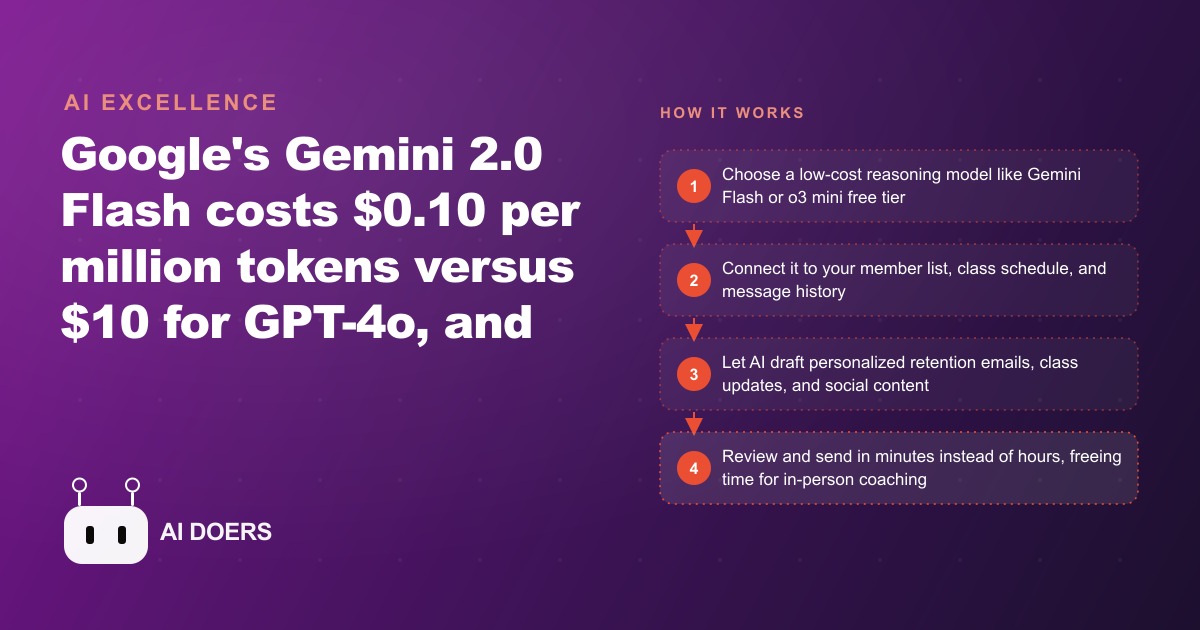
When Google released Gemini 2.0 Flash at $0.10 per million tokens, it forced every AI company to compete on price, and the result is that powerful reasoning AI is now within reach of any gym or fitness studio.

Google cut the price of AI reasoning by a factor of one hundred this week, and the business that gains the most from this shift is not a Fortune 500 company with a dedicated AI team. It is a fitness studio owner answering member emails alone at nine in the evening.
Madhuranjan Kumar has been tracking the week's model releases closely, because the pricing change is the kind of shift that looks like a tech story on the surface and operates like a business story underneath. Here is what changed, why it matters, and the concrete move worth making before next month.
Google Just Made Enterprise-Grade AI Reasoning Cost Almost Nothing Per Token
Gemini 2.0 Flash is priced at $0.10 per million input tokens. GPT-4o is priced at $10 per million. Claude 3.5 Sonnet is priced at $15 per million. That is a one-hundred-fold difference between the cheapest and most widely used models, and the practical effect for a small business running AI across a daily workflow is that the cost moves from noticeable to essentially invisible.
To put this in real terms: if a business runs ten thousand AI-assisted tasks per month, each consuming roughly five thousand tokens of input, that is fifty million tokens per month. At GPT-4o pricing, that is $500 per month. At Gemini Flash pricing, that is $5 per month. The tasks are the same. The output quality is competitive across the vast majority of practical business applications. The difference is $495 per month, compounded across the full year.
OpenAI released o3 mini in the same window. It outperforms every competing model in math and science benchmarks except the $200 per month o1 Pro tier, and it is available on the free tier of ChatGPT. Free users access it by pressing the Reason button in the interface, and can combine it with web search simultaneously by pressing both buttons at once. The model shows a summarized version of its thinking process, which makes it easier to verify the logic on a complex task before acting on the answer.
The combined effect of this week's releases is that the quality ceiling for AI tools available at near-zero cost just rose sharply. Any business owner who has been hesitating on AI integration because of cost concerns is looking at a different calculation today than they were looking at two months ago.
The Three Gemini 2.0 Models Released This Week and What Each One Changes
Google released three distinct models, and each fills a different position in a business workflow.
Gemini 2.0 Flash is the general-availability release and the most relevant for most small businesses. At $0.10 per million tokens, it is the practical default for high-volume automation: newsletters, follow-up messages, social captions, product descriptions, and any repetitive communication task that runs at scale each week. The quality is more than sufficient for these applications, and the cost at typical business volumes is under $5 per month.
Gemini 2.0 Pro is the state-of-the-art model with a two-million-token context window. Two million tokens means the model can hold an entire book, a full client email history, or a complete CRM export in a single session. For a business that needs to analyze a large body of text, generate a strategy from a complex set of inputs, or process a document set that would overwhelm a shorter context window, Pro is the appropriate choice. The cost is higher than Flash, but still far below what comparable capability cost six months ago.
Gemini Flash Lite is the efficiency model, designed for high-volume, low-cost tasks with a one-million-token context window. If the automation involves simple, repetitive processing at very high scale, Flash Lite reduces the already-low Flash cost further.
On LM Arena, the community benchmark where human raters compare models head to head in live conversations, Gemini 2.0 Flash Thinking holds the top position. Gemini 2.0 Pro is second. GPT-4o is third. This is the first time Google models have held both of the top two positions simultaneously on the human preference rankings, and it represents a meaningful competitive shift that aggregate benchmark numbers alone do not capture.
The LM Arena result is worth pausing on, because it is a different kind of evaluation than the standard capability benchmarks. Most benchmark scores measure how well a model answers structured questions with known correct answers: coding problems, math problems, factual recall. LM Arena measures something closer to preference in open conversation: which model do real humans choose when they compare two responses side by side without knowing which model produced which. A model that tops LM Arena is not just technically accurate. It is the one people prefer to work with across a wide range of real tasks. For a business owner using AI for communication, that distinction matters more than a coding benchmark score does.
A Fitness Studio Now Has Access to the Same Reasoning Power as a Fortune 500 Team
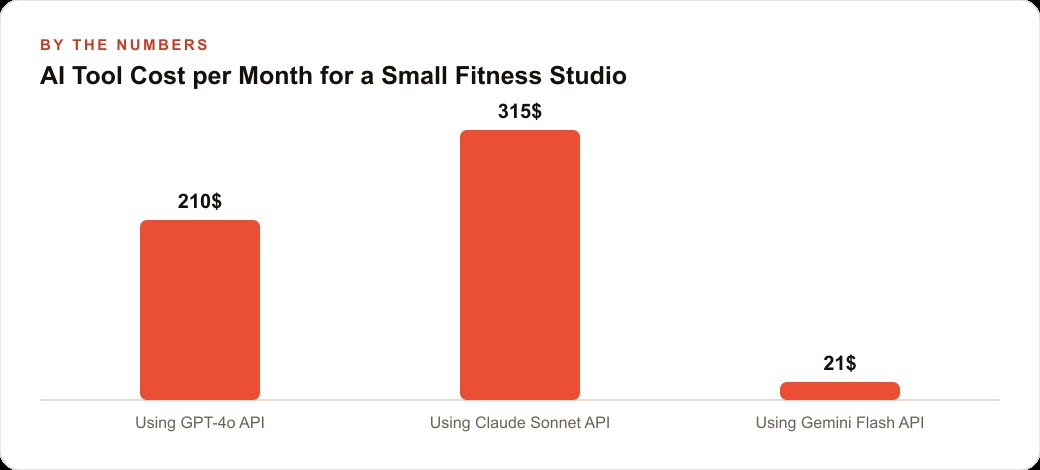
Before this week's releases, the cost of running a serious AI integration across a fitness studio's member communication workflow looked like a line item that required justification. At $10 to $15 per million tokens for models capable of handling nuanced, personalized member communication, a studio running meaningful daily volume was looking at $150 to $300 per month just in API costs. For an owner managing a 200 to 300-member gym on thin margins, that price point made the automation feel optional.
At $0.10 per million tokens, the same volume costs $1.50 to $3 per month. The quality required to write a personalized re-engagement message to a member who has not attended in two weeks is well within what Gemini Flash delivers. The economic barrier is gone. What remains is the setup: knowing which tasks to automate, how to write the prompts, and how to connect the tool to member data.
This is the access gap that closed this week. A Fortune 500 company with an AI team had already done that setup work and was running these automations at scale. A 280-member fitness studio owner could not justify the setup cost for a benefit that seemed marginal at previous pricing. At current pricing, the payback on setup time is measured in weeks rather than quarters. That changes the calculation completely for any studio owner who has been watching enterprise AI adoption from the outside.
The owners who moved early on email automation two years ago, when the tools required some technical setup, now have working systems generating consistent communication with minimal weekly effort. The owners who waited are still doing it manually. The same dynamic applies here. The price drop this week removes the last economic objection that was reasonable to make. What separates the owners who build the system next month from the ones who look at this again in a year is not cost. It is the decision to start.
The Lyft Deployment Is the Enterprise Signal That Production Readiness Is Here
Among the week's news items, the Lyft deployment is the one that matters most for a small business owner deciding whether AI is reliable enough to trust with real customer interactions.
Lyft deployed Claude for customer service and reduced resolution time by 87 percent. That is not a prototype or a limited pilot. That is a company processing millions of customer service interactions, with real reputational and legal exposure, running an AI reasoning model in production and measuring an 87 percent improvement in resolution speed. The model is handling the kinds of complex, context-dependent conversations that had been considered too sensitive for full automation.
For a fitness studio, the question of whether AI is ready to draft a re-engagement message to a member who has been absent for two weeks is a far simpler question than the one Lyft was asking. If a company at Lyft's scale trusts an AI reasoning model with high-stakes customer service in production, the studio can trust one with a newsletter draft.
The enterprise signal matters because small business adoption of new technology tends to follow enterprise validation. When a company of that scale deploys something in production and reports strong documented results, the risk calculation for smaller operators changes. The technology is no longer experimental. It is in use at scale, and the outcomes are on record.
The Cheapest Path From Zero to Automated Member Communication
Consider a fitness studio with 280 active members. The owner manages operations, coaches four classes per week, and handles all marketing personally. Communications currently consume about five hours per week: a weekly newsletter, social posts on two platforms, re-engagement messages to inactive members, and responses to new-member inquiries.
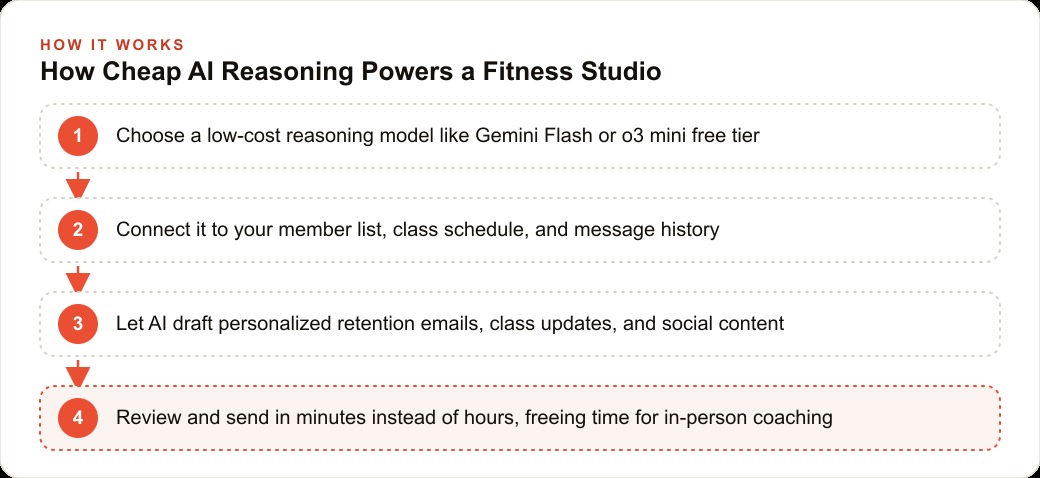
Here is how that changes with Gemini Flash at roughly $5 per month in API costs.
For the weekly newsletter, the owner writes three bullet points: what happened this week, what is coming up, one programming note worth highlighting. The prompt asks the model to write a 400-word newsletter in a warm, coaching voice. A full draft arrives in eight seconds. The owner adds one personal anecdote from the week and sends. A task that used to take fifty minutes takes twelve.
For re-engagement messages, the owner pulls a list of members who have not checked in for fourteen days or more. The prompt asks for one focused paragraph per member, referencing their most frequently attended class type and suggesting a specific upcoming session that fits their history. For ten members, the model generates ten distinct messages in under a minute. The owner reads each one, corrects any inaccuracies, and sends. Two hours of thoughtful manual writing becomes twenty minutes of review.
For social content, the owner asks the model for three caption options for any given post: one educational, one motivational, one that invites community response. All three arrive in under a minute. The owner picks the one that fits the mood that week, schedules it, and moves on. Ninety minutes of weekly social writing becomes twenty minutes.
Across all three tasks, the owner recovers roughly three and a half hours per week. At an owner-time value of $80 per hour, that is $280 per week, or $1,120 per month, in recovered productive capacity against an API cost under $5 per month.
The re-engagement messages carry a compounding return beyond the time saving. Consistent outreach to members who have gone quiet tends to recover a portion of those memberships before they lapse entirely. If those messages recover an average of two memberships per month that would otherwise have cancelled, and average member lifetime value is $1,200, that is $2,400 per month in retained revenue attributable directly to the automated communication. The path from zero to this setup requires one afternoon to build three core prompts, test them on real content from the current week, and refine until the output is consistently on-brand. After that the system runs on the time it takes to review and send.
The week's releases do not change what good member communication looks like. They change who can afford to send it consistently. A studio owner who was priced out of meaningful AI automation two months ago is not priced out today. The tools are better, cheaper, and proven in production at enterprise scale. The only question is how quickly the setup gets done.
The three-prompt library built in that first afternoon becomes the core of a communication system that runs indefinitely. The newsletter prompt works the same way in month six as it did in week one. The re-engagement template improves slightly as the owner refines the voice over the first few months, but the structure stays the same. The social caption prompt adds new formats as the owner discovers what works on each platform. None of that requires rebuilding from scratch. It requires updating a text file and testing the new version against one real example. The ongoing maintenance cost of the system is measured in minutes per month, not hours. None of that requires buying an enterprise contract, hiring a specialist, or waiting for a vendor integration. The only requirement is an afternoon to set up three prompts and the discipline to use them every week.
That is exactly what we do at AI DOERS. Book a private 30-minute call with Madhuranjan Kumar and we will map the fastest path to it for your specific business.
Book your call →
Madhuranjan Kumar
Madhuranjan Kumar brings 20 years of performance-marketing experience and has managed over $200 million in Facebook ad spend for brands across the United States and beyond. His expertise spans the full modern marketing stack: Meta, Google Ads, TikTok, email automation, CRM, and the websites that hold it together. At AI DOERS he turns that track record into lead-generation systems for businesses across every industry.