
AI Is Moving From One Giant Model to a Coordinated Team of Models
A coordinator that routes each task to the best specialized model may matter more than raw size, and the same idea reshapes how a business should stack its AI tools.

Every well-run organization discovered the same thing eventually. Your strongest generalist, when given everything to do, becomes the bottleneck. The answer was never to find a smarter generalist. It was to route work to the right specialist and put someone skilled at the routing decision in charge of the handoffs. Every law firm figured this out. Every hospital figured this out. Every manufacturing operation figured this out. AI is currently catching up to organizational wisdom that humans spent decades arriving at, and the implications for every business using AI tools today are more immediate than most of the coverage suggests.
The conductor model: why routing intelligence might matter more than raw model size
For years the prevailing assumption in AI development was that capability gains would come from scale: bigger models trained on more data would produce better outputs. That assumption produced remarkable results and is not entirely wrong. But it is increasingly incomplete, because the businesses deploying AI are discovering that the challenge is not always model size. It is model selection and task routing.
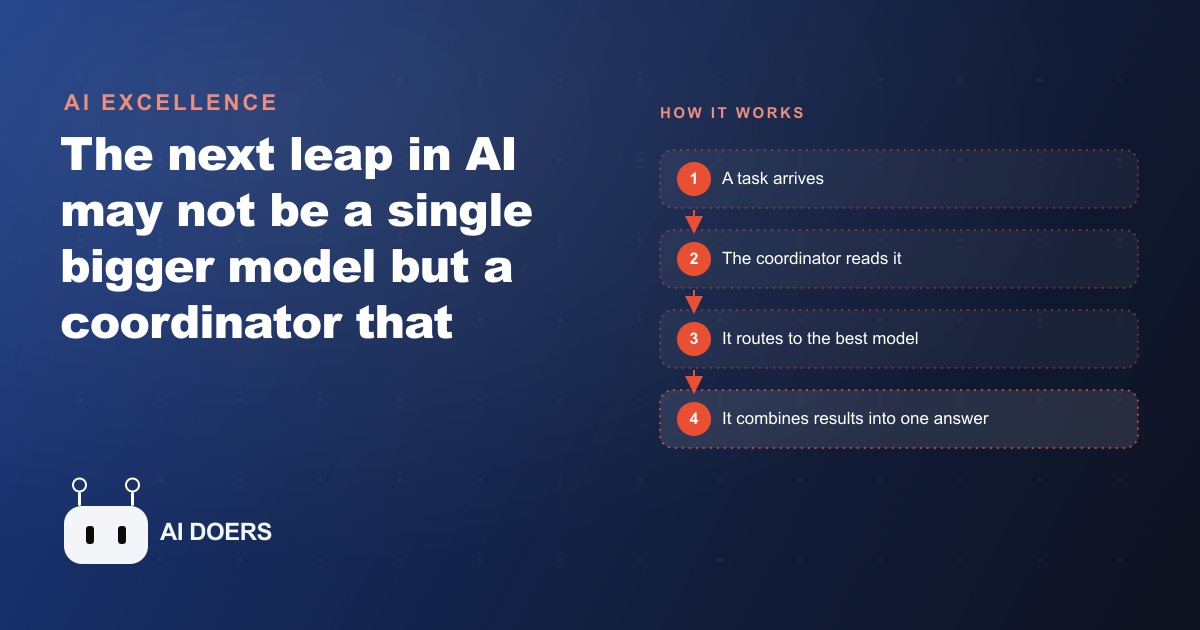
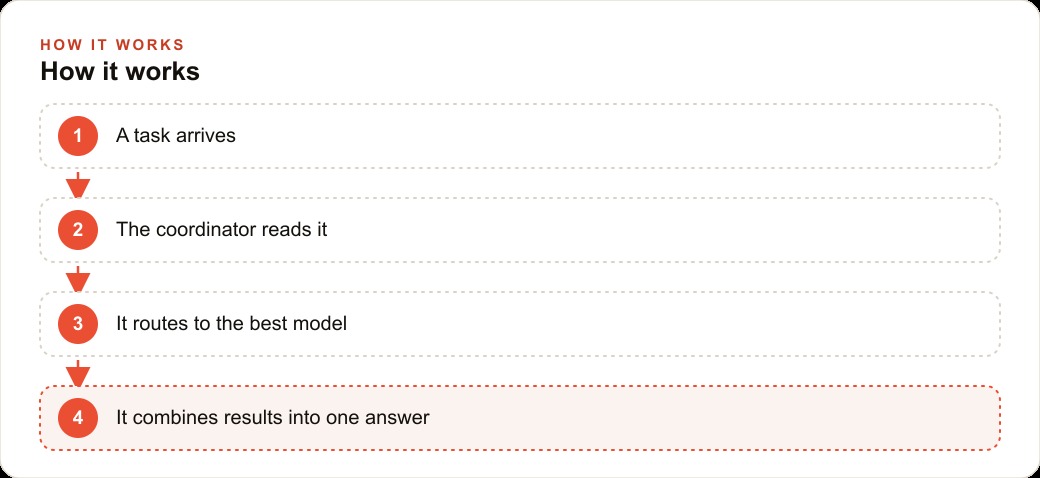
The AI equivalent of a conductor is an orchestrator model. Its primary job is not to answer your question directly. It is to read the incoming task, identify which model in a pool of available models is best suited for that exact work, route the job, receive the output, and combine results into a single response. The user sees one capable system. Behind it are specialists, each strong at different categories of work, coordinated by a model trained specifically for the routing decision.
What Madhuranjan Kumar finds genuinely useful about this framing is that it maps almost perfectly onto how a real business should already be thinking about its AI subscriptions. The question shifts from how do I find the single best AI tool to how do I make sure each task goes to the right one. Those are very different problems. The second one is already actionable with the tools available today, and it does not require building anything technical. It requires a routing rule, written down and followed consistently.
The orchestrator insight is not that no single model is good enough. It is that even when a single model is very good, routing each task to the model most suited for it produces better results than forcing one tool to cover everything. The conductor does not play every instrument better than the specialists can. The conductor produces something better than any soloist could produce alone because the combination is shaped by someone who understands what each part needs and when to bring it in.
There is a related principle worth naming: the cost of choosing the wrong tool for a task is not just a worse output on that task. It is the correction work that follows, which typically falls on a human who now has to identify what is wrong with the output and redo it with a better tool or by hand. The routing error multiplies into rework time, and that rework time is invisible in most business productivity measurements. It shows up only in aggregate as a creeping sense that AI tools are not saving as much time as they should be.
What the new generation of benchmarks reveals about what capable AI actually means
The clearest signal that the field is shifting toward coordination rather than raw size comes from what the leading benchmarks now test. The earlier generation of benchmarks measured recall: what facts does the model know, can it answer questions correctly, does it pass tests designed for human students. Those tests were useful for establishing baselines and captured something real about capability.
The benchmarks that matter now ask something fundamentally different. They give a model a genuine research problem that requires multiple steps to solve. The model must form a hypothesis, design a test, run the test, evaluate the result, identify what did not work, revise the approach, and try again. This is much closer to what capable professional work actually looks like. It requires not just knowledge but planning, self-correction, and the ability to improve across iterations within a single session.
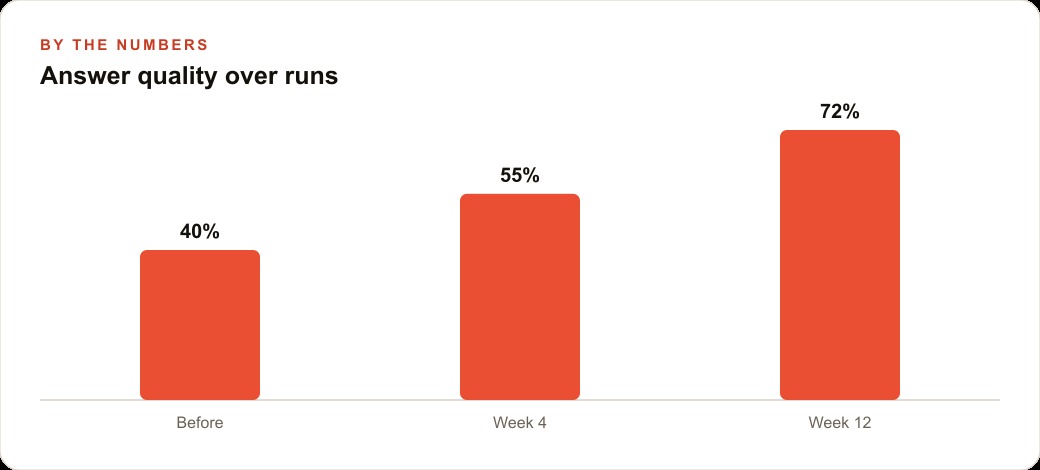
The early results from these more demanding benchmarks show a specific pattern worth understanding. Models evaluated on multi-step iterative tasks tend to start slowly, taking several rounds to orient themselves to the problem structure before they find effective approaches. Then they pull ahead in later rounds as the compounding benefit of each iteration builds. The coordinator design, where an orchestrator routes each sub-task to the specialist most likely to handle it well, tends to perform better on these multi-step tasks than any single model working alone, because the coordinator applies different capabilities to different phases of the same problem. This is exactly what a senior team member does when managing a complex project: they do not try to handle every phase personally; they route each part to whoever on the team is best at that specific thing.
There is a second development reinforcing the coordination frame. Companies building at the frontier report that their models are contributing to the design of the hardware those models run on. That feedback loop, where improving models help design better chips, which make future models cheaper to run, which produces more deployment data that informs the next improvement, is compressing the economics of AI deployment quickly. The cost of running AI day to day is on a steep improvement curve. Tools that feel expensive today will look very different in twelve months, which means the businesses that build routing discipline now will capture the benefit of that cost improvement without having to redesign their workflows to take advantage of it.
How the same coordination logic maps to the tools a business already has
A business owner with three or four AI subscriptions already has a pool of specialized tools. The question the orchestrator pattern answers is whether those tools are being coordinated deliberately or used interchangeably by habit. Most businesses, if honest, use their AI tools by habit. The writing tool gets used for everything because it was adopted first and became familiar. The scheduling tool handles calendar logistics but also gets asked questions it handles poorly. The image tool gets opened occasionally when someone remembers it exists.
The orchestrator insight is that the writing tool, the scheduling tool, the summary tool, and the image tool are specialists. Each is genuinely better than the others at the category of work it was designed for. Using the writing tool for scheduling logic is exactly like asking your best copywriter to also build your rate quotes. They might be able to produce something, but it is not what their skill is for, and the result will be worse than what a proper routing decision would produce.
Becoming the conductor does not require building a technical orchestrator model. It requires defining which tool handles which class of task and writing that routing rule down so it is applied consistently rather than decided case by case. Customer replies go through the writing tool. Calendar requests go through the scheduling tool. Call summaries go through the summary tool. Photo editing goes through the image tool. That written routing rule, applied every time, is the business version of what the AI orchestrator model does at the technical level: consistently routing the right work to the right capability, every time, without the overhead of deciding fresh with each task.
The discipline this requires is mostly behavioral. You have to resist the gravitational pull toward the familiar tool even when a less familiar tool is better suited to the job. Writing the rule down and committing a team to following it is the intervention. The routing decision itself is often obvious once you have mapped your tasks and your tools. The gap between knowing the right routing and actually applying it consistently is where most businesses lose the benefit they expected from their AI subscriptions.
Over time the routing rule also functions as an organizational asset. When a new team member joins, the routing rule tells them exactly which tool to use for each type of work. They do not need to learn the workflows by watching others or by trial and error. The institutional knowledge about which tool handles which task is encoded in the rule rather than sitting only in the head of whoever has been using the tools longest.
What this means for the HVAC business owner who has three subscriptions they use inconsistently
An HVAC owner with four field technicians and a modest set of AI tools is a concrete illustration of what consistent routing is worth. Available tools: a writing assistant, a scheduling app with some AI features, and a spreadsheet that calculates quotes from field measurements. The problem: the owner uses the writing assistant for everything, including when the scheduling app would handle the task far better.
The routing change is straightforward. Customer messages and proposal copy go to the writing assistant. Calendar logistics, appointment confirmations, and reminder sequences go to the scheduling app. Quote math goes to the spreadsheet formula. The owner stops opening the writing assistant for scheduling tasks it handles inconsistently and stops manually correcting the calendar outputs that result from forcing a text tool to do calendar logic.
The result of that routing discipline is approximately 30 minutes per day of manual correction work eliminated. At an owner time value of 75 dollars per hour, that is 37.50 dollars per day. Across a full working year of 260 days, the value of the routing change is 9,750 dollars recovered from a task-to-tool alignment decision that cost nothing to implement beyond the hour required to write the routing rule and commit to following it.
That figure is not the value of the AI tools themselves. The owner already had those subscriptions. It is the value of using them correctly rather than by habit. The same pool of tools, routed deliberately, produces better output and eliminates the manual correction work that routing-by-habit creates. There is no additional cost. The only investment is the clarity of thought required to map tasks to tools and the discipline to follow the map.
The broader implication is about how to think about AI tool adoption going forward. Adding a fourth subscription before getting the routing right on the first three is a common and expensive mistake. The new tool gets used inconsistently because the problem was never the number of tools. It was the absence of routing discipline. Fixing the routing on the existing stack before adding more capabilities is the higher-value move, and it costs nothing beyond the clarity required to write down which tool does which job.
For the field technicians, the routing discipline produces a secondary benefit: the instructions and communications they receive become more consistent because the tools producing them are being used for the work they were designed for. A quote drafted by the spreadsheet formula is more consistently structured than a quote drafted by the writing assistant improvising format on the fly. A booking confirmation sent through the scheduling tool is more reliably formatted than one written from scratch each time. Consistency in the tools produces consistency in the outputs, which produces consistency in the customer experience, and that is where business reputation compounds over time. Customers who receive the same quality and format of communication across multiple interactions with a business perceive it as more professional and organized, which is exactly the impression a small HVAC operation needs to compete with larger established players who have full administrative teams.
The orchestrator model at the technical level and the routing rule at the business level are the same idea applied at different scales. It is not a new idea. Every well-run operation already understood it. The AI development community is now building it into the infrastructure of the models themselves because the principle works wherever there are specialists who perform best at their specific strength and someone who knows how to deploy them. That insight is as useful to an owner with three AI subscriptions as it is to a research team building frontier models.
That is exactly what we do at AI DOERS. Book a private 30-minute call with Madhuranjan Kumar and we will map the fastest path to it for your specific business.
Book your call →
Madhuranjan Kumar
Madhuranjan Kumar brings 20 years of performance-marketing experience and has managed over $200 million in Facebook ad spend for brands across the United States and beyond. His expertise spans the full modern marketing stack: Meta, Google Ads, TikTok, email automation, CRM, and the websites that hold it together. At AI DOERS he turns that track record into lead-generation systems for businesses across every industry.