
AI Now Does Whole Projects at Expert Level. Here Is What It Means for Your Business.
New testing shows AI finishing entire professional projects as well as seasoned experts. The practical move for a small business is to point it at the back-office grind and free your people for the work that needs them.

The GDP val result is being read backwards by most of the media
Seventy-four percent sounds like a replacement number. That is how it has been framed across most of the coverage that followed the benchmark's release: AI now beats expert humans on professional projects nearly three-quarters of the time, therefore experts are being replaced. That reading is wrong, and the business decisions made on the basis of it will be wrong too.
I am Madhuranjan Kumar, and I want to stake a clear position: the GDP val result is one of the most practically significant pieces of AI research to emerge this year, and the dominant interpretation of it is backwards. The right reading of a seventy-four percent win rate on professional projects is not about who loses a job. It is about which category of work a small business owner can now get done for the first time, because they never had the budget or the headcount to commission it before. The story is about back-office project capability becoming accessible, not about expert judgment becoming obsolete. Those are different stories with different practical implications, and conflating them produces anxiety where there should be a clear action plan.
The businesses that will benefit most from this result are not the ones debating whether AI replaces professionals. They are the ones identifying the specific back-office projects they have been skipping for years because the economics never made sense, and starting to run those projects now that the economics have fundamentally changed.
Seventy-four percent is not the number that matters; the slope over six months is
The seventy-four percent win rate is a threshold number. It tells you that the system is past the point of interesting demo and into the territory of genuinely useful output on real professional work. That is worth knowing. But it is not the number with the most practical weight.
The number that matters more is the slope. A few months before the seventy-four percent result, the same benchmark recorded a win or tie rate under forty percent. That gap, from under forty to seventy-four, happened in a short period. The rate of improvement is what determines how quickly the capability will keep crossing new thresholds.
A business that is updating its assumptions about what AI can do based on what it could do twelve months ago is making decisions on stale information. The practical test is not whether a benchmark published this quarter shows a number that clears some arbitrary threshold. The practical test is: how frequently are you re-evaluating your assumptions against your own real work? A business that re-evaluates every six months and finds significant improvement each time is staying aligned with the actual capability curve. A business that evaluated once eighteen months ago and concluded the tool was not yet ready is now operating on information that is significantly outdated.
The benchmark's methodology is also worth understanding before leaning on the number. The evaluators are experienced professionals averaging around twelve years in their fields, with management responsibility. They grade the work blind, without knowing which output is from a human and which is from AI. The projects are real professional deliverables, not simplified test questions. That methodology produces a number that is more meaningful for practical business purposes than most AI benchmarks, which test isolated capabilities rather than complete work products. When those evaluators are choosing the AI output over the human output nearly three-quarters of the time, the practical implication is that the AI output would pass a real-world quality review in those same categories most of the time.
The work most exposed is the back-office project grind, not expert judgment
The research makes a distinction that is critical and that most media summaries omit. The capability improvement is sharpest on entry-level tasks: the structured, procedural, completable work that used to be handed to junior staff or commissioned from external specialists on a per-project basis. Financial model templates, competitive landscapes, workforce scheduling plans, formatted reports, structured research summaries. The benchmark does not show AI matching expert judgment on open-ended strategic questions. It shows AI matching professionals on the kind of work those professionals were glad to delegate to their most junior colleagues.
This distinction matters enormously for small business owners because it identifies exactly the category of work where the impact is immediate and positive. Most small businesses do not employ the experts who are theoretically at risk of displacement from this benchmark. Most small businesses do not have a financial analyst, a market research specialist, a management consultant, or a workforce planning expert on staff. They have a generalist owner or manager who does as much of this work as time allows and outsources the rest when the budget permits, which is usually less often than needed.
The back-office project grind that the benchmark covers is the work a small business owner either does themselves, consuming hours that would produce more value elsewhere, or skips entirely, accepting that some analysis and planning simply will not happen this quarter. A quarterly competitor review, an updated financial model, a schedule optimization for a busy season, a formatted summary of customer feedback themes: these are projects most small businesses want and most do not consistently do.
When the benchmark shows AI producing this category of work at expert quality seventy-four percent of the time, the practical implication for a small business is that a large class of back-office projects that were previously too expensive or too time-consuming to commission are now available for a few dollars and an hour of oversight. The business that starts systematically doing those projects, getting better competitive intelligence, more rigorous financial modeling, and tighter operational planning, will compound an advantage over the ones that continue to skip them.
Auditable output closes the gap between impressive demo and usable business tool
The single most important capability distinction in the GDP val result is not the overall win rate. It is the specific finding that the work is produced in auditable formats.
Earlier generations of AI produced outputs that were difficult to verify. A strategic recommendation that sounded authoritative but could not be traced back to specific data points. A financial summary that presented conclusions without showing the underlying calculations. Output you had to either trust entirely or reject entirely, with no easy path to spot-checking the specific claims that mattered most for your decision.
The outputs the GDP val benchmark describes are different. A financial model produced correctly is a spreadsheet where every formula is visible, every input is labeled, and a reviewer can trace the path from raw data to the summary figure in a few minutes. A workforce plan is a structured document where each staffing recommendation corresponds to a specific load assumption that can be checked against actual schedule data. A competitive landscape is a formatted report where each claim about a competitor is sourced from a specific observation that can be independently verified.
Auditable output changes the trust calculus. Instead of choosing between blind trust and complete rejection, a business owner can review the specific elements that matter most in the time available, catch the errors that would produce bad decisions, and trust the elements that check out. This is how professional work is reviewed in organizations that do it well, by experienced reviewers who verify the critical assumptions rather than re-doing the entire analysis. The AI output, when it is genuinely auditable, fits into that review workflow.
It also enables a quality check that is only recently available: having a second model audit the first model's output. Running a complex financial model through one AI and then having a second AI review the formulas and flag any anomalies is a quality control step that costs a fraction of a human review and catches a meaningful portion of structural errors. The combination of auditable output and model-on-model review is what closes the gap between impressive demo and business tool you can actually rely on for real decisions.
The veterinary clinic that reclaimed fourteen weekly admin hours with this shift
I want to make the practical case concrete with a specific example that shows the actual math.
A veterinary clinic with two vets and four support staff was spending significant time each week on administrative project work that required structured thinking but not veterinary expertise. The tasks included monthly performance summaries for each vet broken down by visit type and revenue, a weekly reorder recommendation for medications and supplies based on appointment volume and current stock, a template for post-visit care instructions customized for each common procedure, and a structured summary of client feedback collected through follow-up calls.
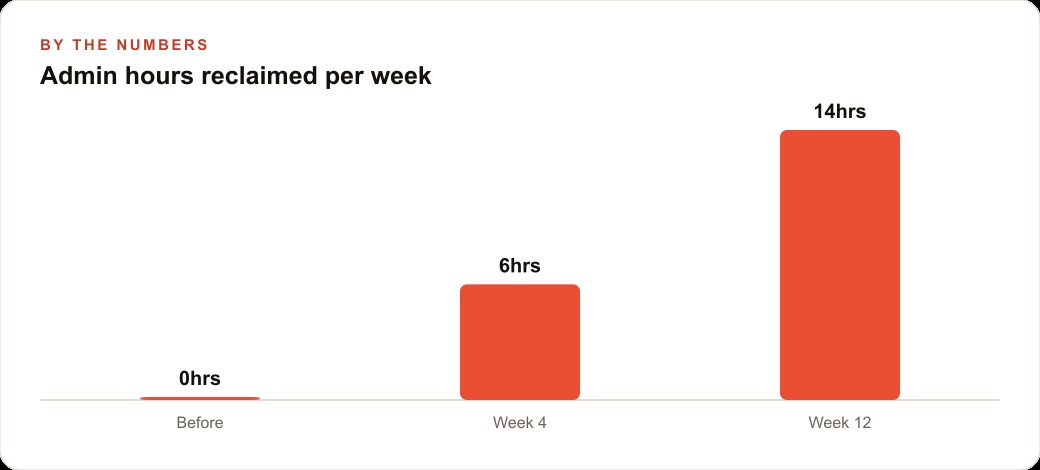
Before this shift, these tasks were distributed across the support staff and the practice manager, consuming an estimated fourteen hours per week across the team. The nature of the work was clear and completable. Each task had defined inputs and a defined output format. None required a licensed vet's judgment. All required organized attention and time, both of which were in short supply.
The practice manager worked through each task type once with an AI model, providing the actual data and specifying the exact output format needed. The monthly performance summary required the clinic's actual appointment records and a specific breakdown format the manager defined. The reorder recommendation required the current stock list and the upcoming appointment schedule. The care instructions required the procedure name and the standard steps the clinic used for each common case. The feedback summary required the raw notes from the follow-up calls.
Each task type now runs on a regular schedule. The manager provides the current inputs, the model produces a structured output in the defined format, and the manager reviews it before it is used. The review takes roughly fifteen to twenty minutes per task compared to the sixty to ninety minutes each task previously consumed. The total weekly time commitment for these four task types dropped from fourteen hours to approximately two and a half hours, including the review time.
The fourteen-hour recovery went back into the work that requires human presence and veterinary expertise: extended appointment slots, follow-up calls on complex cases, and a client communication program the clinic had wanted to run for eighteen months but never had the capacity to start. Client satisfaction scores measured over the following quarter improved, which the practice manager attributed partly to the extended appointment time and partly to more consistent follow-up communication.
The total cost of running the four task types through AI is under five dollars per week in API costs. Against a fourteen-hour weekly labor saving at a fully loaded internal rate of twenty-two dollars per hour, the weekly saving is three hundred and eight dollars. The annual saving is approximately sixteen thousand dollars, against an annual API cost of roughly two hundred and sixty dollars. The return ratio is over sixty to one.
Start with the projects that would embarrass you if the numbers were wrong
The practical question, after understanding the benchmark and the example, is where to start. The answer is not with the most important project or the most complex one. It is with the one that would embarrass you most if the numbers were wrong.
The reason for this starting point is that it enforces the audit discipline from day one. If you start with a project where the numbers do not matter much and the output is not being used for a real decision, the natural tendency is to accept the output without reviewing it carefully. That builds a habit of trusting without checking, which is exactly the habit the evidence argues against.
If you start with a project where you would be embarrassed by a wrong number, you review it carefully. You check the formulas. You trace the claims to the sources. You find the one input that was slightly off and correct it. That review habit, built on the project where it matters most, is the habit you want running across every AI-produced project. Build it on work where the stakes make you pay attention, and it will transfer naturally to work where the stakes are lower.
The second practical step is to define the output format before you start the project, not after. The benchmark works in part because the outputs are in structured, checkable formats: spreadsheets, formatted reports, organized documents. Asking AI to produce work in a format you have defined precisely in advance produces output you can review efficiently. Asking it to produce work in whatever format it chooses produces output in many different formats that are harder to compare across runs and harder to audit consistently over time.
The third step is to set a calendar reminder to re-evaluate in three months. The capability slope is steep enough that what you test today and find marginally adequate may be genuinely excellent in ninety days. The businesses that stay current are the ones that test regularly, not the ones that form a single opinion and maintain it indefinitely. The benchmark's number will be higher next quarter. The question is whether your practice is ready to take advantage of it when it arrives.
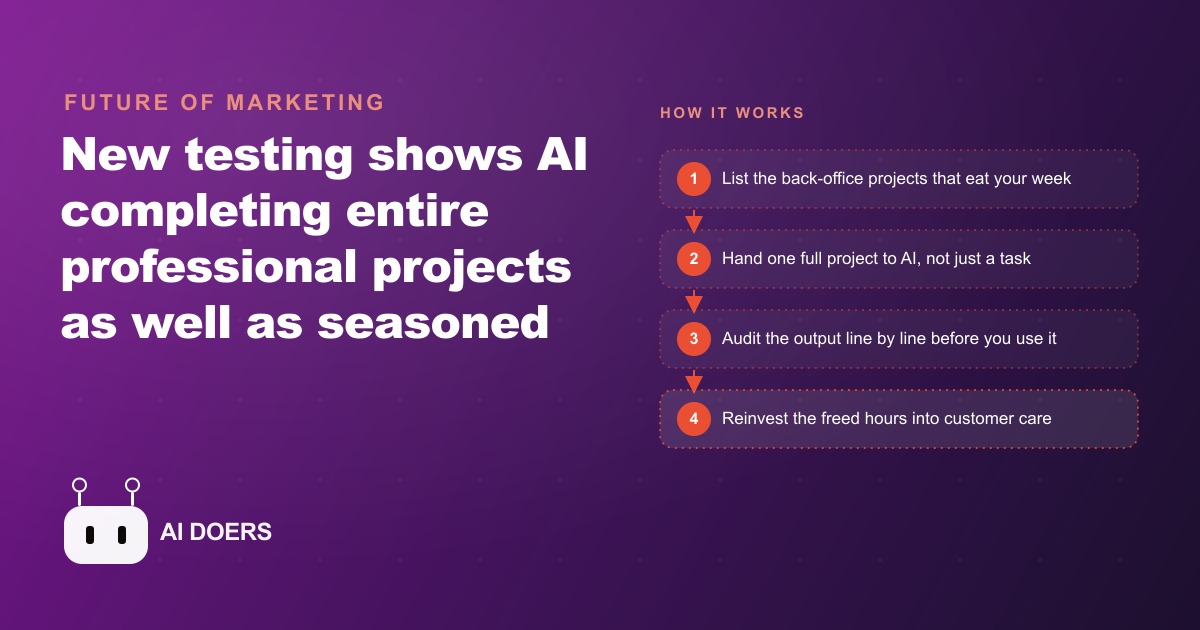
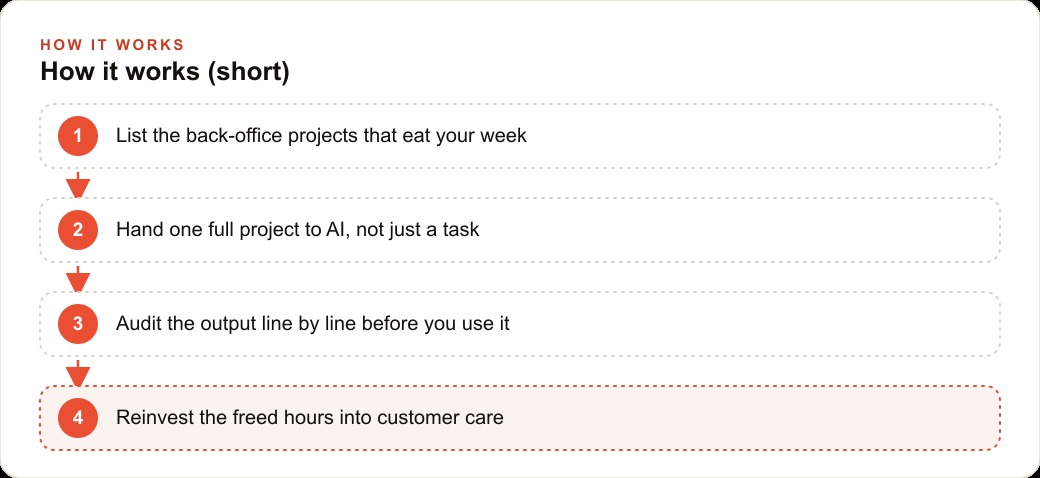
Start with the project whose numbers matter, define the format up front, audit the output carefully, and set a date to re-evaluate. Those four steps are the practical action plan that the GDP val result points to, and they have nothing to do with whether AI is replacing professionals. They have everything to do with whether your business gets the analytical and operational projects done that it has been skipping because the economics of doing them properly never added up until now.
That is exactly what we do at AI DOERS. Book a private 30-minute call with Madhuranjan Kumar and we will map the fastest path to it for your specific business.
Book your call →
Madhuranjan Kumar
Madhuranjan Kumar brings 20 years of performance-marketing experience and has managed over $200 million in Facebook ad spend for brands across the United States and beyond. His expertise spans the full modern marketing stack: Meta, Google Ads, TikTok, email automation, CRM, and the websites that hold it together. At AI DOERS he turns that track record into lead-generation systems for businesses across every industry.