
AI News Roundup: Data Centers in Space, Apple Picks Gemini, and Agents That Do Tasks
Orbital data centers, a billion-dollar Siri deal, and AI assistants that shop for you. Here is what the latest wave of AI news means and how I would turn the practical parts into wins for a local business.


The most revealing story in this week's AI news cycle was not the Apple-Google model deal, not this breakdown model update, and not the layoffs tied to AI efficiency. It was the sentence buried inside the orbital data center story: some AI facilities have all their chips installed but cannot turn them on because there is not enough electricity available to run them. I am Madhuranjan Kumar, and that single fact reframes every other story in this batch. Once you see the energy constraint clearly, you can trace it through the Siri redesign, through the agent-driven browser story, through the dropping cost of AI-generated visuals, and through the overall direction AI development is taking. The week looks very different when you organize it around the constraint rather than around the individual headlines.
The Constraint That Makes Orbital Data Centers a Serious Proposal
Google is studying the feasibility of solar-powered data centers in low Earth orbit. The study is real, and the reason it is a serious conversation is not primarily about the technical elegance of satellite computing. It is about electricity.
Data centers require enormous and continuous power. The most advanced AI chips generate substantial heat that requires active cooling infrastructure, which in turn requires more power. The result is that building a data center is now often easier than powering one. Some facilities that have completed construction and installed their full complement of hardware are sitting idle or running at partial capacity because the local electrical grid cannot supply the load the facility requires. This is not a forecasted constraint for some future expansion. It is a current operational reality at multiple sites.
When the binding limit on AI capability is not chips or software but the power grid, alternative energy sources become worth studying even when those alternatives are technically exotic. Orbital solar power is exotic. It is less exotic than the alternative, which is accepting that AI infrastructure cannot grow faster than electricity generation can be expanded, and electricity generation expansion is typically measured in years rather than months. The energy constraint is real enough that it is shaping capital allocation across the industry. Laboratories and cloud providers are funding nuclear, geothermal, and grid-scale battery projects not primarily as sustainability initiatives but as compute investments. The constraint they are trying to remove is electricity supply, and every dollar spent on power supply expansion is a dollar enabling compute growth. Orbital data centers are the most dramatic expression of this logic, but they sit on a continuum with the full range of energy infrastructure investment currently underway.
Why Apple's Billion-Dollar Model License Is an Energy Decision, Not Just a Quality One
Apple is paying approximately $1 billion per year to license a custom version of a Google AI model for a more capable version of Siri, running on Apple's own private servers with a rollout expected in spring. The standard framing for this deal focuses on model quality: Apple's in-house models were not at the frontier, the licensed model is stronger, and Apple is paying for the gap.
That framing is incomplete. Training a frontier model requires substantial compute, which requires substantial electricity, and Apple runs that compute at scale on infrastructure it controls specifically to meet its privacy commitments to users. The decision to license rather than train is partly a quality decision and partly an energy and capital allocation decision. Training a model at the scale required to compete with the leading frontier systems takes months and tens of millions of dollars in electricity and compute costs per run, across multiple runs, to get to a deployable result. Licensing a model that already exists eliminates those costs entirely and converts a multi-hundred-million-dollar infrastructure commitment into a predictable annual fee.
The deal also reflects a specialization argument. Apple's competitive advantage is not model training at the frontier. It is hardware design, operating system integration, and the user trust built over decades of privacy commitments. Licensing the model keeps Apple competitive on capability without requiring it to build and maintain a capability in frontier model training that is peripheral to its actual identity. The energy constraint sharpens the trade: building the training infrastructure would consume resources, attention, and physical power supply that Apple can apply more effectively elsewhere.
The Cost of Running an AI Task Is Falling Faster Than Most Headlines Notice
Two items in this week's cycle connect directly to inference costs: a new video model that reached near the top of generation leaderboards with support for multiple reference images, and a major technology company releasing an in-house image model described as producing photorealistic results without the generic quality artifacts of earlier AI images. Both represent improvements in the quality available at a given cost per generation.
The cost of producing an AI-generated image has fallen by more than two orders of magnitude over the past three years. What cost several dollars per image in 2022 costs fractions of a cent per image today. Video generation has followed a similar trajectory on a slightly delayed curve. What this means in practice is that the class of task where AI generation is economically rational is expanding continuously. Three years ago, AI image generation was a novelty. Two years ago, it was a tool for rough conceptual drafts. It is now a production tool for businesses with meaningful volume requirements and quality standards that were previously only met by professional photography or commissioned illustration.
The photorealism improvement matters because it removes a ceiling that was limiting the use cases available to that production class of work. Generic AI images are identifiable as AI images to most viewers, which limits their credibility in marketing contexts where authenticity and specificity are important signals. Photorealistic AI images that do not trigger the generic-AI recognition response expand the set of contexts where AI generation is a viable substitute for commissioned photography, and that expansion is driven as much by cost as by capability.
What Shopping Agents Signal About the Direction of the Shift
AI browsers that shop on the user's behalf appeared in this week's releases. The mechanism is an AI system with access to a browser that can navigate product pages, compare prices, read specifications, and complete a purchase within parameters the user specifies. The user defines what they want and sets constraints on budget and preferences, and the agent handles the actual transaction.
This is the clearest illustration of the shift from AI that answers questions to AI that completes tasks with real-world consequences. Answering a question about the best product in a category requires retrieving and synthesizing information. Buying a product requires navigating to a site, locating the correct item, selecting a configuration, entering payment credentials, and confirming an order. The second task is more consequential because it produces effects that are harder to undo and that involve actual financial transactions on the user's behalf.
The fact that AI is moving into this territory is a signal about the trust users are beginning to extend to AI systems, not just the capability those systems have reached. The shopping agent pattern is also a preview of how AI will interact with business digital properties. If a meaningful share of purchases are eventually initiated by AI agents rather than by human users navigating a browser directly, the structure of product pages, the clarity of specifications, and the quality of structured data about inventory and pricing become factors in how reliably agents can complete transactions on behalf of consumers or how easily they can find and evaluate what a business offers.
How the Image and Video Improvements Connect Back to Cost-Per-Inference
The ability to interrupt a long AI task mid-run and add context, announced this week, is another expression of the same cost-optimization logic that runs through this breakdown and image improvements. Long AI tasks consume compute over extended periods. Interrupting a task and redirecting it before it completes a full run reduces the compute spent on work heading in the wrong direction, which reduces cost per useful output.
This breakdown model's support for multiple reference images reduces the number of generation attempts required to produce an output that meets the user's standard. Currently, a significant share of AI generation compute is spent on outputs that do not meet the required quality or consistency threshold and are discarded before use. Any improvement that reduces the average number of retries required reduces the compute per usable result, which reduces the effective cost of the task, which expands the economic range of use cases where AI generation makes practical sense over alternatives.
The compounding of these improvements across image generation, video generation, and agent task management all move in the same direction: more useful output per unit of compute consumed. When inference costs fall far enough, tasks that were previously marginal cases, where the AI alternative was only slightly cheaper than the human alternative, shift clearly into the economically rational category.
Where This Lands for Businesses That Are Not Building Data Centers
A landscaping company is not making energy infrastructure decisions. It is not licensing frontier AI models for a billion dollars annually. The connection between its daily operations and orbital data centers is indirect. But the direction of the cost-per-inference curve is directly relevant to what tools the business can afford to use in production work.
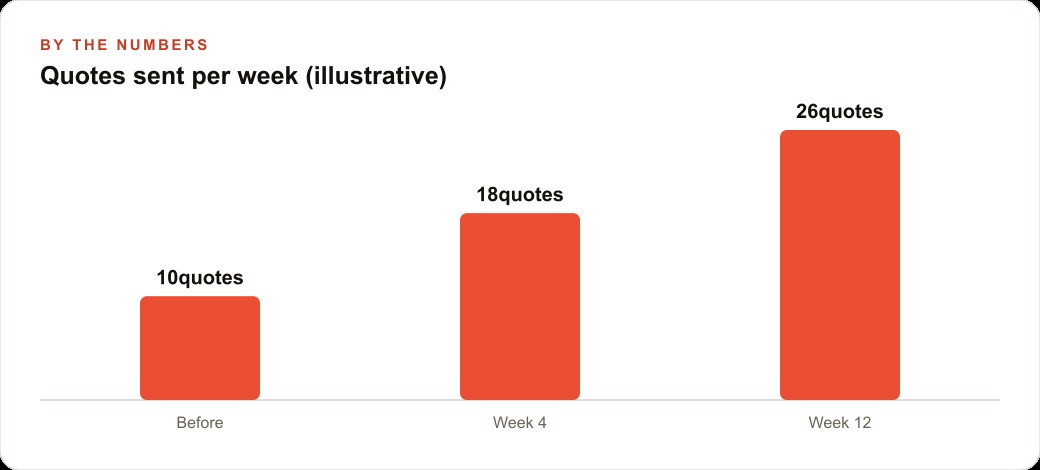
A landscaping company that uses AI image generation to produce photorealistic seasonal campaign visuals now saves $3,600 per year in photography costs. The calculation is direct: four seasonal campaigns per year, at roughly $900 each in professional photography costs covering photographer time, editing hours, and licensing for commercial marketing use, replaced by AI-generated images produced in under an hour at negligible per-image cost. The quality threshold for residential landscaping marketing visuals has been reached. The images are usable in commercial contexts. The cost differential is clear and recurring.
The more substantive business impact is on the proposal-to-close cycle. Before AI image generation was viable, a residential project proposal included hand-drawn sketches or generic stock photography that did not match the client's actual property. The proposal required imagination from the client, who had to visualize the end result from an approximation. After switching to AI-generated proposal visuals, the same company produces renderings that show a photorealistic interpretation of the specific yard with the proposed plantings and structures applied. The client sees what they are approving rather than imagining it. The proposal-to-close time for visual-heavy residential projects falls from five days, which included time for back-and-forth questions and requests for more detail, to one day, because the visual question is answered by the proposal itself.
That improvement is a direct consequence of inference costs falling below the threshold where AI-generated visuals are economically viable for a business spending $3,600 per year on the underlying problem. Three years ago, the same quality of AI generation would have cost more per image than the professional photography it was replacing and would still have required significant manual correction to be usable in client-facing contexts. The energy infrastructure debates, the model training expenditures, and the hardware investments happening at the major laboratories and cloud providers are the upstream cause of a downstream reality in which a landscaping company can produce better proposals for less money than it spent before. The constraint they are all working to remove is the cost of intelligence at scale. The businesses that benefit are distributed across every industry where the cost-per-task ratio has recently crossed a threshold that makes the AI approach clearly preferable to the prior approach.
The energy constraint and the inference cost curve are the same underlying story told from two different angles. One is about how expensive intelligence is to produce. The other is about how quickly that cost is falling. For businesses, both angles point to the same practical question: which tasks in your operation have a cost-per-AI-task that is now below the cost-per-human-task for the same output? The businesses that answer that question accurately and act on it are the ones that will look back at this period as the moment the shift became irreversible.
That is exactly what we do at AI DOERS. Book a private 30-minute call with Madhuranjan Kumar and we will map the fastest path to it for your specific business.
Book your call →
Madhuranjan Kumar
Madhuranjan Kumar brings 20 years of performance-marketing experience and has managed over $200 million in Facebook ad spend for brands across the United States and beyond. His expertise spans the full modern marketing stack: Meta, Google Ads, TikTok, email automation, CRM, and the websites that hold it together. At AI DOERS he turns that track record into lead-generation systems for businesses across every industry.