
This Week in AI: Faster Models, Open Standards, and a Scramble for Power
GPT-5.2 looks imminent, Mistral shipped an open coding model, MCP and agents.md went nonprofit, and the industry is racing to power its data centers. Here is what it means for a real business.

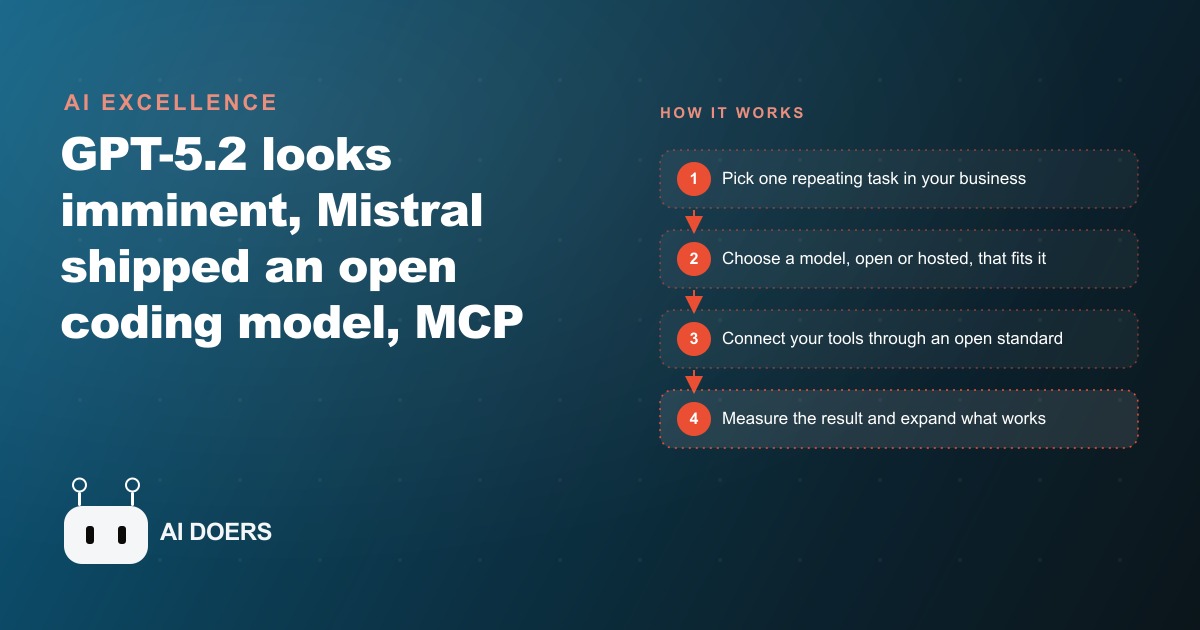
Something structural shifted in the past few weeks and most people are reading it wrong
I am Madhuranjan Kumar, and the individual announcements from this news cycle look like a product launch, a nonprofit formation, and a power grid concern. Read together, they describe a moment when the infrastructure for AI systems is being formalized in a way that will matter for years and the energy required to run it is creating pressure that will show up in operating costs for every business using these tools.
The surface reading of AI news is usually about individual models. Which lab released something new. Whether the benchmark is higher than the previous record. Whether the demo is impressive. That reading is not wrong but it focuses on the layer that changes most frequently and matters least for the decisions most businesses need to make. The layer that is changing in a more durable way is underneath the models: the protocols that govern how AI systems communicate with external tools, the energy infrastructure that determines the practical ceiling on how much AI compute can be deployed, and the pricing dynamics that govern what access to capable models will cost over time.
All three of those layers moved in the same news cycle, which is what makes this moment worth reading carefully rather than as just another week of announcements.
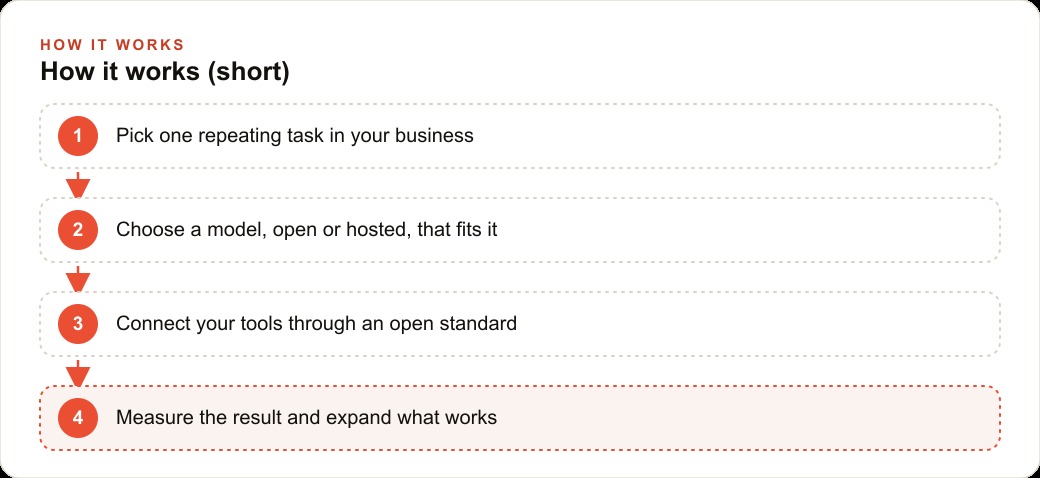
The formalization of agent communication has a specific meaning for anyone building with AI
The Agentic AI Foundation forming around the Model Context Protocol is not primarily a technology story. It is a standardization story, and standardization stories matter in ways that take a year or two to become fully visible. The MCP protocol defines how AI agents discover and call external tools. When that protocol is managed by a single company, every participant in the ecosystem has to trust that company's incentives will remain aligned with the ecosystem's needs indefinitely. When that protocol moves to a nonprofit governance structure with industry participation, the protocol becomes infrastructure rather than a product.
The practical difference for a business building AI workflows is significant. A workflow built on a proprietary protocol carries the risk that the protocol changes in ways driven by commercial interests rather than technical improvement. A workflow built on a nonprofit-governed standard can expect that the protocol will evolve based on the needs of the full ecosystem of participants rather than one controlling party. The expected stability of the foundation is higher.
The agents.md standard being included in this governance shift extends the same principle to how AI agents identify themselves to websites and services. An AI agent visiting a restaurant's website to check their menu should be identifiable as an AI agent so the restaurant can, if they choose, present information in AI-optimized form. An AI agent visiting a service to make a reservation on behalf of a user should be identifiable as acting on behalf of that user rather than appearing as an anonymous request. The standardization of agent identity is a prerequisite for building systems where AI agents and human-operated services interact reliably.
For the restaurant owner who is thinking about what this means operationally: the restaurant that has thought through how to present its information to AI agents visiting on behalf of potential customers is going to be in a stronger position as voice ordering and AI-assisted reservation workflows become common. The menu that is structured for AI consumption is the one that gets recommended accurately when someone asks their AI assistant what is available for a specific dietary need. This is not speculative for the near term.
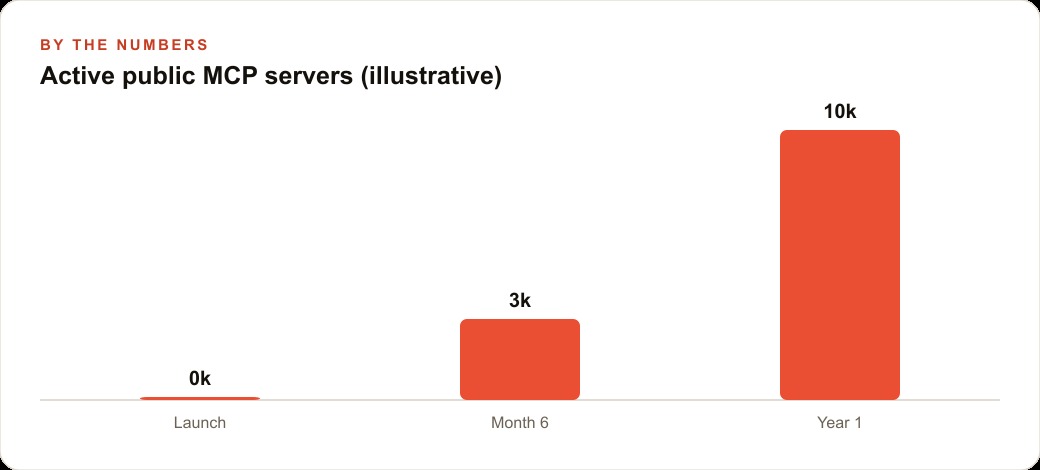
Devstral 2 answers the question of whether open model quality is keeping pace
The coding model space has a specific dynamic that does not apply to all AI categories: the people most qualified to evaluate coding models are also the people most likely to make deployment decisions based on that evaluation. Developers evaluating Devstral 2 against the frontier options are evaluating on real work in real codebases, not on synthetic benchmarks, and their assessments carry more signal than benchmark leaderboard positions.
The consistent report from that evaluation community is that open models capable of genuine software engineering tasks are now available without the premium that commercial API access to frontier models commands. For businesses that have workloads where model quality rather than convenience is the binding constraint, the open option is now a realistic consideration rather than a compromise.
This matters most for the category of AI applications where volume is high and task type is predictable: document processing, code review, content generation at scale, classification tasks where the categories are stable. These are applications where deploying on open models, with the infrastructure management that requires, can produce cost structures that commercial API access at frontier prices cannot match. The businesses that will capture this cost advantage are the ones that have separated their AI workloads by task type and identified where open model quality is sufficient.
The power constraint is real and will show up in prices before it shows up in outages
The energy discussion around AI compute is often framed as an environmental story, and the environmental dimension is real. The framing that is more useful for business planning is the supply constraint dimension. AI compute is power-limited in a way that semiconductor capacity and software development are not. A fab can be built in a predictable number of years. A power plant takes longer to build and faces regulatory timelines that are not responsive to demand signals in the way that chip manufacturing capacity is.
When the power required for next-generation training runs and large-scale inference is growing faster than the power infrastructure can be expanded, the result is competition for existing capacity. Competition for capacity means higher prices for the electricity that runs the compute. Higher electricity prices flow through to the operating costs of data centers and from there to the API pricing that businesses pay for inference. This transmission is not immediate: data centers typically have power contracts of defined duration, and the transmission from power price increases to API price changes takes time. But the direction is clear.
For a business that has built workflows heavily dependent on large-scale AI inference, the medium-term trajectory of inference costs is relevant to financial planning in a way it was not two years ago when the dominant trend was consistent price reduction. The reduction trend is not over: efficiency improvements at the model layer continue, and more efficient models reduce the compute required per unit of output. But the energy constraint adds upward pressure on the supply side that was not previously in the model.
The practical implication is one that applies across all the trends in this news cycle: the businesses that are thinking about their AI infrastructure as a real part of their operational cost structure, that are tracking the relevant trends and making deliberate choices about what they run on and how, are in a better position than the businesses that are treating AI as a utility with a stable cost. The infrastructure is not yet utility-grade in terms of pricing predictability.
Reading the news cycle as a system rather than as a list of announcements
The restaurant operator who reads the MCP governance news, the Devstral 2 release, the power constraint analysis, and the GPT-5.2 pricing as separate items walks away with four data points and no clear direction. The operator who reads them as a system walks away with a coherent picture: the infrastructure for AI agent interactions with external services is being standardized and will be more stable going forward; open model quality has reached a level where cost-sensitive workloads should be evaluated against open options; inference costs have upward pressure from the energy side that is not reflected in current promotional pricing; and the frontier model releases continue to produce capability improvements worth tracking for the highest-complexity tasks.
None of these items requires an immediate action. All of them inform decisions that most businesses will face over the next twelve to eighteen months: whether to build workflows that assume stable API pricing or to build flexibility to shift providers; whether to invest in the infrastructure to run open models or to stay fully on commercial APIs; whether to structure menus and service information for AI agent consumption now or to wait until the patterns are more established.
The businesses that read these developments as operational inputs rather than as technology news are the ones that will be in a better position when the decisions those inputs inform become urgent rather than optional. That is the argument for following these news cycles carefully: not to have opinions about which lab is ahead, but to have grounded views about the infrastructure the next few years of your business will depend on.
That is exactly what we do at AI DOERS. Book a private 30-minute call with Madhuranjan Kumar and we will map the fastest path to it for your specific business.
Book your call →
Madhuranjan Kumar
Madhuranjan Kumar brings 20 years of performance-marketing experience and has managed over $200 million in Facebook ad spend for brands across the United States and beyond. His expertise spans the full modern marketing stack: Meta, Google Ads, TikTok, email automation, CRM, and the websites that hold it together. At AI DOERS he turns that track record into lead-generation systems for businesses across every industry.