
The AI Model Race Just Got Tighter: How a Small Business Turns It Into Lower Costs
When Google, OpenAI, and the rest trade the lead every few weeks, the smart move for a small business is to stay tool agnostic and pocket the upgrades. Here is the simple playbook.

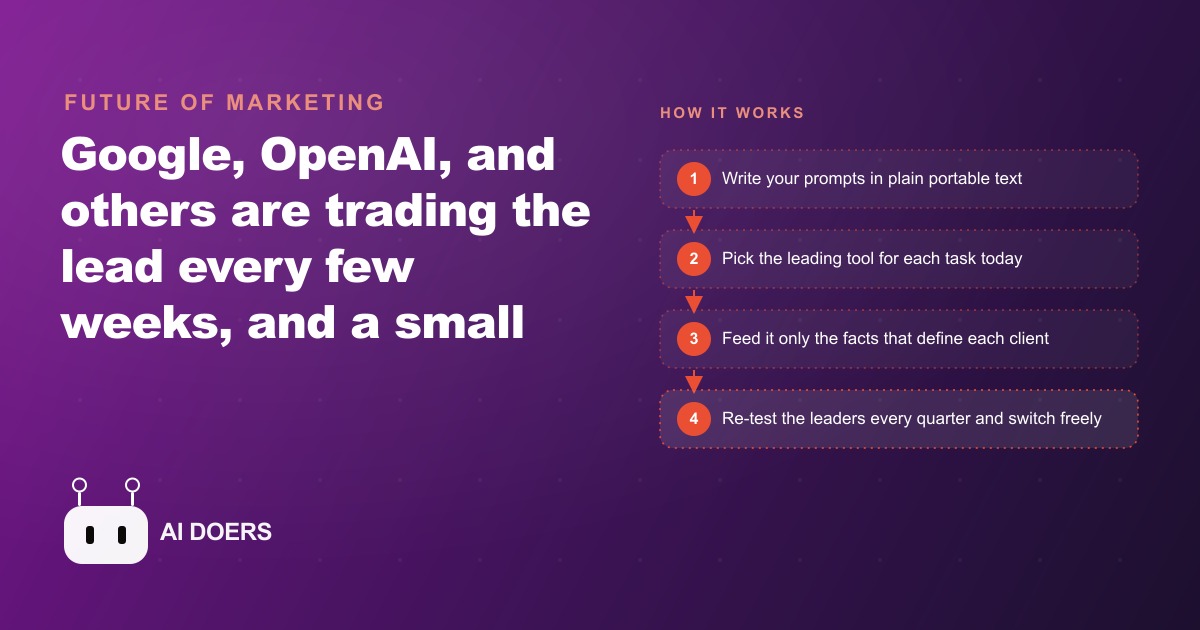
The lead changed again, and that is exactly the point
I am Madhuranjan Kumar, and I want to spend a moment on what actually happened before I talk about what it means. One AI lab held the top position across the public leaderboards for writing, reasoning, and instruction following. A competing lab reacted with what insiders described as a code-red response, scrambled its engineering resources, and shipped a competitive model within weeks. Prediction markets swung. Headlines declared a new leader. And then within another few weeks, a third lab released something that challenged both.
If you have been following this pattern for more than six months, it feels familiar because it is. The specific labs and models change. The structure does not. One lab leads, another responds, the bar rises, and the lead is contested again. I have watched this cycle play out repeatedly, and the most reliable observation I can offer is this: the cycle is not a sign of instability. It is the mechanism through which AI tools get better and cheaper, and that mechanism works in your favor every single time it turns, whether or not you follow the headlines.
The news that matters is not who won this round. The news is that every round produces better tools at lower cost, and the businesses that are positioned to use them gain that benefit whether or not they have an opinion on which lab they prefer.
What the memory research means for client-facing businesses today
Buried in the same news cycle as the model leapfrogging was a research development that I think matters more for daily business use than the benchmark competitions. Multiple labs published work on longer-term memory systems for AI models, and the specific insight that is most directly applicable to a service business is this: the new memory approaches work more like human memory than like a database.
The old way to give an AI assistant persistent memory was to store everything and retrieve everything. The result was a context that grew without limit, became expensive to process, and paradoxically often produced worse results because the model had to wade through everything it had ever seen to find what was relevant now. The new research architecture stores what is surprising or consequential and lets routine, forgettable content fade. That is how human memory works. We remember the unexpected detail about a client even after years because it was distinctive. We do not remember the routine ones because nothing marked them as worth retaining.
For a service business, this has a direct practical implication. The AI assistant you use to communicate with clients and track their preferences can now maintain meaningful context across conversations that span weeks or months, without the cost and performance problems that came with forcing every interaction into a single growing context. Feed it the few facts that truly define each client: the preference, the constraint, the context that makes them different from the others. The new memory architectures are specifically designed to hold onto exactly that kind of distinctive, consequential information.
A concrete example from a photography studio I worked with: the coordinator maintained a simple note about each client's primary concern, whether it was timeline, flexibility, a specific shot list, or a family dynamic. Before the new memory approaches, that information had to be re-injected at the start of every AI-assisted task because the assistant reset between sessions. With persistent memory, the assistant surfaces that concern without prompting when a new task involves that client. The coordinator stops re-briefing the tool and starts trusting it with follow-up tasks that require knowing the client. That shift from re-briefing to trusting is where the real time saving is.
Hardware cost curves and why they compound in your favor
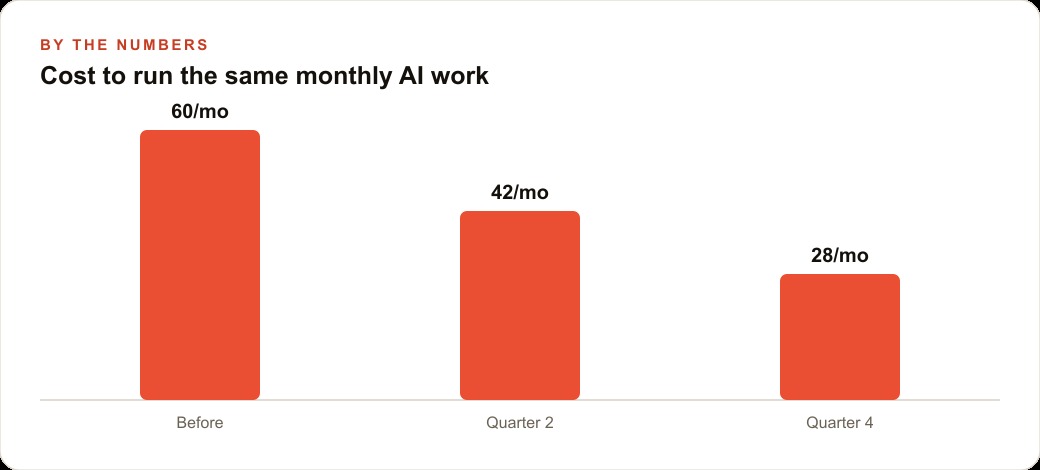
The third thread in the same news cycle that most coverage treated as a footnote is the hardware story. Custom AI chips are beginning to reach customers more broadly, and the unit economics of running AI models are following the trajectory that new chip generations always produce: more compute per dollar with each generation, delivered to end users in the form of lower subscription and API prices.
This does not happen instantaneously. The cost reduction from hardware improvements typically takes one to three quarters to flow through to the prices businesses pay, because labs need to recapture their infrastructure investment and transition existing capacity before the savings reach pricing. But the direction is unambiguous and has been consistent. The price per token for capable models has fallen substantially over the past two years, and the trend continues.
For a small business, this means two things that compound together. First, the same AI budget buys more output each quarter. Second, the tasks that were previously too expensive to automate at meaningful volume become economically viable as prices fall. A business that could afford to have AI draft a few client emails per day at previous prices might be able to have it draft every client communication at current prices and potentially route all internal documentation through it at next year's prices. The expanding scope of what is affordable is not a one-time shift. It is an ongoing process that keeps working in the background.
The one structural move that lets you profit from every round of the race
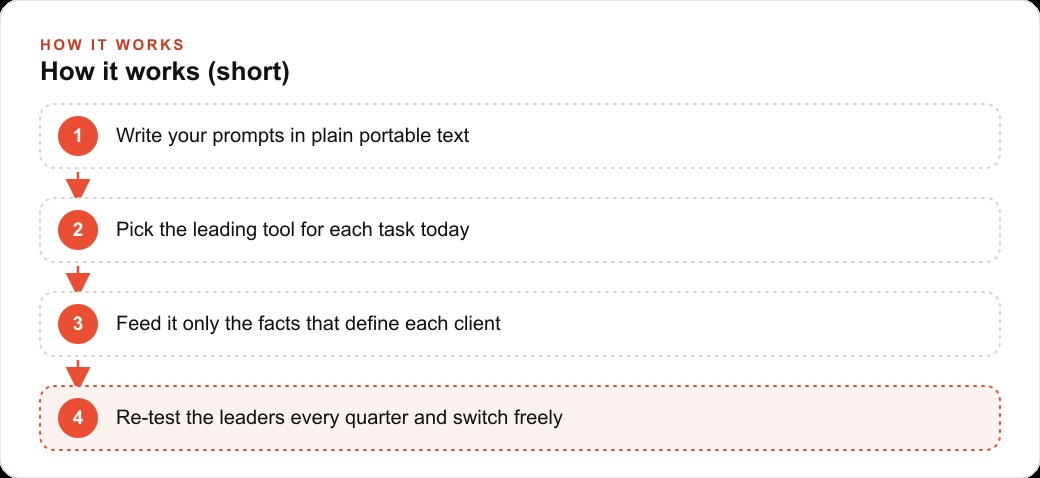
All of this, the model competition, the memory research, the hardware cost curves, converges on a single practical recommendation that I have given to every business I have worked with since the AI tool market began moving this fast. Write your instructions in portable plain text, pick the leading tool for each task, and build the habit of switching when a better option appears.
The portable text principle is the foundation. If your AI instructions are written in proprietary syntax specific to one platform, they cannot travel. When a new model emerges that handles your specific task better or cheaper, migrating requires rebuilding the instruction set from scratch. Portable plain text means the core instruction, the description of your business voice, your common scenarios, your expected outputs, lives in a document that pastes cleanly into any tool. The model behind it changes. The instruction stays constant.
The task-specific selection principle comes next. Different models lead on different dimensions. A model that tops the leaderboard on creative writing may rank lower on instruction following or on reasoning through complex schedules. Matching your tool to your task type rather than to a brand preference means you are always using the tool that is actually best for the specific thing you need done, not the tool that is best on average across all possible tasks.
The quarterly review habit closes the loop. The model that is best for your main tasks this month may not be the best model in three months. A recurring calendar event, once per quarter, to run a standard set of your actual recurring tasks through two or three current leaders and compare the outputs takes about three hours total and keeps you current without requiring you to follow every announcement. If a cheaper or sharper model has taken the lead on your specific tasks, you switch. If it has not, you stay, with the confidence that you checked recently rather than the vague anxiety that comes from not knowing.
The businesses that quietly accumulate an advantage from the AI model race are not the ones most plugged into the news. They are the ones most disciplined about the portable instruction habit. Their investment in the instruction set, the carefully tuned prompt that produces consistent, on-brand output, grows more valuable over time rather than becoming stranded on yesterday's tool. Every round of the model race benefits them because they can take the new leader for a test run in an afternoon without rebuilding anything. The race becomes their discount program rather than a source of confusion, and that is exactly the relationship a small business should have with a technology market moving at this speed.
That is exactly what we do at AI DOERS. Book a private 30-minute call with Madhuranjan Kumar and we will map the fastest path to it for your specific business.
Book your call →
Madhuranjan Kumar
Madhuranjan Kumar brings 20 years of performance-marketing experience and has managed over $200 million in Facebook ad spend for brands across the United States and beyond. His expertise spans the full modern marketing stack: Meta, Google Ads, TikTok, email automation, CRM, and the websites that hold it together. At AI DOERS he turns that track record into lead-generation systems for businesses across every industry.