
How AI Market Research Saves Restaurants From Building Things Nobody Wants
CES 2026 showed the world $400 vibrating knives and motorized doormats that nobody asked for. Restaurants make the same mistake every week. Here is the AI system that stops it.

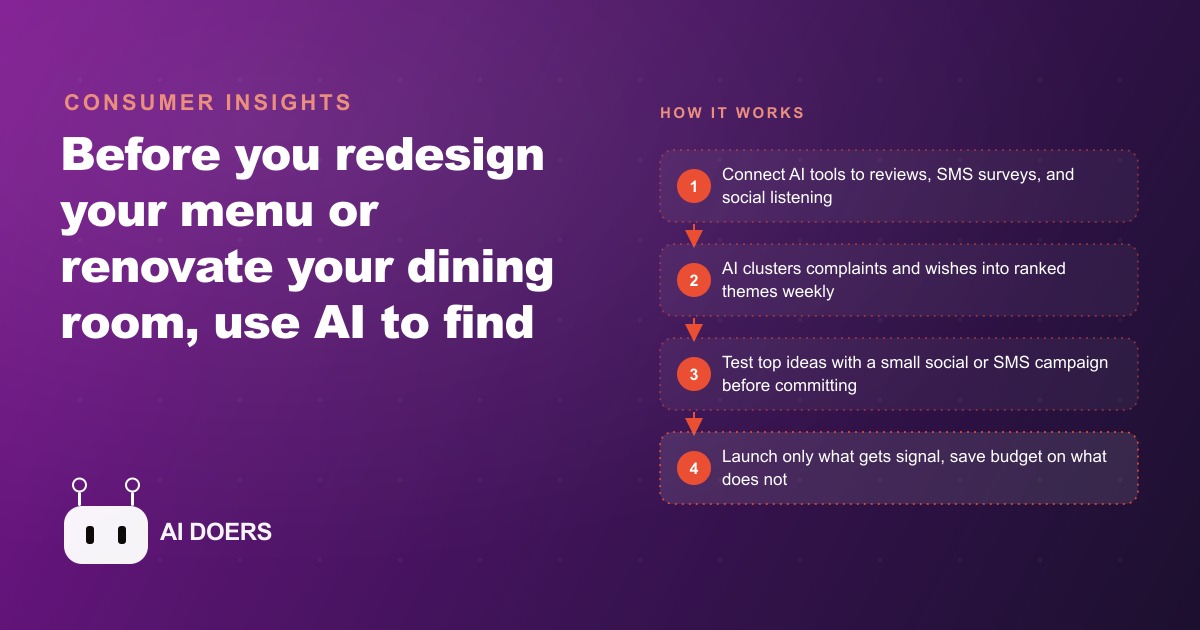
The most expensive restaurant decision is not the one that fails, it is the one you could have seen coming and launched anyway
The most expensive restaurant decision is not the one that fails, it is the one you could have seen coming and launched anyway. I have watched restaurant owners spend $12,000 on equipment for a brunch program that nobody in their reviews ever asked for, $8,000 on a renovation for a private dining room that their customer base had never mentioned wanting, and thousands more on menu launches built on gut feeling rather than anything a customer actually expressed. The money is not what hurts the most. The months of slow recovery are.
AI market research tools now make this specific category of mistake mostly preventable. Not all mistakes, not the bad-luck ones where the timing was wrong or the execution missed, but the class of mistake where the business spent real money solving a problem nobody had expressed. CES 2026 made this pattern visible at scale: room after room of expensive solutions to problems nobody in the target market had said they experienced. Restaurants are not immune to the same dynamic. The chef who has wanted to add a Sunday jazz brunch since culinary school, the manager who watched a competitor add a tasting menu and assumed that was the direction to chase, the owner who renovated based on a friend's advice: these are the decisions that validation would have caught.
What I am going to walk through here is the validation system itself, in the order you would build it, so that the data gets to say no before the deposit clears.
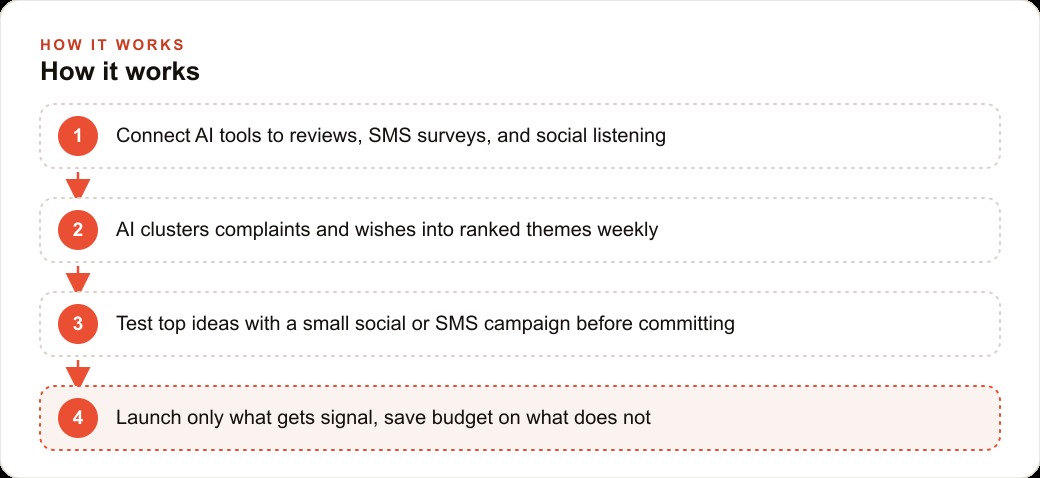
Mine your existing reviews for the top complaint before you form any new hypothesis
The first step is backward-looking, not forward-looking, and that is intentional. Before you develop any hypothesis about what your customers want next, you need to know what they are already telling you they do not have. Your existing reviews on Google, Yelp, OpenTable, and any delivery platform you use are a dataset you almost certainly have not read analytically.
AI tools can process a few hundred reviews in seconds and surface the themes that appear most frequently. Run your last 200 to 500 reviews through an AI analysis tool and ask it to identify the top five complaints and the top five compliments. The complaints are your most important signal. They tell you what customers already want from you and are not getting. The compliments tell you what you have that is working and should not be disturbed.
Before I would take any new initiative seriously, I would want to know whether the reviews mention anything related to that initiative. If nobody in 400 reviews has mentioned wanting brunch, that is not proof that brunch would fail, but it is a signal that the hypothesis did not originate in customer expression. It originated somewhere else, and that distinction matters when you are deciding how much to spend before testing. A $200 trial event is appropriate for an untested hypothesis. A $12,000 equipment purchase is not.
The review analysis also surfaces something more valuable than just complaints. It surfaces the language customers use to describe your food, your service, and your atmosphere. That language should go into your marketing copy, your menu descriptions, and your social content. Customers converting their own words back to them in your marketing is one of the lowest-effort, highest-conversion adjustments most restaurants never make.
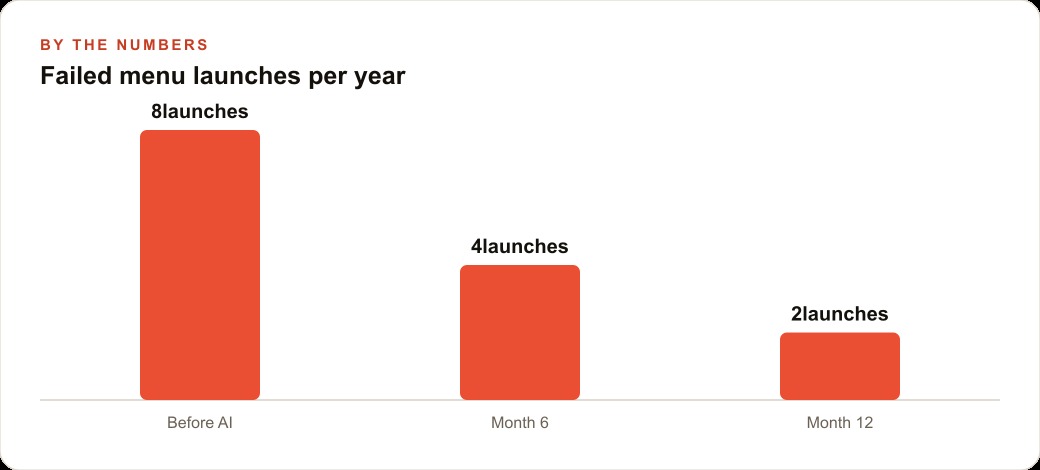
Set up competitor review monitoring before you get attached to any idea
Before you fall in love with an idea, check what your competitors' customers are saying about it. This is the step most owners skip because it feels like extra work, but it is actually the step that pays off fastest when it prevents an expensive mistake.
AI-powered competitor review monitoring tools can watch the Google and Yelp reviews of any restaurant you specify and surface themes as they emerge. Set up monitoring for the three or four restaurants in your market that are most similar to yours, and run a monthly analysis of their recent reviews. Look specifically for reviews that mention the features or programs you are considering adding.
If two competitors in your area added brunch in the last year and their reviews from that period show a pattern of complaints about wait times, inconsistent food quality, and staff that clearly was not trained for the different pace of brunch service, you have meaningful information before you invest a dollar. If those same reviews show that the brunch added measurably to their online rating and customers consistently call it out as a reason to return, that is also meaningful. Either way, you are not making your decision in an information vacuum.
The other thing competitor monitoring catches is the things your competitors are doing badly that you could do well. A competitor whose customers consistently complain about slow service during peak hours is not your benchmark, it is your opportunity. Review monitoring tells you where the gap is without you needing to visit every restaurant personally.
Post an AI-generated image of the dish on Stories for 48 hours before you source a single ingredient
This is the test most restaurant owners do not know they can run, and it costs almost nothing. Before you add any new menu item, create a photorealistic image of the dish using an AI image generation tool, post it to your Instagram or Facebook Stories, and watch what happens for 48 hours.
Stories let you see view count, tap-forward rate (how quickly people swipe past), and if you add a poll or a question sticker, direct responses. An image of a dish that gets 30% fewer views than your typical Stories content and zero poll responses is telling you something. An image that gets more views than usual and generates direct message responses asking when it will be on the menu is also telling you something. The signal is imperfect, which is why this is a preliminary filter rather than a final decision, but it is real customer behavior rather than your intuition about customer behavior.
The AI image needs to look realistic and appealing. A rough sketch or a low-quality render produces a meaningless test because you are measuring customer response to an unappealing image rather than customer response to the dish concept. Spend the extra few minutes to generate an image that looks like it belongs on your Instagram grid, and then post it the same way you would post any other content. Do not announce that you are testing, just post it naturally and measure the response.
For the 40-seat Italian restaurant case I will detail later, this step alone was enough to shift the owner's thinking before a single dollar changed hands.
Send the two-question SMS survey in the hour after the meal, not the next day
Timing on customer surveys matters more than the questions themselves. A survey sent 24 hours after a meal is asking a customer to remember and reconstruct an experience they have partially forgotten. A survey sent in the hour after they leave the restaurant, while the meal is still fresh and they are in a good mood if the experience was good, gets a response rate that is three to four times higher and answers that are more specific.
Two questions is the maximum for SMS. More than two and the response rate drops sharply. The first question should be about the specific thing you are trying to validate: "We are thinking about adding Sunday brunch, with dishes like eggs benedict and smoked salmon crepes. Would that bring you back on a Sunday?" The second question should be open-ended: "What is one thing we could add or change that would make you a regular?"
The open-ended question is often more valuable than the closed one because it surfaces things you were not thinking to ask about. A restaurant owner who asked two questions consistently for three months received responses about parking difficulty so frequently that addressing the parking situation became the highest-priority operational change, more impactful than any menu addition. She would not have known to ask about parking directly, but the open field surfaced it repeatedly.
Use an SMS tool that lets you send from your business number or a dedicated short code. Text messages from recognizable numbers get opened at rates that email cannot match, and the in-the-moment timing matters for the quality of responses you receive.
Build a monthly decision meeting where the data gets to say no
Having all of this data available does not help if you do not have a structured moment to look at it collectively before making decisions. The monthly decision meeting is a one-hour session where you review the review analysis from the past month, the competitor monitoring summary, any Stories performance data from dishes or concepts you tested, and the SMS survey results. The explicit purpose of the meeting is to let the data influence what you do next.
The structure of the meeting matters. Start with the data, not with the ideas. If you start with the ideas and then look at the data, you are unconsciously filtering the data through a conclusion you have already reached. If you start with the data and let the ideas emerge from what you see, the decisions are genuinely data-informed rather than just data-decorated.
The meeting also creates a forcing function for consistency. Running review analysis once and forgetting about it for six months produces one data point. Running it monthly and reviewing it in a structured meeting produces a trend line that shows you whether your complaint frequency is decreasing, which complaints are persistent and structural versus occasional and random, and whether competitor moves are affecting your customer sentiment before you can see it in your own numbers.
Invite whoever is involved in menu and operational decisions. Keep the meeting short and output-focused. The output of each meeting should be a short list: what we are testing this month, what we are not doing yet because the data does not support it, and what we are committed to based on what the data consistently shows.
Document the decision and the data behind it so you can learn from the outcome
Every decision that goes through this validation system should be documented before it is executed. The documentation does not need to be long. It needs to record what you decided, what data you looked at before deciding, what the data said, and what you predicted would happen as a result. Three or four sentences is enough.
The reason for documentation is that without it, every decision looks like it was made with good judgment in retrospect if it works and with poor judgment in retrospect if it fails. That attribution is almost always wrong, and it makes it impossible to improve your decision-making process over time because you cannot tell which inputs actually predicted the outcome.
With documentation, you accumulate a track record. After six months you can look back and see that the decisions you made when the review data supported the hypothesis and the competitor monitoring confirmed the gap had a significantly higher success rate than the decisions you made when you overrode weak or mixed signals because someone on the team was enthusiastic about the idea. That pattern is worth knowing because it tells you when to trust the process and when the process is telling you to slow down.
The 40-seat Italian restaurant that cancelled a $12,000 equipment purchase and grew revenue by 18%
I want to be concrete about what this system looks like in practice, so let me walk through the 40-seat Italian restaurant that I referenced earlier. The owner had been considering adding Sunday brunch for over a year. The logic was reasonable: the neighborhood had young professionals, brunch was popular at the restaurant two blocks over, and the Sunday lunch slot was the slowest part of the week. The plan was to add brunch equipment including a commercial waffle iron station, additional chafing dish capacity, and beverage equipment for mimosa service, at a total cost of around $12,000.
Before committing, the owner ran the review analysis on 840 of their own reviews. Zero mentions of brunch. Not one customer in 840 reviews had expressed interest in or requested a brunch option. The owner also set up competitor monitoring for the two restaurants in the neighborhood that had added brunch in the prior year. The reviews from those restaurants told a clear story: both showed a pattern of complaints in the months following the brunch launch, including slow ticket times, food quality inconsistency on egg dishes, and staff that seemed unprepared for a different service pace. Both restaurants showed a 0.3-star rating drop in the period following their brunch launch.
The owner posted an AI-generated image of a planned brunch dish, eggs florentine with a house-made hollandaise over house-made pasta, to Stories. The view rate was below average and there were no direct message responses. The SMS survey, sent to the prior month's diners, asked directly about brunch interest. Sixty-two responses came back, and forty-four of them indicated they would not use a brunch service. Eighteen indicated they might. None were enthusiastic.
The owner cancelled the equipment purchase. Instead of brunch, the monthly data review surfaced that the most consistent complaint across their reviews was that reservation availability was limited on Friday and Saturday evenings, and that multiple customers had mentioned they would return more often if they could get a table on a Friday without booking two weeks out. The owner added a second dinner seating on Friday and Saturday, absorbing only the staffing cost for a few additional hours per week with no equipment investment. Revenue grew 18% in the following quarter. The customers who were already fans of the restaurant came back more often because the access improved. No brunch equipment needed.
That is exactly what we do at AI DOERS. Book a private 30-minute call with Madhuranjan Kumar and we will map the fastest path to it for your specific business.
Book your call →
Madhuranjan Kumar
Madhuranjan Kumar brings 20 years of performance-marketing experience and has managed over $200 million in Facebook ad spend for brands across the United States and beyond. His expertise spans the full modern marketing stack: Meta, Google Ads, TikTok, email automation, CRM, and the websites that hold it together. At AI DOERS he turns that track record into lead-generation systems for businesses across every industry.