
The Big AI Lawsuit and the Quiet Lesson for Small Businesses
A major AI lab is locked in a court fight with one of its co-founders over how it restructured and who promised what. The drama is far away, but the lesson is close to home: keep your business portable and your agreements written.

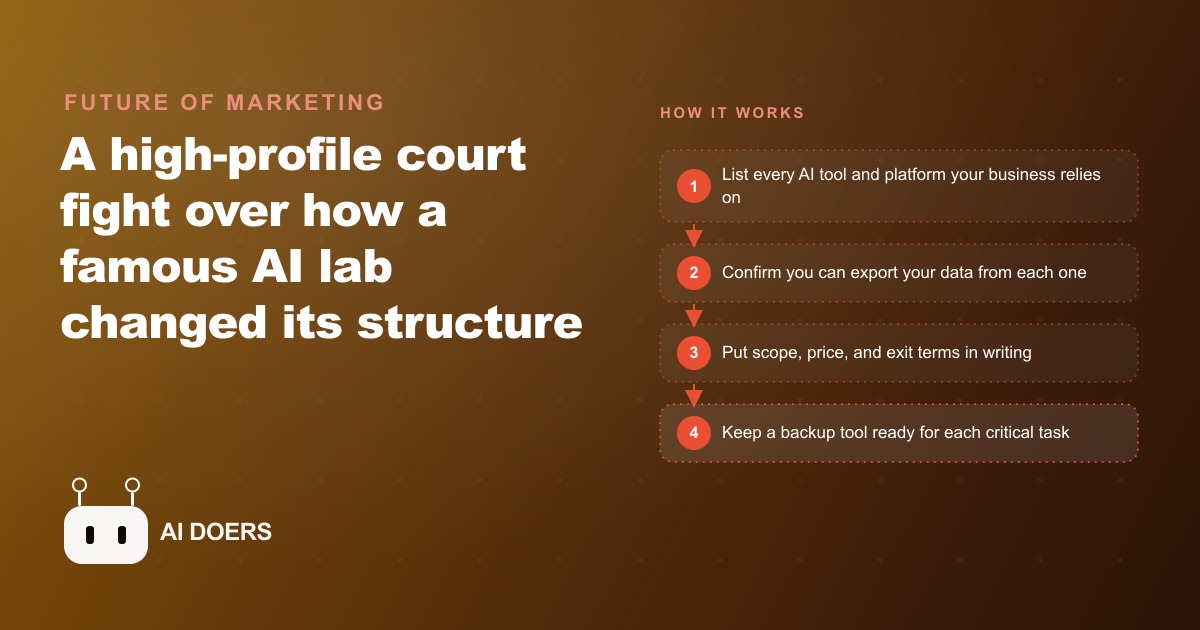
A high-profile court fight over whether promises made in meetings count as binding commitments is, for most observers, entertainment. For a small business that runs on AI tools, it is a dry run for a situation that arrives without a press release.
The case involves an AI lab that restructured from a nonprofit to a for-profit entity, a co-founder who argues the terms of his participation were violated in the process, and disputes about what was agreed verbally versus what was ever put into a signed agreement. The ethical questions about whether the restructuring honored the founding mission are genuinely interesting to those who follow AI governance. But the reason Madhuranjan Kumar believes this case matters for any business running on AI tools has nothing to do with those ethics questions. It is about the architecture of vendor relationships, and what every business building on a platform quietly accepts when the relationship rests more on informal understanding than on written terms.
The thesis here is one that many people will resist: the lawsuit is not primarily a story about corporate ethics, broken promises, or the soul of a technology company. It is a story about vendor dependency, context lock-in, and what happens when a business relationship built on informal understanding meets structural change at scale. That pattern is not specific to AI labs. It is playing out in smaller, quieter ways inside businesses that rely on AI tools without having thought through what they would do if the vendor changed.
The lawsuit is a warning about vendor architecture, not corporate ethics
The instinct when following this case is to take sides. Was the restructuring a betrayal of the founding mission? Did the co-founder have a reasonable expectation that the original terms would hold? Both are interesting questions about a specific organization. Neither is the question a small business should walk away asking.
The question worth asking is this: what would happen to my operation if the AI vendor I depend on most restructured in a way that changed the terms I originally accepted? The answer to that question depends almost entirely on how the relationship was built. Specifically, it depends on whether the context, workflows, and data that make the relationship valuable live inside the vendor's proprietary systems or in formats and locations the business controls independently.
The lab at the center of the case is not a cautionary tale about bad actors. It is a cautionary tale about fast-moving organizations that change their structure and priorities as they grow, and about the gap between what people understood the relationship to be and what was actually documented. That gap is not specific to AI labs. It exists in any vendor relationship where informal understanding outpaced written terms, and in the AI market specifically, informal understanding has been the norm because the tools have been moving faster than anyone's legal or procurement processes.
The businesses that are most vulnerable right now are not necessarily the ones using the most powerful AI tools. They are the ones that built workflows on the assumption that the current terms would hold indefinitely, that the pricing they started on was stable, and that the model they trained their processes around would always be available. Every one of those assumptions can be invalidated by a single vendor announcement.
Informal agreements are where every vendor relationship eventually breaks
Much of the lawsuit turns on what was agreed verbally in meetings and whether private notes from those meetings accurately reflect the agreement. One side presents excerpts from journals and chat logs. The other provides context that changes the apparent meaning of those same excerpts. A sentence that reads as a firm commitment looks like normal negotiation language when the surrounding messages are restored.
That pattern, informal agreements breaking down under pressure, is not a story about dishonesty. It is a story about the structural vulnerability of verbal understanding. People in business relationships often operate on a shared mental model of what each party owes the other, and that mental model diverges quietly over time, especially when the business grows quickly or undergoes significant structural change. The divergence stays invisible until something forces the issue and each party retrieves their version of what was agreed.
For a small business working with AI vendors, informal agreements accumulate fast. What counts as acceptable use of the platform. What happens to your data if you cancel. Whether the pricing tier you started on can be changed without notice. Whether the model your workflows depend on will remain available. Whether a free tier that your business relies on will be continued. Most of these questions are never asked directly, and the answers that come from sales conversations or documentation FAQs are less binding than they felt at the time.
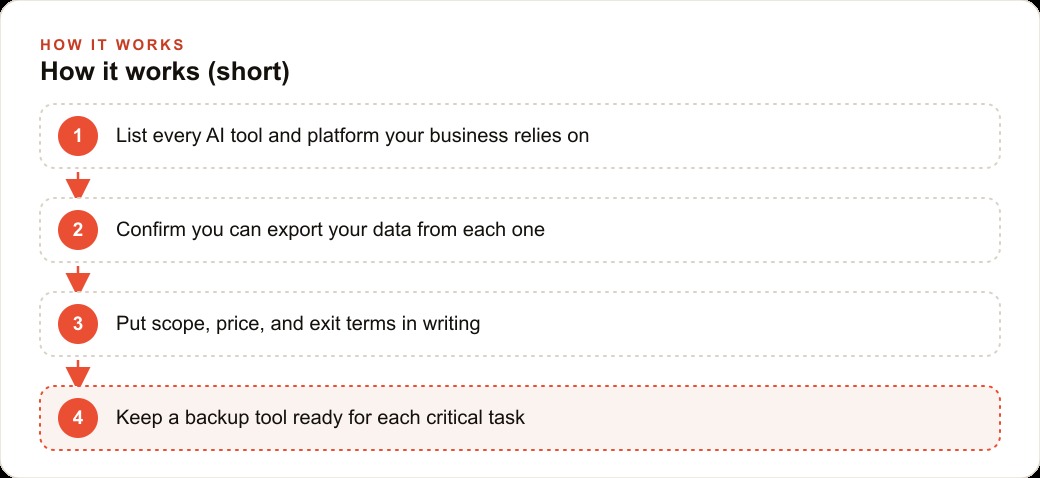
The defense is straightforward: get the important terms in writing, specifically for any vendor relationship where a change in terms would require significant time or cost to recover from. That is not a novel idea, but it is the one that prevents the situation the lawsuit describes from playing out on a smaller scale inside your own business.
Context lock-in is the expense nobody calculates until they need to leave
The concept people most commonly reach for when discussing vendor risk is data portability: can you export your records if you need to leave? That is a real concern but it is the more manageable one. The harder form of lock-in that the AI market has introduced is context lock-in, and it is what makes AI vendor relationships specifically more consequential than previous categories of business software.
Context lock-in is what happens when the thing that makes a vendor genuinely valuable is the knowledge the vendor's system has accumulated about how your business works. A CRM that holds your customer records is a data portability problem: you can export the records and import them somewhere else. An AI assistant that has been given your pricing history, your internal policies, your team's communication patterns, and your operational workflows is a context portability problem. The records can be exported. The trained understanding of how your company operates cannot.
When a business builds an AI-native workflow on top of a single vendor's platform, the AI model is not just answering questions. It is holding a representation of how the company makes decisions, who the customers are, what the priorities are, and how the team communicates. That contextual understanding is what makes the assistant genuinely useful rather than merely capable. When the vendor restructures, raises prices, changes their terms of service, or gets acquired by a larger company with different priorities, the business is not just losing a tool. It is losing institutional memory that lives inside someone else's system.
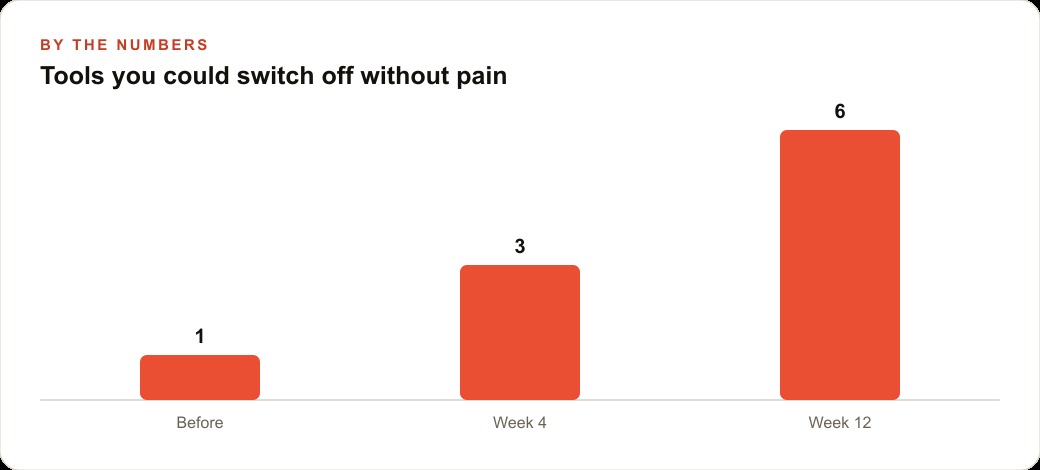
This expense does not appear on any invoice. It shows up only when the business tries to leave and discovers that switching vendors means rebuilding the context from scratch on a new platform, at the same cost as the original setup, under the additional pressure of the disruption that triggered the switch.
Portable by design is a decision you make before the disruption, never after
The solution to context lock-in is not to avoid building AI-native workflows. The tools are genuinely useful and the productivity gains are real. The solution is to build those workflows in a way that the institutional context lives in systems the business controls, not only inside the vendor's platform.
In practice this means a few specific choices made early. Keep your company's key knowledge, the policies, the pricing guides, the process documentation, the client profiles, in formats you own and can export. Write the context that powers your AI workflows into documents that are yours, rather than training a vendor's proprietary system on knowledge that becomes inaccessible if you leave. Prefer AI tools that accept standardized inputs and produce standard outputs, so switching to an alternative provider is a matter of routing the same inputs to a new system rather than rebuilding the pipeline from the start.
These are design decisions and they must be made before the dependency deepens. Once a workflow is deeply embedded in a vendor's proprietary system, extraction is disruptive and expensive. The cost of portability by design is an afternoon of planning and some documentation discipline. The cost of portability discovered under pressure is weeks of disruption at the worst possible time, usually when a season is busy or a deadline is close.
An HVAC business that Madhuranjan Kumar has discussed this approach with built a simple portability audit into its quarterly operations review. Once every three months, the owner and operations lead spend one afternoon confirming that every AI tool in the business can be replaced, that the company's data can be exported from each platform in a usable format, and that an alternative option has been identified for each critical workflow. If any tool fails either test, it gets flagged for a workflow adjustment before the dependency deepens further.
In the quarter after they started this practice, a pricing change at one of their scheduling platform providers doubled the monthly cost for the feature set they relied on. Two competitor businesses using the same platform were effectively held hostage: their workflows were too embedded to switch quickly, and moving under pressure during peak season would have disrupted scheduling for several weeks. The HVAC business switched cleanly in three days because their data was portable, their backup option was already identified, and the migration plan existed before the disruption arrived. The one-afternoon quarterly audit had paid for itself in a single vendor pricing event.
The AI vendor landscape in 2026 rewards the businesses that planned to leave
The market conditions that make this lesson timely are not temporary. The early phase of the AI market, characterized by generous free tiers, low API pricing, and aggressive competition for enterprise customers, is giving way to a phase where vendors need to generate returns on enormous capital investments. Several major AI platforms have raised prices, reduced free usage, changed their model availability policies, or altered their terms of service in the past twelve months. The restructuring and consolidation that creates the conditions for disputes like the one in the lawsuit is accelerating.
The businesses that set up AI workflows in 2023 and 2024 on the assumption that pricing would remain flat, that the free tier would persist, or that the specific model they trained their processes around would always be available are discovering now what those assumptions cost. The businesses that built with portability in mind, keeping their context in systems they own and maintaining the ability to route the same workflows through different providers, are adjusting smoothly to each vendor change.
This is not an argument against using AI tools. The tools are genuinely valuable and the competitive advantage of using them well is real. It is an argument for using them in a way that keeps the leverage on the side of the business rather than the vendor. The businesses that get the most from AI over the next several years will not necessarily be the ones that committed earliest or deepest to a single platform. They will be the ones that built real capability while retaining the ability to move, and who treated every vendor relationship as one that could change on short notice.
The lawsuit is a story about what happens when informal expectations meet structural change at scale. For a small business, the structural change does not arrive as a court filing or a press release. It arrives as a pricing update, an acquisition announcement, a deprecation notice, or a terms-of-service revision delivered by email on a Tuesday morning. The process is quieter. The impact on operations is the same. The defense is identical in both cases: own your context, get the important terms in writing, know what you would do the day the relationship changes before that day arrives, and treat portability as a design requirement rather than an afterthought.
The vendors themselves are not villains in this story. They are organizations navigating extreme capital requirements, competitive pressure, and governance challenges in a market that is still defining its own rules. What they cannot do is guarantee that their priorities will always align with yours. Protecting your business from that gap is your job, not theirs, and the businesses that do it quietly and consistently are the ones that compound their AI advantage without the disruption that catches others off guard.
That is exactly what we do at AI DOERS. Book a private 30-minute call with Madhuranjan Kumar and we will map the fastest path to it for your specific business.
Book your call →
Madhuranjan Kumar
Madhuranjan Kumar brings 20 years of performance-marketing experience and has managed over $200 million in Facebook ad spend for brands across the United States and beyond. His expertise spans the full modern marketing stack: Meta, Google Ads, TikTok, email automation, CRM, and the websites that hold it together. At AI DOERS he turns that track record into lead-generation systems for businesses across every industry.