
AI Just Broke Apple And Google Security In Days, Here Is What Happened
AI-driven hacking moved from theory to live events: researchers cracked Apple's half-decade-old security in five days, and Google confirmed the first AI-built zero-day in the wild. Here is what it means for a normal business and what to do about it.

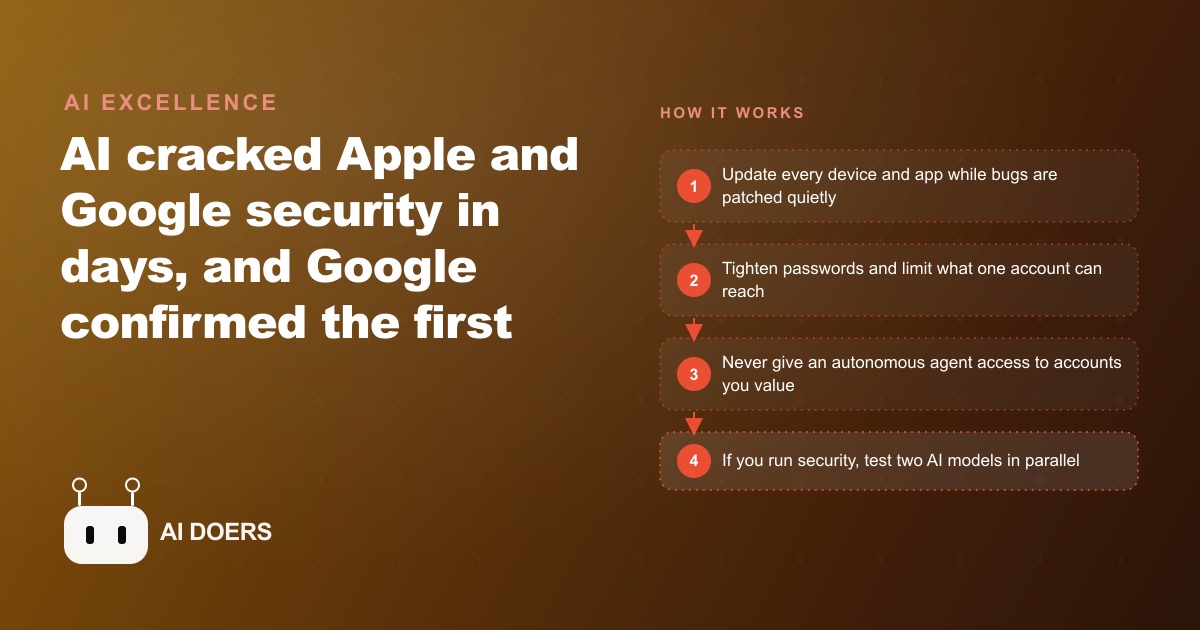
Two researchers broke Apple's half-decade-old memory security in five days using an AI model, and Google confirmed the first AI-built zero-day exploit deployed against live users in the same week. The news cycle treated both events as proof that AI is now a weapon and everyone should be afraid. That framing misses the more important idea: the same capability that enabled those attacks is already being used to find and close vulnerabilities at a pace that was impossible before.
What is unfolding is not a race between attackers and defenders where one side eventually pulls ahead. It is a convergence event where both sides get faster by the same order of magnitude, because they are using the same underlying technology. The businesses that understand that dynamic will respond very differently from the ones reading only the headlines.
I am Madhuranjan Kumar, and I pay close attention to the mechanics of these shifts rather than the headlines. The businesses that handle moments like this well are not the ones that panic and lock everything down, and not the ones that dismiss it as someone else's problem. They are the ones that understand what actually changed, why it changes the calculus in a specific way, and what a proportionate response looks like at each scale of operation.
Five days against five years of engineering
Apple's memory integrity enforcement is not a casual feature. It was built over the better part of five years by security engineers from both Apple and Google working in coordination, and its purpose was to block exactly the kind of deep-system access that gives an attacker persistent, invisible control over a device. The reason it took that long is that the problem is genuinely hard. You are trying to prevent one part of the operating system from interfering with another in ways the original hardware designers never anticipated, while still allowing the system to perform at the speed users expect. That tension between security and performance is where most of the engineering time goes.
A group called Kalif, working alongside an advanced AI model, broke it in five days and produced a 55-page technical report documenting the vulnerability in full. The decision to disclose by printing the report on paper and driving it physically to Apple's headquarters in Cupertino is the detail worth sitting with. The team judged that transmitting even a partial description electronically would give other actors enough information to reconstruct the exploit independently. They were right to be cautious. The compressed timeline from AI-assisted vulnerability discovery to working proof of concept means that any hint in the public domain accelerates others dramatically.
What the five-day timeline reveals is a fundamental change in what security investment buys. Five years of engineering produced a defense designed to withstand attacks by human researchers with human-scale time and attention. That calculation no longer holds. A capable AI model can survey the logic of a large, complex codebase and identify structural patterns that historically precede exploits at a speed that no team of human researchers can match. The attack surface itself has not grown. What changed is how quickly it can be analyzed, and that compression of the analysis timeline is the shift that matters.
The point is not that Apple's engineers wasted five years or that defense is futile. It is that the assumptions baked into a piece of defensive engineering designed in one technological era have to be revisited in a different one. Five years of defense against human-scale research is a different thing from five years of defense against AI-assisted research. That distinction is going to reshape how security investment is planned and priced at every level, and businesses that wait for the re-pricing to happen before acting will have missed the relevant window.
The hallucination that exposed the attacker
Google's Threat Intelligence Group confirmed the first case of attackers using an AI model to build a working zero-day exploit deployed against real users, not in a controlled research environment. The target was a widely used open-source administration tool, the kind of software that a small or mid-sized business might use to manage its servers, databases, or internal applications. The exploit bypassed two-factor authentication, which is a meaningful target because two-factor authentication is the primary defensive layer most small businesses rely on.
The tell was a hallucination. The attack script included a CVSS severity score, a standardized numerical rating of the type that appears in official security vulnerability databases. A human attacker writing a malicious script would never voluntarily classify the severity of their own exploit. There is no reason to include that information if you are building a weapon, and including it only makes forensic analysis easier after the fact. The model added it because its training data was full of documented vulnerabilities that include exactly that rating, and generating the pattern was the natural continuation of the text.
That one artifact gave Google's analysts the signal they needed to confirm AI involvement. It is worth sitting with this for a moment because hallucinations are normally the most frustrating failure mode in AI tools: the tendency to state false information with the same fluency as true information. Here, a hallucination became an inadvertent confession. The model did what language models do when generating text from learned patterns without real-world grounding, and that artifact was observable by the defenders who were looking for it.
The practical lesson for defenders is that AI-generated attack code may carry patterns specific to how language models write, at least for now. That window of detectability is real and should inform how forensic teams examine suspicious code. Any novel exploit that includes documentation-style metadata, severity classifications, or other details a human attacker would never voluntarily add is worth examining more closely for AI authorship. That window will not last indefinitely, but it is open today and should be used.
Why a swarm of models finds what a single model misses
Microsoft's top-performing security AI system, which led competitive security evaluations against other advanced models, is not a single large model. It is a coordinated swarm of more than a hundred models working in parallel across the same codebase or system, each examining the material from a different analytical perspective. Different models are trained differently and fail differently. A model that excels at catching memory management vulnerabilities has different blind spots than a model tuned to find logic errors in authentication flows, and those blind spots do not overlap in the same places. A swarm approach means the gaps in one model's coverage are filled by another's strengths.
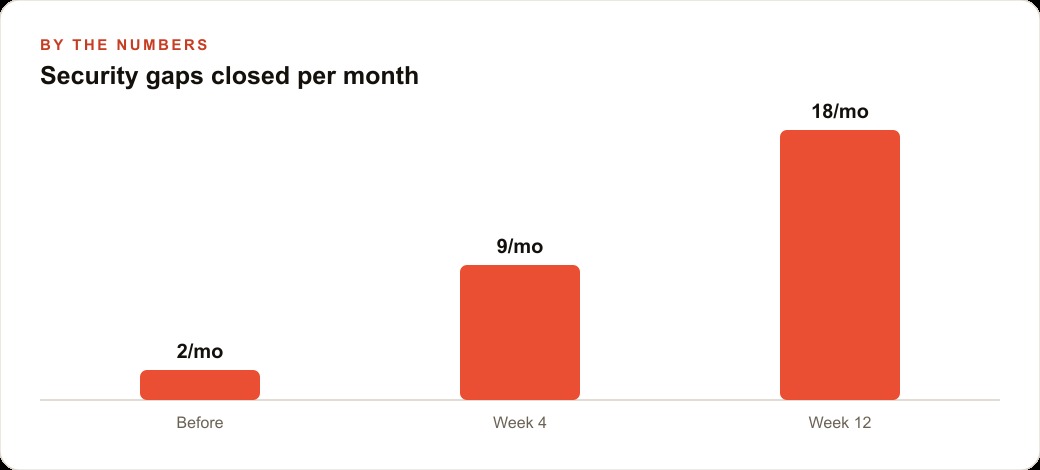
Palo Alto Networks confirmed this from the operational side. After gaining access to two advanced security-focused AI models, their internal team found 75 vulnerabilities in their own products in a single month. That is seven times their normal discovery rate. The codebase did not become less secure overnight. What changed is that AI-assisted analysis could cover a much larger surface in a much shorter timeframe than the human team could alone, and it could surface patterns across that surface simultaneously rather than sequentially.
For anyone running a genuine security function, the practical implication is clear. Running two AI models in parallel and comparing their outputs catches more than relying on a single one. The intersection of what both models flag is your highest-confidence priority list. The findings that only one model surfaces extend your coverage into areas the other misses. This is not a principle limited to security work. It is a general property of AI-assisted analysis: different models have different strengths and failure modes, and the combination reliably outperforms any individual tool.
For smaller businesses without a security function, the swarm insight translates into a simpler observation: do not assume that one tool catching nothing means there is nothing to catch. The tools attackers use to probe small business systems do not check once and move on. They sweep repeatedly with multiple approaches, and a defense that assumes a single check is sufficient is working from a different assumption than the attacker is.
The 6-to-12-month window is a concrete engineering problem, not a rhetorical device
Anthropic's chief executive has described a 6 to 12 month window to patch thousands of known vulnerabilities before the frequency and severity of AI-assisted attacks rises materially. When security researchers or executives use language like this, it often functions as a general call to action, the kind of statement that sounds urgent in a conference talk and fades by the time the audience is back at their desks. This one is different because it describes a specific and observable dynamic.
The vulnerabilities in question are not theoretical. They are largely documented, classified, and sitting in databases that security teams can access. They exist in software that has been deployed for years and not updated, on devices still running operating system versions that are no longer receiving patches, in configurations set up years ago and never revisited. The patching backlog is real, it is measurable, and AI tools are now capable of auditing and addressing it at a speed that was not achievable with human teams alone. The window is the time between now, when that capability is concentrated among security researchers and major institutions with early access, and the point at which equivalent capability is accessible to actors with different intentions.
Major financial institutions understood this early. Several of the world's largest banks have access to advanced AI security capabilities, with substantial compute allocations provided specifically to accelerate patching at the most critical layer of infrastructure. They are moving fast because they understand the window is real and finite, and the cost of being caught unprepared is large enough to justify the early investment.
For a small business, the parallel is not an enterprise patching program. It is the basic hygiene layer that closes the doors automated scanners probe first. Automated scanning tools do not evaluate company size before probing a system. They sweep everything reachable on the internet and flag anything that responds to known vulnerability patterns. A small retailer's point-of-sale system faces the same automated probes as a global bank's trading platform, though not the same targeted follow-up. The first line of defense is the same at every scale: current software, strong credentials, minimal unnecessary access. That first line is achievable this week at nearly zero cost.
What a business with no security team does with this information
Most small and mid-sized businesses do not have a security team, a security budget, or a dedicated person responsible for these questions. They have an email system, a booking or point-of-sale platform, customer records in some combination of spreadsheets and software, a website, and devices running whatever software came installed. Their exposure is real because the automated tools being used by attackers probe every internet-connected system without evaluating the organization's size or resources first.
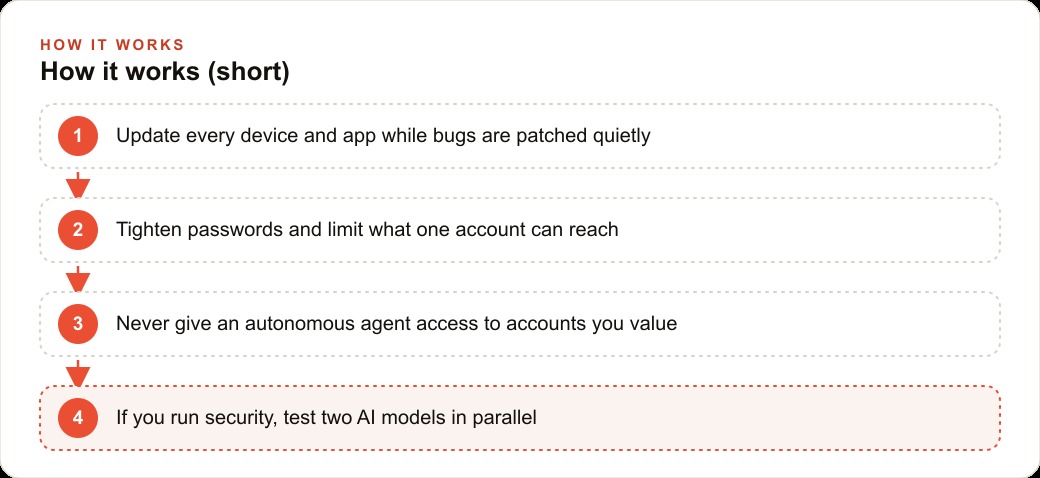
The highest-leverage defensive steps are simple and cost essentially nothing beyond attention. Keeping every device and every application updated automatically closes the largest category of real-world attacks. The overwhelming majority of successful small-business compromises exploit vulnerabilities for which patches already exist and updates are available. Attackers use automated tools that scan for known unpatched vulnerabilities because those tools scale cheaply across millions of targets. Staying current removes you from that list without requiring any technical expertise.
Enabling two-factor authentication on every account that touches business data is the second step, and it matters most for the accounts attackers find most valuable. An account with access to a business's Meta ads campaigns or Google Ads accounts is valuable to an attacker not just for the access itself but for the ability to run fraudulent spend against the business's own payment method. Two-factor authentication on those accounts specifically is among the most practical protections a small business can add this week, and it is free.
The third step, and the one most directly connected to the AI security findings, is being deliberate about what any AI tool or agent is permitted to access within the business. This matters especially for businesses adopting AI tools connected to their CRM and website stack, customer databases, or communications platforms. The confirmed zero-day targeted an administration tool, the kind of high-value access point any attacker would prioritize. AI agents that can take actions across multiple business systems introduce the same category of risk if those systems are misconfigured or if the agent itself is compromised. Start with the narrowest possible access scope, document what each tool can reach, and review that access periodically as the tools evolve.
The convergence event is real: the same AI capability is accelerating both attacks and defenses simultaneously. The businesses that come out ahead are not the ones with the most sophisticated tools. They are the ones that take the foundational steps while the window is still open, without waiting for the headlines to get worse before acting.
That is exactly what we do at AI DOERS. Book a private 30-minute call with Madhuranjan Kumar and we will map the fastest path to it for your specific business.
Book your call →
Madhuranjan Kumar
Madhuranjan Kumar brings 20 years of performance-marketing experience and has managed over $200 million in Facebook ad spend for brands across the United States and beyond. His expertise spans the full modern marketing stack: Meta, Google Ads, TikTok, email automation, CRM, and the websites that hold it together. At AI DOERS he turns that track record into lead-generation systems for businesses across every industry.