
AI Is Reshaping Every Business, Here Is How to Stay Ahead Instead of Behind
No role and no business is fully insulated from AI. The edge goes to whoever stays adaptable, learns fast, and uses the right tool for each job. Here is how I would think about it for a real business.

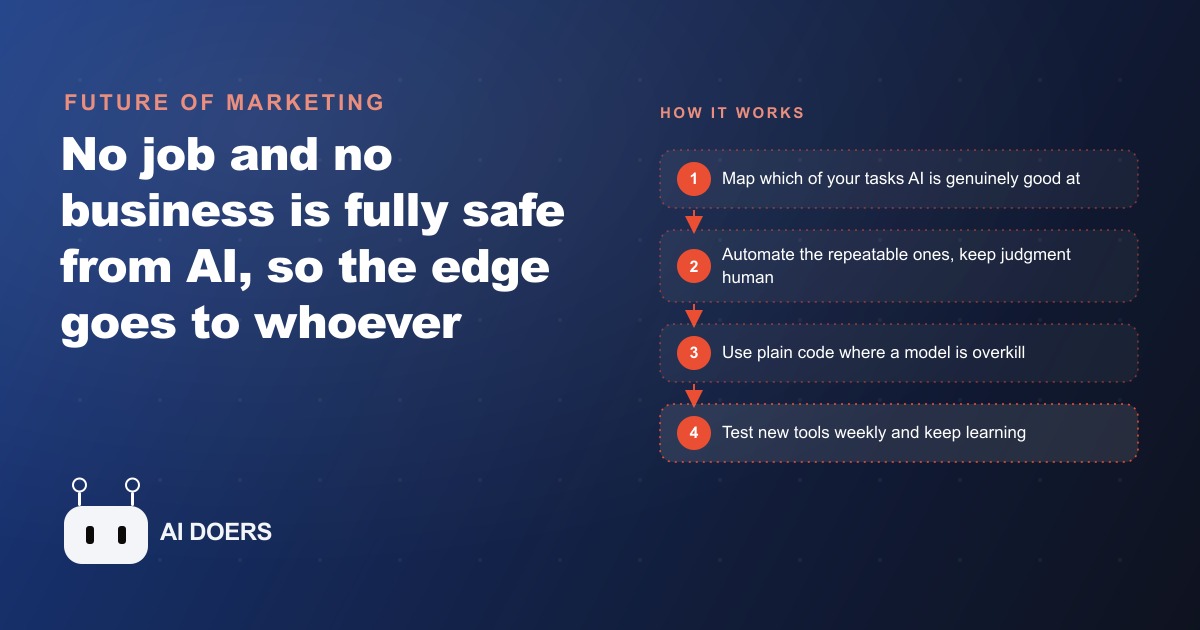
The most unusual thing about the current AI transition is not the pace. It is the simultaneity. Previous technology waves moved through industries in sequence: manufacturing first, then finance, then retail, then professional services. This one is crossing every sector at once, which means the rules of the prior cycle do not apply. There is no safe industry to wait in while watching early adopters stumble, because there are no industries where the early adopters have not already started.
AI disruption is crossing every sector in the same window, which is what makes this moment structurally different
In past technology transitions, a business could legitimately adopt a wait-and-see posture. Watching others figure out the internet, or mobile, or social media, and then entering once the pattern was clear, was a viable strategy because the transition took long enough that late movers still had time to catch up. Each wave took roughly a decade from the early majority to the laggards, and that window allowed for deliberate timing. AI is compressing that window significantly.
The reason is not just capability. It is that AI tools are delivered through software subscriptions that any business can access immediately, without capital investment, specialized infrastructure, or a large technical team. The corner shop and the law firm can both start using the same models today. That access symmetry means the advantage goes entirely to whoever starts first and learns fastest, not to whoever has the largest resources or the most technical staff.
The businesses that entered last year are not just ahead on tools. They are ahead on the institutional knowledge of how to use those tools in their specific context: what prompts work, which tasks are worth automating, and which workflows need human judgment to stay reliable. That knowledge gap compounds. It is not visible from the outside until the gap in output quality and operating efficiency becomes undeniable to customers and prospective employees alike.
There is also a structural shift worth understanding for software-based businesses specifically. The cost model that made software companies attractive, near-zero marginal cost per additional user, is changing because AI model inference costs money per token. Every additional user of an AI-powered feature adds cost rather than being free. That shifts margin structures and pricing models across the software industry, which ripples into how the businesses using software are priced and served.
The businesses watching from the sidelines are losing to competitors who started six months ago
The gap is not theoretical. A business owner who added AI-assisted drafting, lead follow-up automation, and content creation six months ago has run hundreds of real workflows through these tools. The prompts are dialed in. The edge cases are known. The time savings are banked. Their competitor who starts today is six months behind on that curve, and the operational advantages of that head start are already showing in their capacity to take on more work at the same cost.
This is the uncomfortable part of the current moment. Being on the sidelines does not feel like losing until the comparison becomes undeniable. A competitor who closes quotes faster, follows up more consistently, and produces marketing content without dedicating staff hours to it has a structural advantage in every sales cycle they share. The gap does not appear overnight. It shows up gradually in win rates, response times, and the visible professionalism of every customer touchpoint, until one day the gap is obvious to clients who are comparing options.
The concrete action is to stop evaluating and start testing. The tools are cheap enough and accessible enough that the cost of a bad experiment is negligible. The cost of continuing to evaluate without testing is that the compounding falls further behind every week.
Judgment and customer reading are the tasks current models still fail at consistently
There is an honest accounting of where AI genuinely falls short, and knowing it protects against the most common mistake, which is handing off decisions to a model that is not equipped to make them well.
Current models are weak at judgment in the way a senior professional means that word. They can process a customer complaint and draft a response, but they cannot reliably sense that this particular customer, based on their history and the tone of this specific message, needs to hear something different from the standard reply. They can analyze a proposal and suggest pricing, but they cannot read whether a client relationship is at a stage where a bold number will close or push away. Those reads come from context and accumulated experience that a model is not capturing in the way a person who has worked with a client for two years is capturing it.
This matters practically because it defines where to put human time. The work that survives AI automation is not necessarily the most complex work in a technical sense. It is the work where reading the room, owning the call, and maintaining a relationship over time determines the outcome. That work stays human, and it becomes more valuable as the surrounding administrative layer gets automated away. The professional whose judgment is sharp becomes more differentiated, not less, as AI handles the mechanical layer underneath.
Current models are also inconsistent on multi-step reasoning that involves real-world constraint satisfaction, where the answer depends on a combination of specific facts that are not explicitly stated in any training document. For those tasks, a human with domain knowledge still significantly outperforms any available model.
Plain software beats an AI agent for deterministic tasks, and most business tasks are deterministic
One of the most useful distinctions for a business owner is the line between tasks that need a language model and tasks that just need reliable logic. A scheduling system does not need AI. A payment confirmation text does not need AI. An invoice template does not need AI. These tasks are deterministic: the same input always produces the same correct output, and the right tool for them is plain software that executes reliably every time.
When a language model gets inserted into a deterministic task, two things happen. The cost per execution goes up because model inference costs money per token. And the reliability goes down because a model introduces variability where there should be none. A scheduling system that occasionally misreads an input and books the wrong time is strictly worse than a simple calendar integration that never does that.
The practical discipline is to reach for a model only when the task requires generating language, reasoning through a novel situation, or understanding something from context. For every other task, the right tool is simpler, cheaper, and more predictable software that has been doing that job correctly for years. This discipline also prevents the common trap of gold-plating a simple workflow with unnecessary AI complexity, which adds cost, adds failure modes, and makes the system harder for non-technical staff to understand and maintain.
There is a useful test for any task you are considering automating. Ask whether a slightly different input should always produce a slightly different output, or whether there is exactly one correct output for each input. If there is exactly one correct answer, plain software is better. If the output needs to adapt to nuance, context, or tone, that is where a model earns its cost.
The adaptation habit that compounds: testing one new tool per week without exception
The owners who stay ahead are not necessarily the ones who chose the right tools first. They are the ones who kept testing when others stopped. The tools are changing fast enough that what was mediocre six months ago may now be the strongest option in its category. A business owner who tested an AI meeting summarizer in early 2024, found it unreliable, and wrote off the category entirely is now making decisions based on data that is no longer accurate.
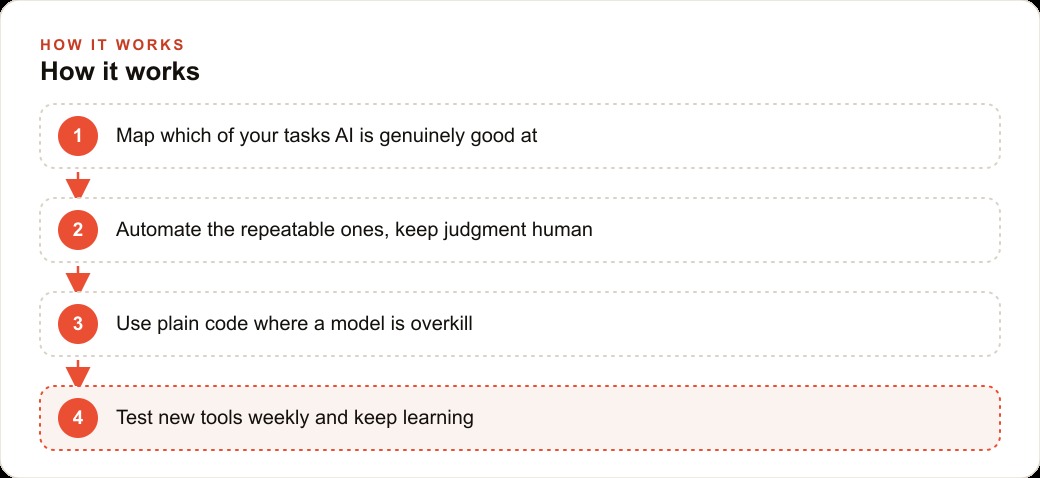
The concrete habit is one new tool per week. Not a deep integration, not a replacement of anything critical, just a genuine test on a real task from the actual workflow. If the tool helps, it earns a second week and a deeper look at whether it can be built into the standard process. If it does not, the data point updates the picture and costs nothing except the hour spent on the test.
Over a year, that habit produces 50 informed data points about what works in a specific business context, which is far more valuable than any review article or benchmark comparison. A review article tells you what a tool does. Testing it on your actual workflow tells you whether it does that thing well enough in your specific context to be worth using.
The secondary benefit is that the habit itself builds fluency. The more tools a person has worked with, the faster they can evaluate new ones, the sharper their questions get, and the more accurately they can spot when a tool will fit a workflow versus when it looks useful in a demo and falls apart in practice. That fluency is a compounding skill, and building it through consistent weekly testing is far more efficient than periodic deep dives spaced months apart.
The concrete move: map your tasks this week and automate the first repeatable one
The clearest path from here is a task audit. Write down everything your team does in a week that takes time without requiring someone to make a real decision. Not the hard calls, not the customer-facing judgment moments, but the mechanical tasks: drafting standard replies, formatting reports, pulling data into summaries, scheduling follow-ups, producing documentation that follows the same structure every time.
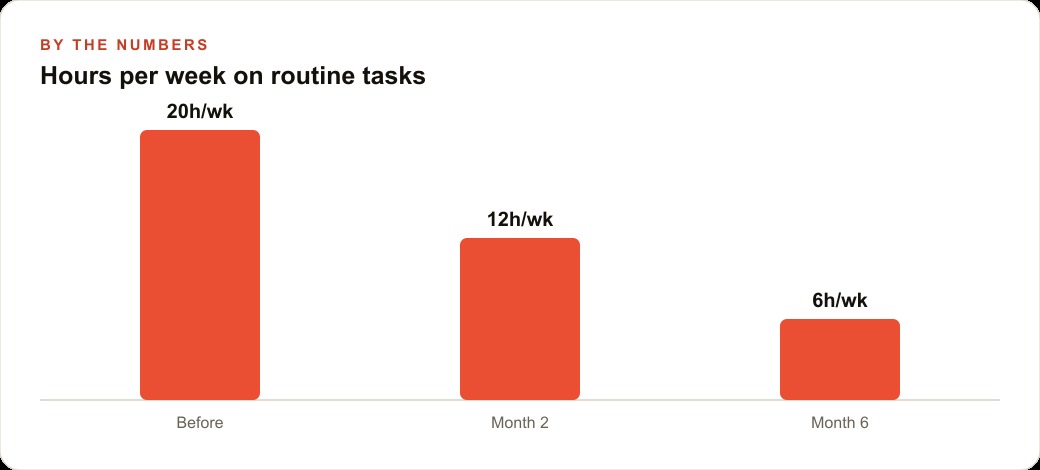
From that list, pick the one task that happens most frequently and takes the most time per occurrence. Build one workflow or use one tool to handle it. Run it for a month. Measure the time saved. Then pick the second task.
It is worth being honest about one more thing. The adaptation habit only compounds if the tests are genuine. Testing a tool on a task it is obviously not suited for, then dismissing the category, is not useful data. Testing it on the exact workflow where it might actually help, comparing the result carefully to the manual process, and making a real decision based on that comparison: that is the habit worth building. The discipline of genuine testing is what separates owners who consistently find value from tools from owners who try them once, get a mediocre result, and return to doing everything the old way.
For a chiropractic clinic, this often starts with the communication layer: the new patient inquiry response, the appointment reminder, the post-visit follow-up message. These are high-frequency tasks that follow a consistent enough pattern that a well-written AI workflow handles them reliably every time. The front desk staff member who was writing those messages manually for five hours a week has those five hours back. At 28 dollars per hour for that role, that is 140 dollars per week recovered, which compounds to 7,280 dollars per year, at the cost of a few afternoons of setup and a few dollars per month in model usage.
That number is not the headline. The headline is what happens to those five hours. They go back into work only a human can do: answering the calls that need empathy, catching the patient situation that needs the chiropractor's direct attention, and handling the edge cases that no workflow handles well. The clinic becomes more responsive in the moments that matter and more efficient in the moments that do not. That is the compounding structure the adaptation habit builds toward.
The task audit itself takes less than an hour. Running the first workflow takes an afternoon. The time saved starts the following week. That timeline is what makes the adaptation habit genuinely actionable rather than aspirational.
Madhuranjan Kumar works through this kind of task mapping with business owners who want to build these systems systematically rather than one ad hoc experiment at a time.
That is exactly what we do at AI DOERS. Book a private 30-minute call with Madhuranjan Kumar and we will map the fastest path to it for your specific business.
Book your call →
Madhuranjan Kumar
Madhuranjan Kumar brings 20 years of performance-marketing experience and has managed over $200 million in Facebook ad spend for brands across the United States and beyond. His expertise spans the full modern marketing stack: Meta, Google Ads, TikTok, email automation, CRM, and the websites that hold it together. At AI DOERS he turns that track record into lead-generation systems for businesses across every industry.