
AI Intelligence Is Jagged: Build the System Around It, Not Faith In It
AI dazzles on some tasks and crumbles on others. The reliable path for a small business is to wrap a simple system around the model and upgrade the model over time.

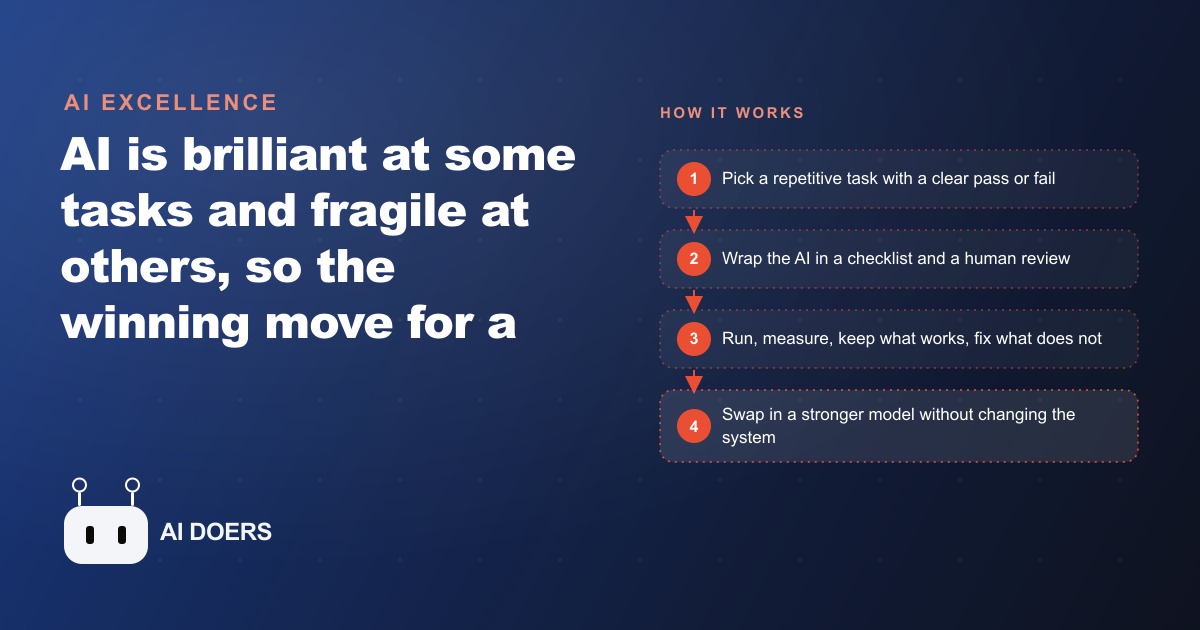
The owner who wins with AI over the next five years is not the one who found the best model. It is the one who built the best system, and the difference between those two approaches is already producing measurably different outcomes for businesses that have been deploying AI long enough to see the pattern clearly.
This argument became concrete watching how AI models behave when managing real money in live financial markets with real consequences. Most of them lost. The interesting observation was not about markets or trading at all. It was about what separated the deployment that performed consistently from the ones that did not. The winner was not running a better model. It was running a better harness: a structure that checked the model's outputs against clear criteria, maintained a deliberate feedback loop, and kept a human in the decision chain for anything with real consequences. The model was only as good as the structure built around it, and the structure was the constant that persisted as models were swapped in and out.
AI intelligence is jagged. This is not a flaw to wait for the next model update to fix. It is a description of how the technology works, and it changes the right way to deploy it in a business. Models that score at the top of standardized tests and produce elegant code solutions stumble on unstructured, context-dependent, real-world tasks in ways that are genuinely difficult to predict in advance. They are superhuman in specific narrow domains and surprisingly fragile in adjacent ones, often without producing any warning signal about which mode they are in. That jagged profile is what every small business owner is actually managing, whether they have named it that or not.
Intelligence is jagged and the implications are specific
What jagged intelligence means in practice is that you cannot evaluate an AI model once and trust that result to apply uniformly across all the tasks you might assign it. A model that writes clear, well-structured code may produce mediocre customer communications. A model that reasons precisely through a pricing calculation may give a confidently wrong answer on a question about contract terms. The shape of the capability is uneven, and the failures arrive without the clear signals that would let you prepare for them. A person who does not know something generally indicates uncertainty in some way, by hesitating, by qualifying the answer, by saying they are not sure. A model often produces fluent, confident text regardless of whether the answer is accurate. The failure mode is harder to catch precisely because it does not signal itself the way human uncertainty does.
For a small business, the practical consequence is specific. You cannot assess AI broadly, decide it is good enough for your purposes, and leave it running unsupervised on tasks that matter. You need to identify the specific narrow tasks it handles reliably, verify that reliability on real examples before depending on it, and keep a human review step on anything where a wrong output has real consequences for a customer, a relationship, or the business's finances. That review step does not need to slow things down. Ten seconds of scanning a draft reply is enough to catch most failures before they propagate. But the step needs to exist as a deliberate part of the workflow, not as an afterthought triggered only when something visibly breaks.
The jagged shape also has a competitive implication that is easy to miss. Businesses that understand the jag and aim their AI deployments precisely at the tasks it handles well are building systems that outperform the ones deployed with broad, optimistic assumptions. The owner who says "I need AI to handle customer communication" and deploys it everywhere does worse than the owner who says "I need AI to handle the first-response draft on quote requests" and builds a specific structure around that one task. Precision about the task is what makes the system reliable, and reliability is what produces compounding returns over time.
The harness is the constant, the model is the variable
The most useful way to think about how AI should work in a business is to separate the system from the model. The system is the car. The model is the driver. The car is your written checklist of what every output must include, your explicit instructions about what should never appear in a reply, and your human review step on anything a customer or a financial system will see. The driver is whichever AI model you plug in on any given day.
When a better model is released next quarter, you do not rebuild the car. You put a better driver behind the same wheel, and the system instantly performs at a higher level without any additional configuration work. You are building for the next model, not just the one available today. That framing resolves most of the anxiety about AI model churn, about whether to commit to a specific provider, about whether the model you chose today will be obsolete in six months. The answer is that it probably will be, and that is fine, because the system you built around it stays intact and immediately benefits from whatever comes next.
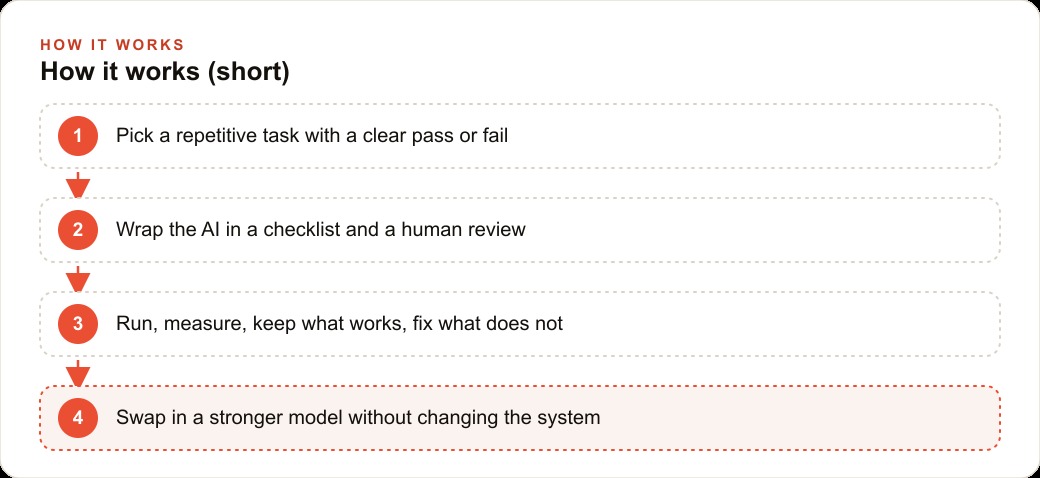
The feedback loop is what transforms the harness from a static structure into something that compounds over time. The loop is simple: try, measure whether the output meets the pass-or-fail standard, keep what works, fix what does not, and repeat. It does not require machine learning expertise or a data team. It requires the discipline to track what the AI produced and whether it was right, and to tighten the instructions when a specific type of error repeats. A business that runs this loop consistently on one task for six months ends up with a well-tuned, reliable system that new team members can learn from and new models run better in. A business that deploys AI and moves on gets the initial efficiency gain and then stagnates.
The pass-or-fail standard is the most critical element to define before starting. The feedback loop only works on tasks where you can honestly say one result is better than another. This requirement is actually liberating rather than limiting: it provides a clear filter for which tasks are ready for automation and which ones are not yet defined clearly enough to hand to any system, human or AI. If you cannot write down what a correct output contains, the task is not ready. Spend another week doing it manually while paying close attention to what makes each good version good. That observation period is itself the work that makes the automation reliable once you build it.
What building the right system looks like for a real business
A residential cleaning service that books jobs through a combination of web forms, referrals, and repeat customers receives forty to sixty quote requests per week during busy periods. Each one requires the owner or the office manager to read the request, assess the right price based on the home size, location, and service type, check against current scheduling availability, write a reply that is specific to the request rather than generic, and send it. The total time for this process: around three hours per week. The average response time: two hours from the moment the request arrives to the moment the reply goes out, because replies are batched rather than answered individually.
The right hill to start with is the quote reply. The output quality is clearly assessable: did the reply include the correct service type, an accurate price range, the right availability window, and a tone that matches the brand. Any reasonable person who understands the business can answer that question. That clarity is exactly what the pass-or-fail standard requires.
Building the car before choosing the driver means writing the standard before opening any AI tool. Write a one-page document: what every quote reply must include, the pricing structure for each home size and service combination, the scheduling windows available for new clients, the exact phrasing to use when a request falls outside the service area or above the maximum home size, and three or four example replies written in the business's own voice. This document is the system. Paste it into any AI tool as fixed instructions and add explicit human review before anything sends. That is the full harness, and it took under an hour to build.
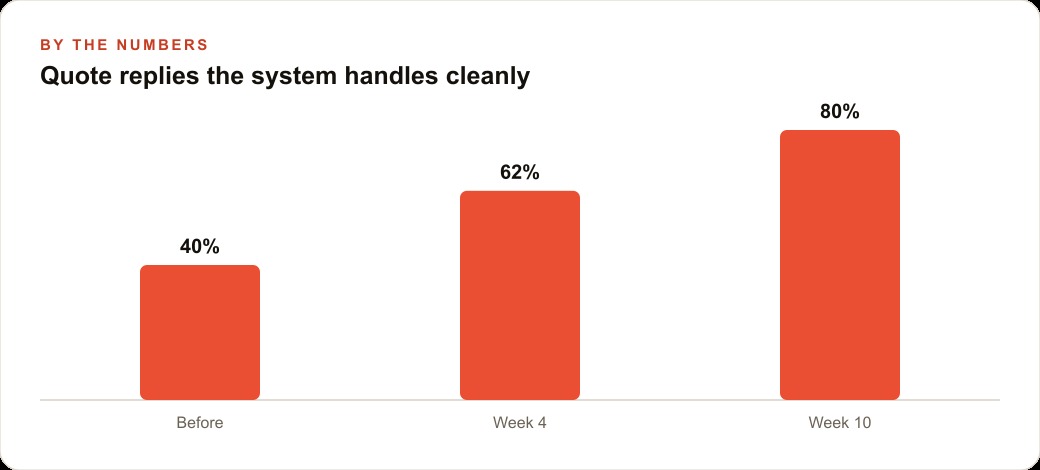
Run the loop. After the first week, look at the replies that needed the most correction and trace each one back to a gap in the instructions. Update the instructions to close that gap specifically. After a month of weekly reviews, look at whether the first-attempt quality has improved. It will have, and the improvement compounds with each tightening of the instructions. The corrections are the work, and they produce permanent gains rather than one-off fixes.
The payoff arrives in two forms simultaneously, which is what makes this worth building. The first form is time: three weekly hours of quote writing becomes thirty minutes of review and approval. The second form is revenue: the cleaning service that replies within five minutes of receiving a request consistently wins more bookings against competitors who reply in two hours, because the prospect typically contacted multiple services at once and often books with the first one that responds credibly. Speed of first response is a real competitive advantage, and the harness delivers it automatically because the draft is ready in under a minute from when the request arrives.
When a better AI model is available next quarter, the cleaning service owner changes one setting. The instructions stay the same. The review step stays the same. The loop stays the same. The replies get sharper overnight without any rebuilding. The system compounds, the model improves underneath it, and the business gets better results from the same process it already built. That is what it means to build the system rather than bet on the model, and it is the practice that separates AI deployments that keep delivering value from ones that peak at the demo and then drift.
The businesses that get this right are not the ones with access to the best models. They are the ones that spent the time to define what a correct output looks like, build a structure that reliably produces it, and maintain the discipline to keep the loop running. Those advantages accrue over months and compound in ways that are not visible from the outside until the gap between the businesses that built the system and the ones that did not becomes too wide to close quickly.
There is a practical exercise worth doing before building any AI workflow. For the task you are considering, write down what a perfect output would contain. Not approximately, but specifically: every element, every constraint, and two or three examples of the real output quality you are targeting. If that exercise takes more than thirty minutes and the document is still not clear, the task is not defined well enough to automate reliably. Spend more time doing the task manually while documenting your own reasoning. That observation period produces the instruction set that makes the harness work.
Once the harness is running on one task and delivering reliably, the compounding effect becomes visible in a specific way. The business has not just saved hours on one workflow. It has built a template for adding the next one and the one after that. Each new task added to the harness follows the same sequence, builds on the operational habits already established, and reaches reliability faster because the team already knows what the correction process looks like and how to run it. The gap between businesses that have built several well-tuned harnesses and those that have not built any keeps widening with each month, and it is not primarily a gap in which model is being used. The model is the variable. The system is the investment. Invest in the system.
That is exactly what we do at AI DOERS. Book a private 30-minute call with Madhuranjan Kumar and we will map the fastest path to it for your specific business.
Book your call →
Madhuranjan Kumar
Madhuranjan Kumar brings 20 years of performance-marketing experience and has managed over $200 million in Facebook ad spend for brands across the United States and beyond. His expertise spans the full modern marketing stack: Meta, Google Ads, TikTok, email automation, CRM, and the websites that hold it together. At AI DOERS he turns that track record into lead-generation systems for businesses across every industry.