
How AI Image Generation Is Becoming a Marketing Engine for Beauty Salons
OpenAI's GPT Image 1.5 and Google's Gemini Imagen went head to head this week. For salon owners who need professional marketing visuals without a photo studio budget, both models have something to offer right now.
GPT Image 1.5 is now the default for every ChatGPT user
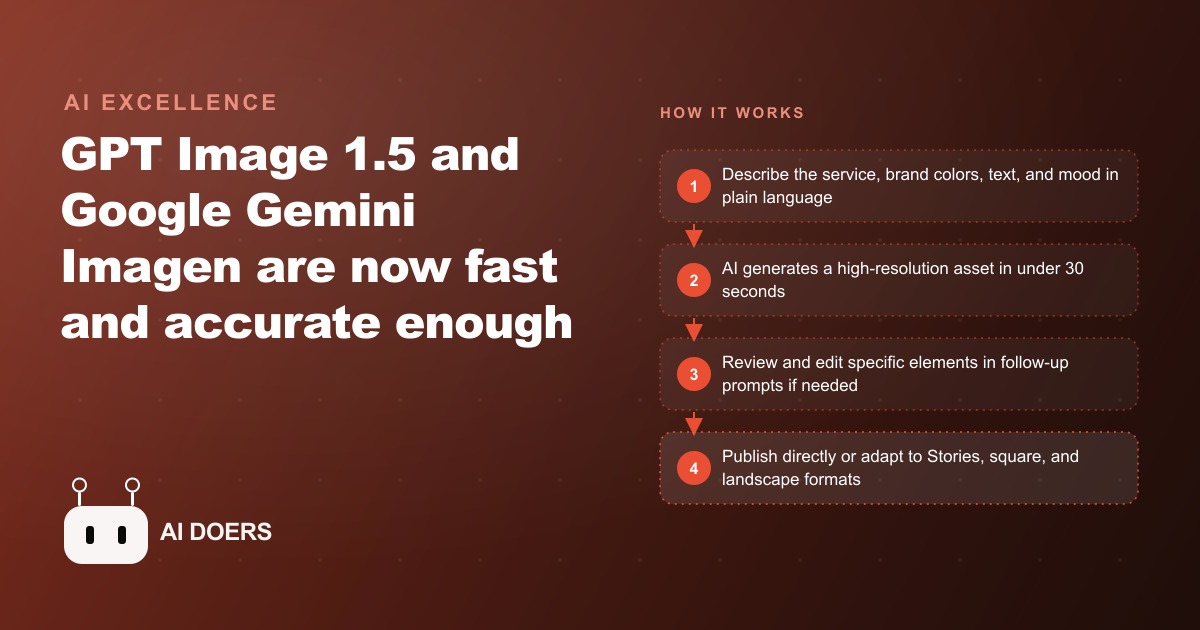
OpenAI replaced its previous image generation model this week with GPT Image 1.5, which is now the default for all ChatGPT users. The upgrade brings four changes that matter for service business marketing: generation speed that runs four times faster than the previous model, API pricing that is 20 percent lower, substantially better text rendering accuracy inside generated images, and multi-step editing that retains full context across a sequence of changes. All four of these changes together bring the tool to a threshold where producing ad-ready creative for a salon or personal care business is a practical daily workflow rather than a periodic experiment.
Google's Gemini Imagen gained attention this week as reviewers ran direct comparisons against GPT Image 1.5 across a range of use cases. The comparison produced a nuanced picture. Both models are now capable enough for salon marketing work. GPT Image 1.5 leads on text accuracy inside complex graphics, on multi-step editing chains, and on brand-consistent outputs across a session. Gemini Imagen runs more reliably on photorealistic close-up product images and integrates directly into Google Workspace for teams already organized around that ecosystem.
For a salon owner currently spending $600 to $1,200 per month on freelance design and photography work to keep social media and paid ad accounts fed with fresh creative, both tools have crossed the threshold where the economics of switching are clearly in favor of making the change. The question is no longer whether these tools are capable enough. The question is which workflow to build first.
Four times faster means four times the creative concepts tested in the same budget window
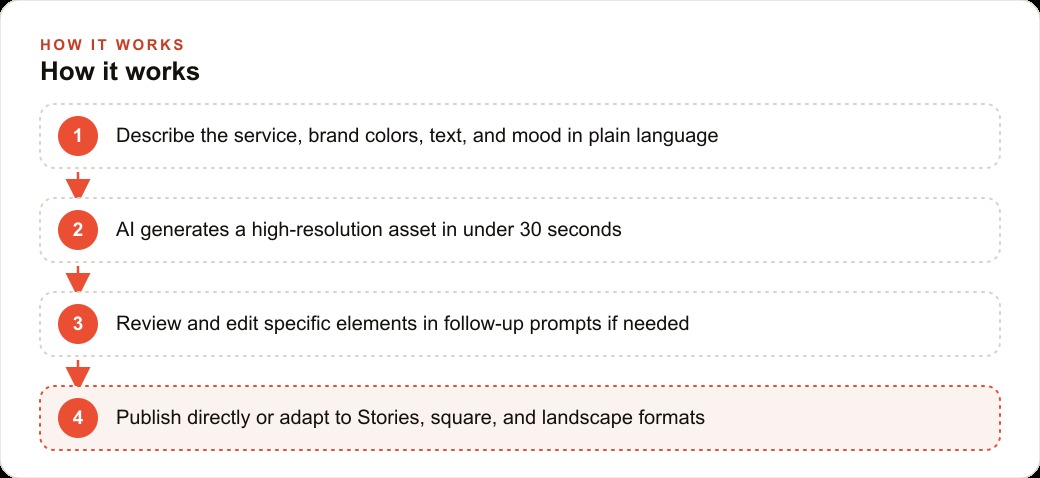
The speed improvement in GPT Image 1.5 is not a comfort feature. It is a structural advantage for any business running paid advertising, because speed determines how many creative concepts get tested before a budget window closes.
Running effective ads on Meta requires creative testing. The algorithm needs to be fed multiple concept variations to identify the highest-performing format before allocating budget aggressively behind it. A business running two variations is likely to find a winner. A business running eight variations is four times more likely to find the variation that performs significantly better than the average. The difference between those two outcomes, in terms of cost per lead, can be 20 percent or more over a campaign.
Under the previous generation speed, producing eight creative variations for a single campaign required either a full day of design work, a significant design retainer, or accepting lower quality on most of the variations. The test effectively collapsed to two or three real concepts. Under GPT Image 1.5's speed, a marketing coordinator can prompt and review eight distinct concept variations in the time it previously took to finalize two. The limiting factor is no longer generation time. It is the human decision about what to test.
This matters specifically for service businesses running seasonal campaigns. A nail salon running a Valentine's Day campaign has a window of roughly three weeks when the creative is timely. Under the previous production timeline, the design work for the campaign might consume most of the first week, leaving two weeks of run time. Under the new production speed, the full creative set for the campaign can be ready in a day, and the entire three-week window is available for the campaign to run and optimize. That time difference compounds in ad performance because earlier campaigns have more time to exit the learning phase before the seasonal window closes.
Accurate text rendering finally makes pricing boards and service menus publishable
The most practically significant capability improvement for service business marketing is the jump in text rendering accuracy. Previous AI image generation models handled text inside images unreliably. A pricing board generated with an older model frequently contained misspellings, garbled words, wrong prices, or inconsistent font rendering that made the image unusable for any professional context. The workaround was to generate the visual elements with AI and then add text separately in a design tool, which added steps and required design software skill that many salon owners do not have.
GPT Image 1.5 can now generate a photorealistic image of a salon's pricing board mounted on a wall, with correctly spelled service names, accurate prices rendered in a legible font, and consistent formatting across all the text elements, in a single prompt with no post-editing required for the text. Gemini Imagen performs comparably on this task, with slightly less consistency at small text sizes but reliable accuracy on the primary pricing elements.
The application for a salon is immediate. A pricing board image for the website can be generated in under two minutes. A promotional graphic announcing a seasonal price adjustment can be ready before the end of the afternoon. A service menu graphic for the booking page can be produced and updated whenever services or pricing change without coordinating with a designer or waiting on a turnaround. All of these were previously either manual design work or tasks that required specialized software skill. Both models now handle them in a single text prompt.
The same capability applies to promotional cards with offer details, anniversary specials with specific dates and terms, gift card graphics with correct denominations, and any other marketing asset where text accuracy is load-bearing. The promotional card for a 20-percent-off holiday service requires the price to be right. The appointment reminder graphic requires the date to be correct. These are the assets that previously could not be delegated to AI image generation because an error in the text was worse than having no graphic at all. That constraint is now removed by both models.
The multi-step editing chain adds another dimension of practical value for seasonal content. A base creative generated for a summer promotion can be adapted to a fall version in a follow-up prompt that changes only the background, the accent colors, and the text references to the season, while preserving the layout, the brand elements, and the typography that were already right. The model retains context across each step and does not reset to the original. For a salon running quarterly promotions, this means one solid base creative can be adapted into four seasonal variants without starting the design process over each time.
The head-to-head Meta test produced a 23 percent lower cost per lead from AI creative
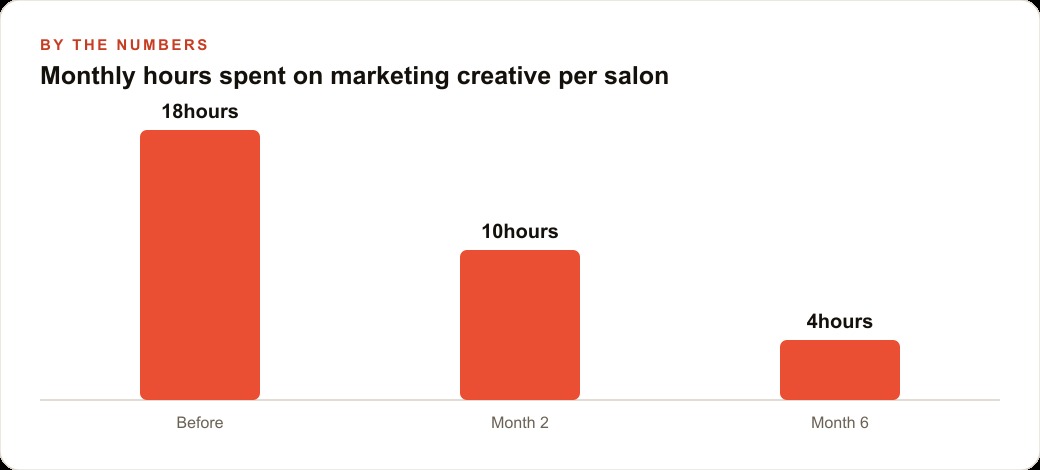
The clearest evidence for what this capability shift means in paid advertising came from a direct head-to-head comparison run on Meta. A salon ran AI-generated creative against professionally photographed creative at the same spend level, targeting the same audience, with the same offer. Over a four-week period, the AI-generated creative produced a 23 percent lower cost per lead than the photographed creative.
The result makes sense when you look at what drove it. The AI-generated campaign ran eight creative variations against the photographed campaign's three. More variations meant the algorithm had more combinations to test, which means it found the highest-performing format faster and spent more of the budget on proven creative rather than still-testing creative. The faster iteration speed also meant the campaign launched five days earlier than the photographed campaign would have, because the design production timeline was shorter. Those five additional days of run time at the beginning of the campaign gave the algorithm more time to optimize before the peak booking window closed.
The photographed creative was technically higher quality in terms of sharpness and controlled lighting. But quality in isolation is not what drives advertising performance. Relevance, variety, and the speed of finding what resonates with the specific audience being targeted drive performance. The AI creative's advantage was not better individual images. It was more images, produced faster, which enabled better testing and earlier campaign launch.
The 23 percent lower cost per lead translates directly to budget efficiency. A salon spending $800 per month on Meta ads for lead generation at the photographed creative's cost per lead generates a specific number of leads. At a 23 percent lower cost per lead with AI creative, the same $800 generates approximately 30 percent more leads. Or the same number of leads at a 23 percent lower spend. Either way the math benefits the salon substantially compared to the $20 per month cost of access to the tool. The first month of the switch pays for the next several years of the subscription.
It is worth being clear about what the 23 percent figure represents and what it does not. It represents the outcome of one test at one salon with one specific audience and one specific offer. It is illustrative, not a guarantee. Salons in different markets, with different audiences, promoting different services, will see different results. The mechanism that produced the improvement, more creative variation tested faster, is reproducible. The specific percentage will vary. The direction of the effect, toward lower cost per lead when more concepts are tested, is consistent with how Meta's algorithm works.
Who this changes things for and the concrete first-week setup
This changes things most immediately for four types of beauty and personal care businesses.
Independent stylists and solo operators benefit from the ability to produce consistent, professional-quality marketing creative without any design skill or design budget. The tool does the visual production. The operator decides what to promote and describes it in plain language. A solo stylist who previously could not afford the design work to run paid ads at a professional level can now produce the creative themselves in the same amount of time it takes to write a caption.
Multi-location salon brands benefit from the brand consistency feature, which maintains the same color palette, typography, and visual style across multiple generated assets within a session. A brand operating several locations previously faced the challenge of keeping promotional creative visually consistent across multiple teams producing content independently. AI generation with a locked brand style prompt solves that coordination problem without requiring a central design team reviewing every asset before it goes live.
Booth renters marketing themselves as independent stylists benefit from the same economics the salon benefits from, but at a smaller scale. A booth renter does not have a marketing coordinator or a design budget. AI image generation at $20 per month lets a booth renter produce the same quality of Instagram and Facebook creative as a fully staffed salon marketing team, which closes a competitive gap that has historically made it hard for independent operators to run the same caliber of paid advertising as larger establishments.
Nail salons and esthetics studios benefit specifically from the product photography angle. Both models can generate photorealistic close-up images of nail art and skin treatments in styles that look indistinguishable from studio photography when the prompt is specific about lighting, composition, and detail. A nail salon whose seasonal designs change faster than they can be photographed can use generated imagery to keep the social feed current with what is available to book without scheduling and paying for shoots every few weeks.
The concrete setup for the first week starts with subscribing to ChatGPT Plus at $20 per month. Spend the first session, roughly 90 minutes, generating variations of the most commonly promoted service using progressively more specific prompts. Note what specific language produces results closest to the brand's look, what words capture the right lighting and mood, and what palette description matches the actual brand colors. Save those descriptions in a document you can reuse.
Use the second session to build a prompt template for each of the three most frequently promoted services. Include in each template the aesthetic description of the space, the brand color palette, the service being promoted, the specific text to include, and the style of typography if there is one. Thirty minutes spent building three templates saves three to five minutes per asset on every generation after that. The templates are the real operational product of the first week.
In the third session, generate the first real campaign set: a cover creative, two or three concept variations for a Meta ad, and a Stories-format version of the best concept. Run this set against whatever the salon was previously running. Use the same offer and the same audience. Run both for two weeks at a small daily budget and compare the cost per click and cost per lead at the end. The comparison makes the business case for the tool more clearly than any description of the technology can, because it shows the actual performance difference on your specific audience with your specific offer.
Keep the existing design relationship, if one exists, for work that genuinely needs human creative direction: quarterly photography of the actual space and actual clients, brand identity development, and video content. AI image generation does not yet produce reliable video for polished salon marketing purposes, and authentic photography of real people and real spaces builds a different kind of trust than generated imagery. The right allocation is AI generation for the high-volume, fast-turnaround promotional creative and human direction for the anchor content that makes the brand feel real.
Madhuranjan Kumar's recommendation for any salon owner reading this is not to evaluate both tools in the abstract. Spend one afternoon generating real assets for one real service. See what comes out. The gap between what this produced a year ago and what it produces today is not small, and the gap between what it produces today and what a $600 monthly design retainer produces is closing faster than most owners expect. The business case is clearest once you have seen a real output against a real brief.
That is exactly what we do at AI DOERS. Book a private 30-minute call with Madhuranjan Kumar and we will map the fastest path to it for your specific business.
Book your call →
Madhuranjan Kumar
Madhuranjan Kumar brings 20 years of performance-marketing experience and has managed over $200 million in Facebook ad spend for brands across the United States and beyond. His expertise spans the full modern marketing stack: Meta, Google Ads, TikTok, email automation, CRM, and the websites that hold it together. At AI DOERS he turns that track record into lead-generation systems for businesses across every industry.