
How Roofing Companies Can Use AI Image Editing to Win More Bids and Build a Stronger Brand
Google's new Nano Banana Pro image model delivers capabilities that go far beyond generating pretty pictures. For roofing contractors, it is a practical tool for bid presentations, before-and-after marketing, brand building, and social media content.


Roofing contractors who are waiting for AI image tools to get good enough are solving a problem that stopped being a problem six months ago.
I am Madhuranjan Kumar, and I want to make a case here that I have not seen made clearly anywhere else: the AI image tools that matter for roofing contractor marketing are already past the quality threshold, have been for months, and the delay in adopting them is not caution. It is compounding cost. Every week a contractor waits is a week a competitor spends building a visual library the first contractor cannot quickly replicate. The gap is not narrowing. It is widening. I want to be specific about what I mean and direct about the objections, because the objections are real and deserve an answer rather than dismissal.
Roofing is still selling trust door-to-door while competitors build it visually at scale
The dominant sales motion in residential roofing is still proximity and timing: the storm rolls through, the contractor knocks on doors in the affected neighborhood, the homeowner sees the truck in the street, and the sale is made on credibility signals that are local and immediate. That motion still works and will continue to work for storm-driven volume.
The problem is the second sales motion, the one that determines whether a homeowner who is not in an active emergency calls one contractor or another when they decide proactively to replace a ten-year-old roof or add a new addition. In that situation the homeowner goes online, looks at social feeds and websites, and builds a shortlist before a single phone call is made. The contractors who have a visual portfolio demonstrating their quality and range of project types appear on that shortlist. The contractors who have a Facebook page with twelve posts from 2022 do not.
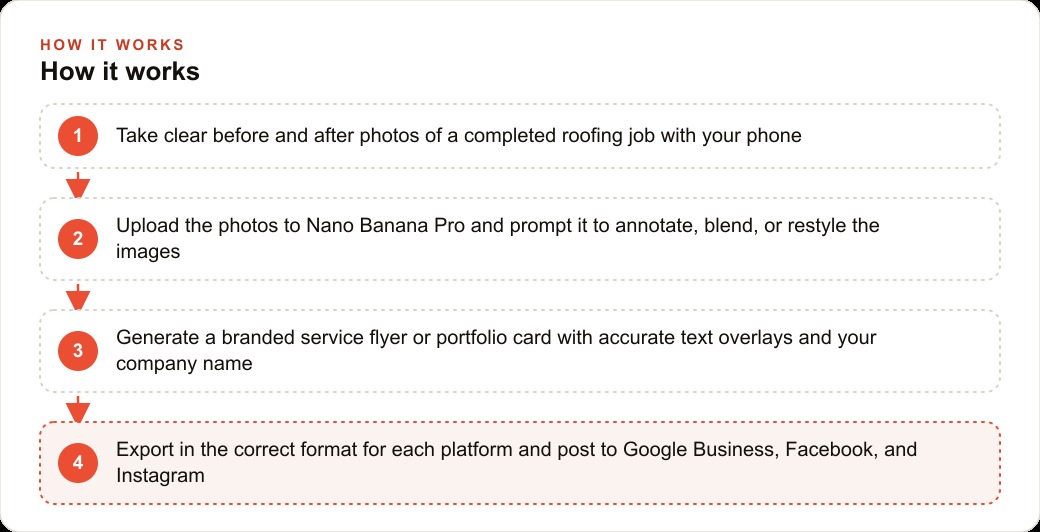
Building visual presence used to require either professional photography on every job site or a marketing coordinator whose job was to document work in progress. AI image tools change the economics of that calculation completely. A contractor can now take a set of job photos from a phone, use AI tools to annotate them, produce finished before-and-after comparisons, and build a week's worth of marketing assets in an afternoon that previously required a photographer, an editor, and a half-day shoot.
The text-on-image failure that blocked contractors was fixed and almost nobody noticed
There was a legitimate technical problem with AI image generation tools through most of 2023 and into 2024: they could not render legible text on images. Any time you asked a tool to include a contractor's name, a phone number, a service label, or a call to action on the image, the text came out distorted, misspelled, or visually broken in ways that made the image unusable for advertising. This was a real barrier for roofing marketing, where job photos often need the company name or a service label overlaid to function as ads rather than just portfolio shots.
That problem is solved. The current generation of AI image editing tools handles text on image cleanly, including custom fonts and brand colors if specified. The fix happened in stages through 2024 and 2025 and was not announced loudly because the improvements were incremental rather than sudden. Most contractors who had an experience with a text-garbling tool in 2023 have not gone back to check whether the same failure is still present. It is not. The barrier that most contractors remember as the reason AI image tools did not work for them has been removed. The tools they wrote off in 2023 are categorically different from what they experienced.
The practical implication is that contractors who dismissed these tools after a bad early experience are now making a decision based on outdated information. The product they tried no longer exists in the form they tried it.
An annotated job photo does more selling work than a clean shot from any angle
A raw job photo from a roofing project shows the finished roof. If the photo is good, it shows the quality of the installation. What it does not show is the specific selling points that distinguish one contractor from another: the flashing detail around the chimney, the valley treatment, the underlayment brand, the gutters cleaned as part of the job, the fact that zero nails ended up in the landscaping.
An annotated job photo shows those details. Arrows pointing to specific elements with short labels, a brief caption explaining why each detail matters to the homeowner. AI tools can take a raw job photo and add these annotations in minutes, producing an image that works harder than a clean shot because it teaches the homeowner what to look for and simultaneously demonstrates that this contractor produces work at that standard.
This is not fabrication. The annotations point to real elements in a real photo. The labels are accurate descriptions of real work. The difference between the raw photo and the annotated version is the difference between showing and explaining. In a market where most homeowners have no framework for evaluating roof quality before they pay for one, explaining is what drives the call. The clean shot shows capability. The annotated shot demonstrates expertise, which converts at a different rate.
The authenticity objection is real but it is being applied to the wrong content
The most common objection I hear from roofing contractors about AI image tools is that using AI to create or enhance images feels inauthentic, and that homeowners who discovered this would feel deceived. This objection deserves a direct answer because the underlying concern about trust is legitimate and roofing is entirely a trust business.
The problem is that the objection is being applied to the wrong content. There are two distinct categories of AI image use in roofing marketing with completely different authenticity implications.
Category one: AI-generated images of roofs that were not actually installed by the contractor. AI-rendered houses with perfect roofs. AI-composited before-and-after images using stock photography. AI-generated social content showing projects that do not exist. This category is deceptive. A homeowner who discovers that the work shown was not real work done by that contractor would have every reason to feel misled. I am not advocating for it and I am not describing it as marketing.
Category two: AI-enhanced images of real work. Compositing fourteen actual job photos into one representative image. Annotating a real job photo with accurate labels. Cleaning up the lighting or composition of a real photo taken on an overcast job day. Generating a before-and-after comparison from actual photos of the same property. This category is marketing, not fabrication. The contractor's work is real. The tools are helping show that real work more clearly and effectively than an unedited phone photo would.
Photographers have been editing job photos in Lightroom and Photoshop for decades: correcting exposure, removing distracting background elements, adjusting color to match what the eye saw rather than what the sensor captured. Nobody argues those edits are deceptive because the underlying work they document is real. AI editing tools are a faster version of the same category of activity. The authenticity objection applies cleanly to category one. It does not apply to category two. The contractors who are delaying because of this objection are usually thinking about category one when they could be using category two freely.
Compositing 14 real job photos into one image is marketing, not fabrication
A roofing contractor with two years in business has hundreds of real job photos sitting in a phone camera roll or a shared drive, rarely organized and rarely used for marketing. Those photos represent real work, real quality, and real range across different materials, architectural styles, and project scales. The barrier to using them is not a shortage of documentation. It is the effort of turning a disorganized collection into something that communicates effectively.
AI compositing tools can take fourteen real photos from different jobs and produce a single representative image showing the contractor's range: different roofing materials across different house styles at different project scales. Every element in the composite is from real work. It is no different from a designer selecting and arranging the strongest images from a project shoot to build a portfolio page. The composite is more effective than any single photo because it shows breadth in one frame, but it is entirely authentic because every element in it is documented real work.
The alternative is showing one photo at a time and hoping the homeowner infers that the contractor has done many types of jobs. The composite shows that directly and immediately. For a homeowner scrolling a social feed at eleven at night deciding which two contractors to call in the morning, the composite wins the shortlist position in a way that a single photo almost never does.
The visual portfolio gap is compounding every week the decision gets deferred
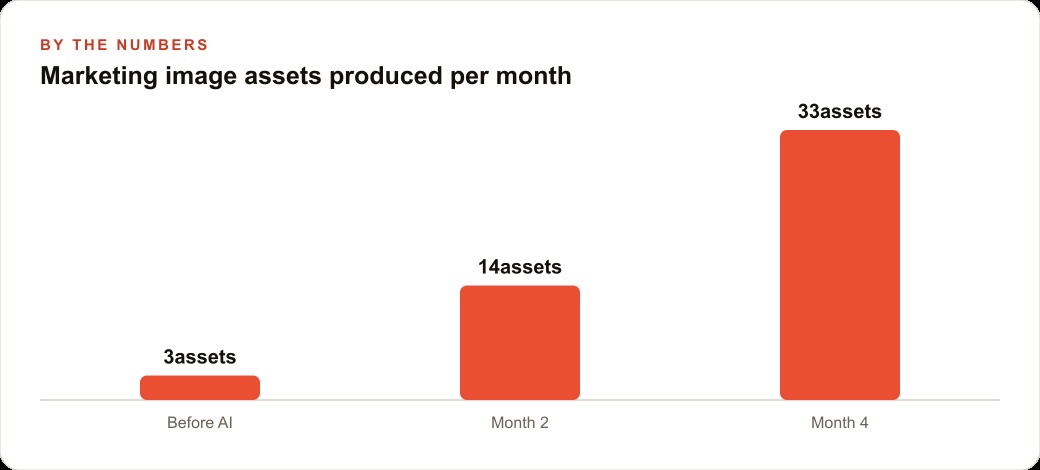
A contractor who begins using AI image tools this week will have a visual library of several dozen polished marketing assets within the first month. A contractor who waits six more months will have spent those months watching competitors build visual libraries that become increasingly difficult to catch up to.
The compounding is real and it works through multiple channels simultaneously. A social feed with consistent, high-quality content builds algorithmic momentum that a new feed starting today cannot instantly match. A website project gallery with thirty well-documented jobs builds image search presence and inbound links that take months to replicate regardless of how quickly new content is produced. A contractor who has been posting annotated job photos since January has a search footprint in March that a contractor starting in March cannot match until late fall.
This is why the delay is expensive rather than merely suboptimal. It is not just the bids missed this month. It is the accumulated algorithmic and reputational position the early movers are building that late movers will spend significant calendar time to close, regardless of how much effort they put in.
What the contractor who moves first actually gets that a follower cannot copy
Speed matters in visual marketing because the assets built early compound in ways later production cannot replicate. A contractor who began building a visual library in January has January's job photos annotated and posted, February's composites indexed by search engines, and March's before-and-afters accumulating engagement history. That library grows each month and tells a story of consistent documented work over time. A new library, however well-produced, cannot tell that story because it has no history to show.
The concrete math on the value of that positioning: a contractor producing three marketing images per month using manual methods has thirty-six images after a year. A contractor using AI tools to process job photos is realistically producing thirty to forty usable images per month. After one year the second contractor has four hundred or more images in active circulation, many indexed by search, many linked from other sites, some generating consistent social engagement.
If one in fifteen bids converts for the typical residential roofing contractor, and if a developed visual presence generates two additional qualified homeowner inquiries per month, that is twenty-four additional bid opportunities per year. At typical residential roofing job values, the economic case for building the visual library is not close. The contractor who moves first is not just building a portfolio. They are building a compounding sales asset that grows in value every month and that a follower who starts six months later cannot replicate in six months, because the follower does not have six months of indexed search history, platform engagement, and algorithmic momentum to match. That is the asset the early mover has that cannot be purchased or shortcut. It can only be built by starting. The contractor reading this in 2026 is still early enough to build it before the approach becomes standard practice across the industry. That window is narrower than it was six months ago and narrower than it will be six months from now.
That is exactly what we do at AI DOERS. Book a private 30-minute call with Madhuranjan Kumar and we will map the fastest path to it for your specific business.
Book your call →
Madhuranjan Kumar
Madhuranjan Kumar brings 20 years of performance-marketing experience and has managed over $200 million in Facebook ad spend for brands across the United States and beyond. His expertise spans the full modern marketing stack: Meta, Google Ads, TikTok, email automation, CRM, and the websites that hold it together. At AI DOERS he turns that track record into lead-generation systems for businesses across every industry.