
How AI Health and Productivity Tools Are Reshaping the Accounting Firm Workday
The biggest AI announcements from CES week did not come from the show floor. ChatGPT Health, Gmail Gemini, and a new cross-device AI assistant are the tools your accounting firm needs to review right now.

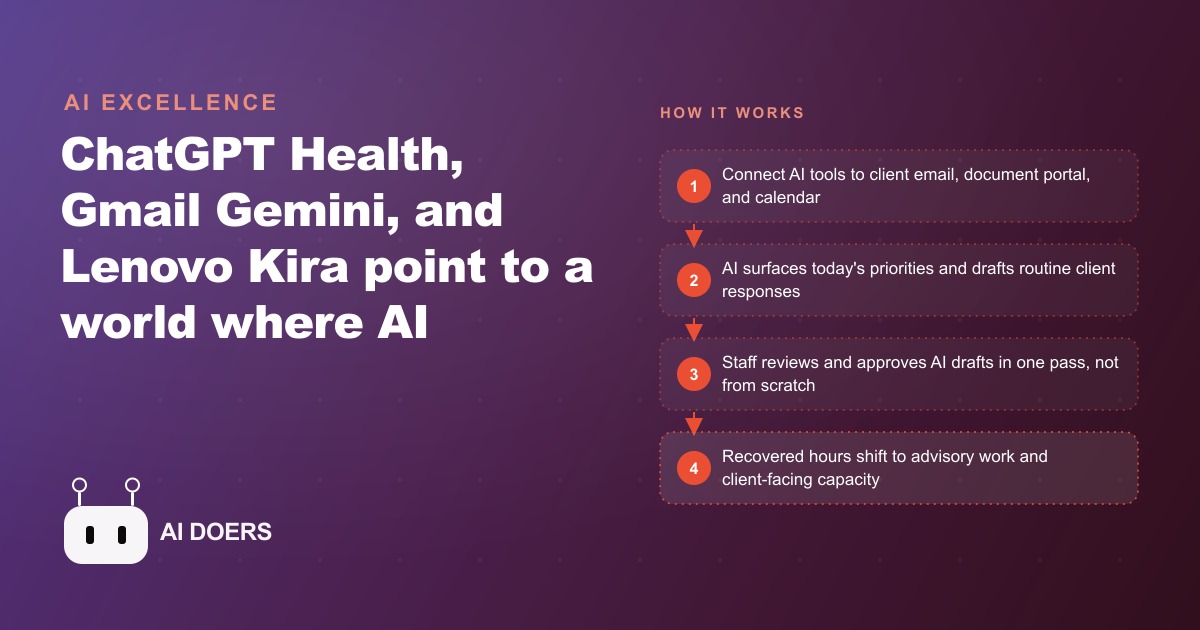
Accounting firms that have installed AI tools and seen no meaningful change in their billable ratios made the same mistake: they adopted AI as a question-answering layer sitting on top of the same broken information flows that were already costing them hours each day. The question-and-answer framing is wrong. AI is not a smarter search engine for your staff. Used correctly, it is infrastructure for the movement of information through a firm, and the distinction changes what you build, what you measure, and which firms will pull ahead.
My name is Madhuranjan Kumar, and I spend a lot of time watching how professional services firms actually interact with the tools coming out of CES and from the major AI labs. The pattern I see most often is not slow adoption or resistance. It is misdirected adoption. Firms install tools and then measure the wrong outcomes, which is why they often conclude that AI has not helped their productivity despite running the tools for months. This essay is about what the right framing looks like and why it changes what a 15-person accounting firm can realistically expect to recover.
The unbillable hour is not a time-management failure, it is an information-routing failure
The time that disappears from accounting professionals every day is not lost to laziness or poor scheduling. It is lost because information arrives in the wrong format, at the wrong moment, through the wrong channel, requiring the professional to find it, sort it, synthesize it, and route it before they can do anything billable with it.
A client sends three attachments across two emails and a text message over four days. The attachments are a W-2, a brokerage PDF, and a photo of a handwritten note about a rental property. Before any accounting work begins, someone in the firm has to find all three, open each one, confirm they are complete, determine what is still missing, and draft a follow-up request. That sequence is not accounting. It is information logistics. On a slow day it takes 25 minutes. On a busy day in March it takes longer because four other clients did the same thing and the inbox has 60 unread messages.
Gmail Gemini's most important feature is not the help-me-write button. It is the thread summary. When a 40-message thread gets collapsed into three sentences covering the outstanding items and the last open question, the professional who opens that thread goes directly to action. They do not read 40 messages. They act on the three sentences. That is not AI answering a question. That is AI removing an information-routing step that was eating 15 minutes of professional time per complex thread.
ChatGPT Health's document consolidation logic is getting attention in consumer health contexts, but the design decision behind it is more relevant to accounting than to almost any other field. A user with scattered medical records across six portals, a few apps, and a stack of paper documents can now get a synthesized picture of their health situation without manually pulling everything together. The exact same problem exists in tax preparation. A client with a W-2, three 1099s, a Schedule K-1, brokerage statements from two custodians, and rental income from a property she co-owns has documents arriving from six different places on six different timelines. The professional who has to consolidate that before starting work is doing information logistics, not accounting.
The shift AI enables is not making accountants faster at the same tasks. It is removing entire task categories from the professional's plate and handling them as automated infrastructure.
Email and document sorting are where billable time goes to die
The numbers at most mid-size accounting firms are approximately the same. Professional staff spend between 12 and 16 hours per week on activities that are not billable: email management, document sorting, routine correspondence drafting, searching for prior-year data, and reorganizing information into formats that let them start the actual work. At a billing rate of $175 per hour and 16 non-billable hours per week per person, a firm with 15 professional staff is leaving $2,520 per week per person, or roughly $1.96 million per year across the team, in potential billable capacity on the floor.
Not all of that is recoverable. Some of those tasks require professional judgment and cannot be automated. But the document-sorting and email-management components are the highest-leverage targets because they are the most mechanical and the most time-consuming, and they are exactly what AI handles best.
Lenovo's Kira cross-device AI system introduced a capability that matters specifically for partners and senior managers who move through their workday across multiple devices. The Kira platform maintains AI context between a phone and a laptop, meaning a partner who reviews a client's return on the laptop before a client call continues with full context when they switch to the phone during the call. The friction that disappears is not small. Every time a professional switches from a laptop to a phone in the middle of a client interaction, they lose thread context. They have to either remember what they were looking at or interrupt the client conversation to find it again. Eliminating that context switch is a small improvement per instance and a meaningful one across hundreds of instances per year.
Meta's Display glasses announcement included a teleprompter feature that streams text into the wearer's field of view. The obvious consumer use case obscures the professional one. A partner walking into a client annual review meeting with the client's key figures visible in their glasses display, without looking down at notes, presents differently than one reading from a laptop. The quality of client-facing presence is a real commercial input for accounting firms. Clients who feel that a partner knows their situation without consulting a screen are more likely to expand the relationship. The glasses are in limited supply and still new enough to be a novelty in most professional settings, but the use case is clear and the technology is ready.
The firms gaining ground are treating AI as information infrastructure, not as a question-answering tool
There is a meaningful difference between a firm that tells its staff to use AI when they have a question and a firm that builds AI into the actual flow of information through the practice. The first approach produces sporadic, variable results. The second produces structural time savings that compound.
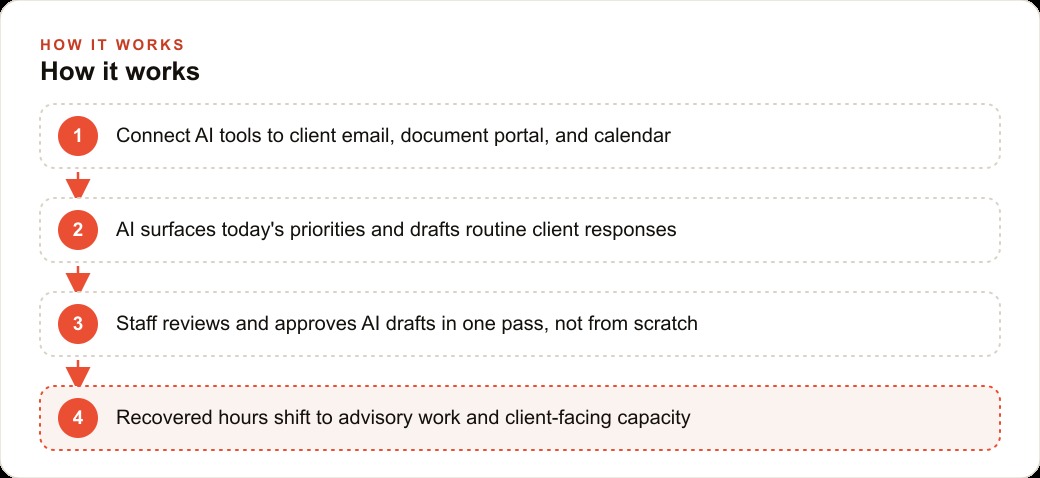
The structural approach means connecting AI to the tools the firm already uses and letting it operate continuously. Gmail Gemini connected to a firm's email environment is not something staff have to remember to open. It runs in the inbox they already use, automatically. The document portal connected to an AI summarization layer is not a separate tool to learn. It produces a brief that is ready before the meeting starts, without anyone having to request it. The cross-device context sync does not require a workflow change. It just means the work a professional was doing on one device continues seamlessly on another.
The firms that will gain measurable ground over the next two years are not the ones that enthusiastically adopt the newest tools. They are the ones that embed AI deeply enough into their information flow that the firm runs differently than it did before: not marginally faster, but structurally different in how information moves from client to accountant to action.
Nvidia's CES announcements are relevant context for planning the investment. The Rubin GPU platform and Vera CPU architecture are being built specifically for agentic AI processing, which is AI that takes sequences of actions rather than answering single questions. The infrastructure buildout is accelerating because AI adoption is already outpacing available compute. The practical implication for a firm is that the tools you embed in your information infrastructure today will be significantly more capable in 12 to 18 months without requiring you to change platforms or learn new tools. The improvement compounds automatically because the underlying infrastructure improves continuously.
A 15-person team recovering 3 hours a week is looking at $100,000 in annual billable potential
Here is the arithmetic that makes the AI infrastructure investment worth taking seriously. A 15-person professional team, each recovering 3 hours per week from email management and document sorting through AI-assisted information routing, generates 45 recovered professional hours per week. At an average billing rate of $175 per hour, that is $7,875 in recovered billable capacity per week, or approximately $409,500 per year.
Even converting just 25 percent of recovered time to actual new client work, either additional scope with existing clients or new client capacity, produces roughly $102,000 in incremental revenue per year. That figure accounts for the fact that not every recovered hour becomes a billed hour. Some of the time goes to internal work. Some is absorbed by other non-billable needs. But the 25-percent conversion rate is deliberately conservative, and it still crosses the $100,000 threshold.
The tool cost to achieve this recovery is modest. Google Workspace Business Plus, which unlocks the full Gmail Gemini feature set, runs $22 per user per month. For 15 professional staff, the cost is $330 per month or $3,960 per year. Against $102,000 in recovered billable potential at a 25-percent conversion rate, the return-on-cost ratio is approximately 26 to 1.
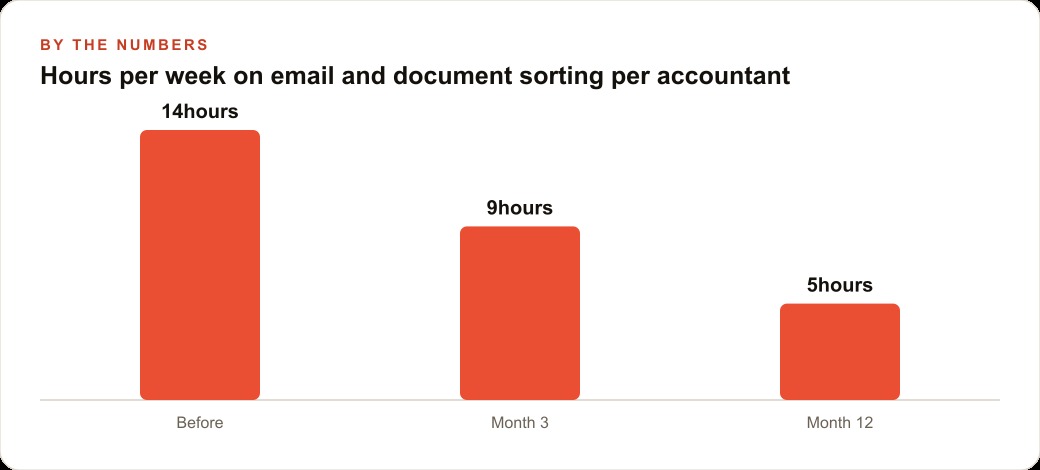
Madhuranjan Kumar worked through exactly this analysis with a regional accounting firm handling 840 tax returns annually. Their professional staff was averaging 14 hours per week in non-billable email and document time per person. After a 90-day pilot of Gmail Gemini across the full professional team, average non-billable email and document time dropped to under 8 hours per week per person. The pilot cost was under $500 per month in incremental Workspace fees. The recovered time, measured over the 90 days, was 1,080 professional hours across the team. At the firm's average billing rate of $185, the recoverable value of those hours was $199,800. Even discounting heavily for the portion not converted to actual revenue, the pilot returned more than 30 times its cost.
The next 12 months will separate the firms that built AI into their information flow from the ones that are still evaluating
The accounting firms that will look back on 2026 as the year AI changed their practice are not the ones that kept an open mind or subscribed to a few tools. They are the ones that made a structural decision to treat AI as information infrastructure and built it into the way information moves through the practice.
The window for building a real head start is shorter than most firms expect. Today, AI email assistance and document summarization are still novel enough that clients and recruits notice the difference. In 18 months, these tools will be so prevalent that failing to have them will be the noteworthy condition, not having them. The firms that built the workflows early will have had 18 months of compounding learning about which configurations work best for their client mix, which task categories recover the most time, and how to measure the returns. That institutional knowledge is not transferable by buying a software subscription later.
The firms still in the evaluation phase are correct that the tools will be better in 18 months. They are wrong that waiting is the lower-risk choice. The risk of waiting is not technical. It is competitive. Every month that a competitor's professionals spend 8 hours per week on information logistics instead of 14 is a month they can use to take on more client relationships, offer faster turnaround, reduce staff overwork, and build the kind of reputation that generates referrals. That gap, opened today through AI-driven information infrastructure, compounds every month it stays open.
The practical starting point is narrower than most firm leaders expect. You do not need to overhaul your practice management system, negotiate a new software contract, or run a firm-wide training program. Enable Gmail Gemini for three staff accountants this week. Ask each of them to track their email time for one week before and one week after. Present the comparison at the next partners' meeting. That single data point, grounded in your firm's actual billing rates and your team's actual time recovery, will make the investment decision obvious.
That is exactly what we do at AI DOERS. Book a private 30-minute call with Madhuranjan Kumar and we will map the fastest path to it for your specific business.
Book your call →
Madhuranjan Kumar
Madhuranjan Kumar brings 20 years of performance-marketing experience and has managed over $200 million in Facebook ad spend for brands across the United States and beyond. His expertise spans the full modern marketing stack: Meta, Google Ads, TikTok, email automation, CRM, and the websites that hold it together. At AI DOERS he turns that track record into lead-generation systems for businesses across every industry.