
AI Can Now Finish a Whole Project in One Shot. Here Is How to Use It.
The newest AI hands back finished projects, not snippets. For a small business that means building brochures, plans and pages you used to hire out, in an afternoon.
Six months ago, a small bakery would have needed a marketing coordinator, a graphic designer, and a freelance copywriter to run a proper holiday campaign. Last November, the owner of a single-location bakery did it in a single afternoon using one AI prompt and two rounds of follow-up notes. The total out-of-pocket cost was less than the cost of a tank of gas. I am Madhuranjan Kumar, and I want to walk through that process in detail because the numbers and the method are more instructive than any general description of what AI can now do.
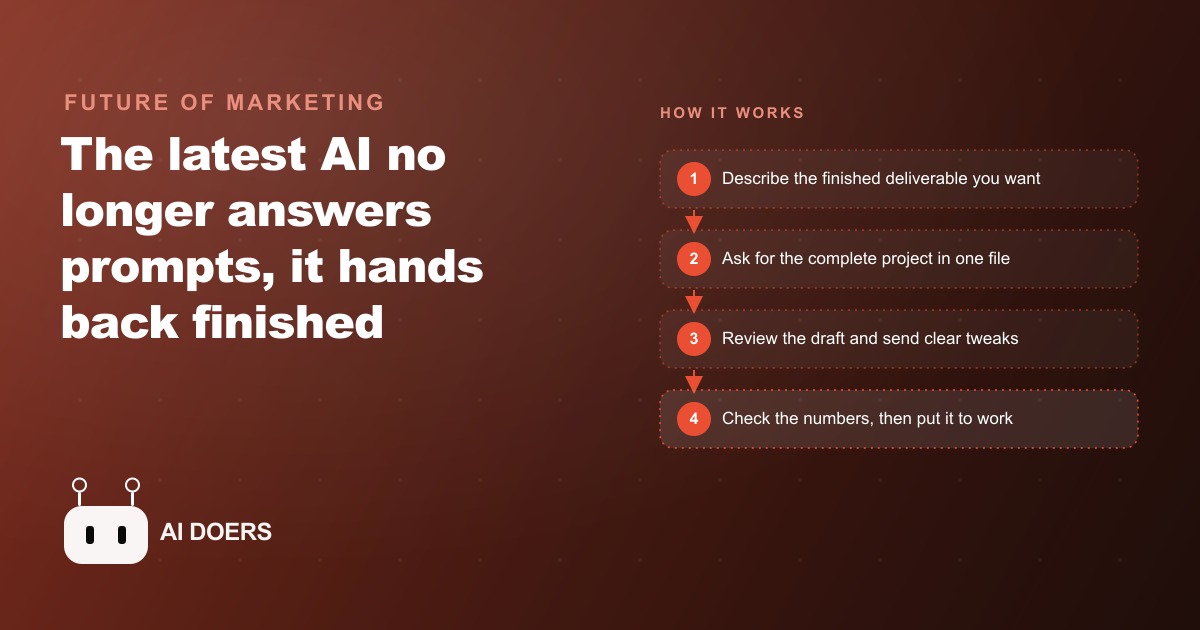
The shift that made this possible is not a small one. The newest AI models do not return snippets or suggestions. They work through a complete task and hand back a finished product, the kind you used to commission from a specialist. Brochures, financial models, web pages, full campaign plans, and even working software applications have all been delivered complete in blind professional evaluations where experienced practitioners graded the work without knowing its source. The AI won outright more often than not and matched or beat the human professionals roughly three quarters of the time. For a bakery, a salon, a retail shop, or any small business that regularly needs polished materials but cannot justify hiring specialists for each project, this is a structural change in what a single person can accomplish in an afternoon.
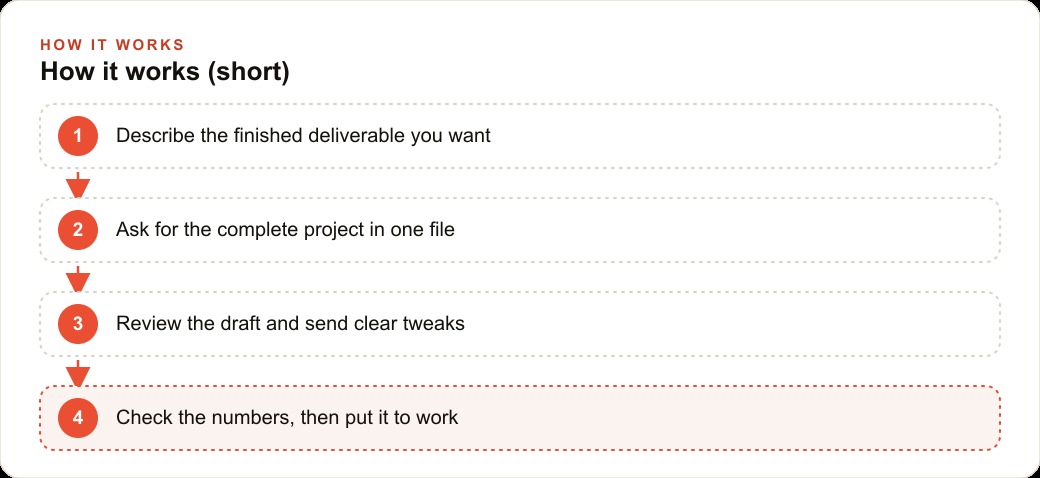
The skill that unlocks this is not technical. It is the ability to describe a finished deliverable clearly, recognize when a draft is strong versus when it needs specific revision, and ask for improvements that are concrete rather than vague. The rest is the AI's job.
The brief: a full holiday campaign in an afternoon with no marketing coordinator
The bakery in this story sells cakes, pastries, and fresh bread from a single storefront. The owner handles operations, purchasing, and most of the marketing personally. Around the first week of November, the decision was made to run a proper holiday push: a printed menu for the window and counter, a landing page for pre-orders of custom holiday cakes, a week of social media posts tied to each specialty item, and a production planning sheet to help the team buy the right quantities of ingredients for the expected order volume.
In previous years, the printed menu had been a rushed document done the night before the campaign started. Social posts had been sporadic, mostly phone photos with whatever caption came to mind. There had never been a proper pre-order page, which meant holiday cake orders arrived through calls, texts, and in-person conversations and were tracked in a notebook. Production planning was guesswork based on the previous year's memory.
The owner had started using an AI tool for simpler tasks earlier in the year and had found it saved meaningful time on routine writing and helped with the bakery's SEO and organic search presence. For the holiday campaign, the goal was to use it for something more ambitious: four complete deliverables instead of a series of disconnected small tasks.
The brief was written out over about 20 minutes. It described the bakery by name, listed the five signature holiday items with their prices, noted that the brand voice was warm and home-bakery in tone rather than corporate, identified the audience as local families and gift-buyers, and stated each deliverable explicitly. The prompt ended with a clear instruction to return every deliverable as a complete finished product in a single response rather than piecemeal output.
The first handoff: what a one-paragraph prompt returned
The AI returned all four deliverables within the same session. The menu was a complete two-column layout with the five items, their prices, a short description of each, and a closing line about pre-order availability, formatted for direct use in a print layout. The pre-order landing page was a full single-page HTML file with the bakery name, a short seasonal story, a product list, and a clear order call-to-action. The social posts were seven drafts, one for each day of the first week of the campaign, each tied to a different menu item and ending with a prompt to visit the pre-order page. The production planning sheet was a spreadsheet with the five items as rows, columns for expected order quantity and batch size, and quantities of flour, butter, sugar, eggs, and packaging materials, with every formula written out clearly and auditable line by line.
The menu copy was accurate and warm. The landing page structure was sound. At least four of the seven social post drafts were usable without changes. The production sheet had every calculation correct and clearly labeled.
Three things needed adjustment. The landing page did not include the bakery's phone number or address in the footer, which the owner wanted there for people who preferred to call or pick up in person. One social post used the word "artisanal" twice in consecutive sentences, which felt off-brand. The production sheet did not include a column for packaging costs, which the owner tracked separately from ingredient costs.
This first-pass quality, strong but not quite finished, is consistent with how this generation of AI performs on real professional deliverables. The output is significantly better than most people expect the first time they ask for something complete, and it is rarely perfect without at least one round of specific revision. The key is recognizing that "nearly finished" is a fundamentally different starting point from "a rough draft to work from," and approaching the follow-up round accordingly.
The follow-up round: three specific notes that made the draft usable
The owner sent three specific revision requests in a single follow-up message. First: add the bakery's phone number and street address to the footer of the landing page, with a short line about pickup being available during store hours. Second: rewrite the social post for day two so that the word "artisanal" appears only once, with the second use replaced by a phrase that emphasizes handmade. Third: add a packaging cost column to the production sheet between the material quantities and the total column, formatted as a currency column with a formula that pulls from a single input cell at the top so the packaging cost per unit can be changed in one place and the entire sheet updates automatically.
The AI returned all three changes in a single response. The footer was added exactly as requested, with a pickup line that fit the brand voice. The social post was rewritten and the second instance of the problematic word replaced cleanly. The packaging column was added with the structure exactly as described, including the single input cell at the top, and every row's formula referenced it correctly.
The entire revision round took the owner about ten minutes to write the notes and a few minutes to review the updated output. All four deliverables were finished by the end of the session.
There is a method worth naming here explicitly. When the first draft needs changes, the most effective follow-up is a short list of specific, observable instructions rather than a general direction like "make it better" or "clean up the copy." Each note in the owner's revision message described a concrete thing to add or change, with enough context that the AI could execute without guessing what was meant. That specificity is what makes the second pass a finished deliverable rather than another draft that needs further rounds.
What shipped and what it cost
The owner printed 50 copies of the menu at a local print shop for about $30. The landing page was uploaded to the bakery's existing website through the hosting control panel, a process that took roughly 20 minutes. The seven social posts were scheduled through the bakery's existing social account, one per day. The production sheet was shared with the part-time kitchen assistant who handled most of the baking.
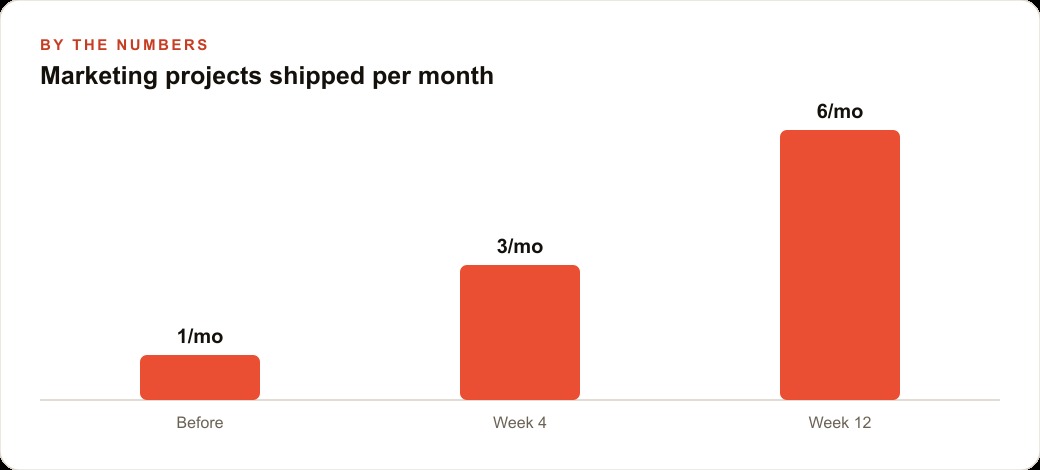
The holiday campaign ran for three weeks. The bakery took 47 pre-orders for custom holiday cakes through the landing page, compared to roughly 25 the previous year when orders came in through phone calls and texts. The owner credited the landing page with making the ordering process simple enough that people who might have called and then not followed through completed the order online instead. The production planning sheet eliminated the overbuying that had happened every prior year: the kitchen ordered within 8 percent of what it actually needed across all five items, compared to a rough 30 percent overstock in previous years that typically meant discounting leftover ingredients or absorbing the waste as a loss.
The time investment across both sessions was about three hours total. Roughly 20 minutes writing the brief. About 90 minutes reviewing the first pass carefully and identifying the three specific changes needed. Ten minutes writing the follow-up. A few minutes reviewing the final versions. Forty minutes uploading the landing page and scheduling the social posts. The AI subscription cost for the month was $20. The print cost was $30. There was no coordinator, no designer, no copywriter, and no freelance invoice.
For a business thinking about running Meta ads or other paid promotion alongside organic content, this kind of self-built campaign infrastructure is exactly what makes paid traffic worth sending. A real landing page that converts, a production plan that controls cost, a set of polished social posts: these are the things that determine whether ad spend generates a return or simply generates visits. The landing page built in this session produced pre-order conversion at a rate the owner described as better than anything they had published before, and it was produced in an afternoon.
The unit of work available from AI has genuinely moved up a level. Two years ago, asking an AI for a finished deliverable meant receiving a rough draft that needed heavy revision or a response that misunderstood the assignment. Today, asking for four finished deliverables in a single session and receiving four strong drafts, three of which are ready to ship without changes and one of which needs three specific notes, is a realistic outcome for a business owner who writes a clear brief. The capability improvement in a single year has been steep, and the cost of access has fallen in parallel.
One thing worth noting about how the bakery used these deliverables together: each piece reinforced the others in ways that would not have happened if the campaign had been assembled piecemeal. The menu and the landing page used the same five items and the same language, so a customer who picked up a menu in the store and later searched online found a consistent experience. The social posts linked to the landing page, which already matched what the posts described. The production sheet was built around the same five items as everything else, so there was no risk of the kitchen preparing for a product the marketing did not mention. A coordinated campaign, built from one brief and one session, had a coherence that a scrambled campaign put together over several weeks rarely achieves.
The skill the owner used in this session is not technical. It is the same skill that makes someone good at briefing a contractor or reviewing a draft: knowing what a good result looks like, reading what came back with specific eyes, and being able to describe what needs to change with enough clarity that someone else can execute it without guessing. Every business owner who has ever reviewed a freelancer's work already has this skill. Applying it to AI output is the only new habit required.
If you want help structuring the brief for your own version of this, or would rather have someone run the session, manage the revisions, and hand you finished deliverables ready to publish, that is exactly the kind of work I take on with clients. One focused afternoon tends to surface a long list of similar projects that used to seem like they required a team to produce. The barrier is lower than most owners expect. The return on a well-scoped afternoon session tends to compound across the rest of the season.
That is exactly what we do at AI DOERS. Book a private 30-minute call with Madhuranjan Kumar and we will map the fastest path to it for your specific business.
Book your call →
Madhuranjan Kumar
Madhuranjan Kumar brings 20 years of performance-marketing experience and has managed over $200 million in Facebook ad spend for brands across the United States and beyond. His expertise spans the full modern marketing stack: Meta, Google Ads, TikTok, email automation, CRM, and the websites that hold it together. At AI DOERS he turns that track record into lead-generation systems for businesses across every industry.