
AI Can Now Build Working Software From a Plain-English Request
There is a noisy public debate about whether AI progress accelerated or stalled. For a business owner the answer that matters is simpler: people with no coding background are now shipping real, working tools just by describing them. Here is how I would use that.

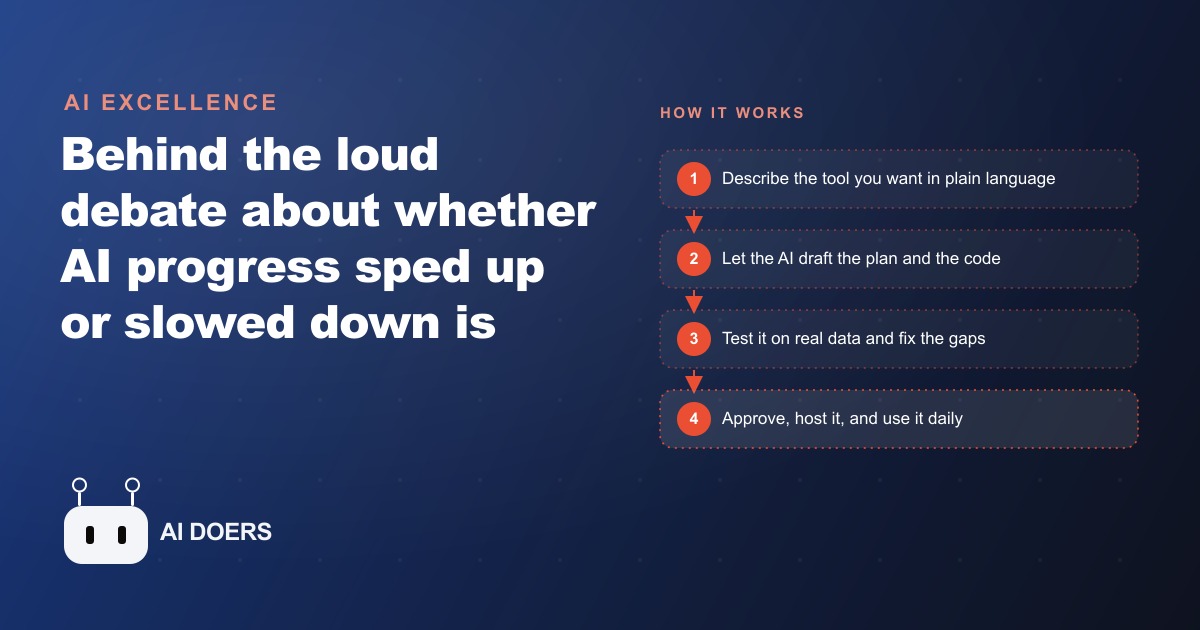
Stop arguing about the shape of the AI curve
I am Madhuranjan Kumar, and I want to disagree with the loudest conversation in technology right now. For most of the past year, smart people have been fighting about a single question: did AI progress explode or did it quietly stall? One camp published essays claiming the pace went vertical, that you can now describe a product, walk away, and return to a finished thing. The other camp pushed back just as hard, arguing that the real breakthroughs happened years ago and everything since has been small, narrow, and overhyped. Both sides marshal charts. Both sides sound convincing.
My contrarian position is simple: the debate itself is a trap for business owners, and the people winning right now are the ones who refuse to join it. The exact slope of the curve is an interesting question for researchers and a useless question for a shop owner. While everyone argues about whether the line is steep or flat, one fact sits in plain view and settles nothing about the theory while changing everything about the practice. Ordinary people, with no engineering background at all, are shipping real, working software by talking to an AI in plain English. That is not a prediction about the far future. It is happening this week.
The only fact that pays your bills
Here is the thing the theorists keep missing. You do not need to know whether AI is on an exponential or a plateau to use it. You need to know one thing: can a non-technical person get a working tool out of it today? The answer is yes, and I have watched it happen enough times to stop treating it as remarkable.
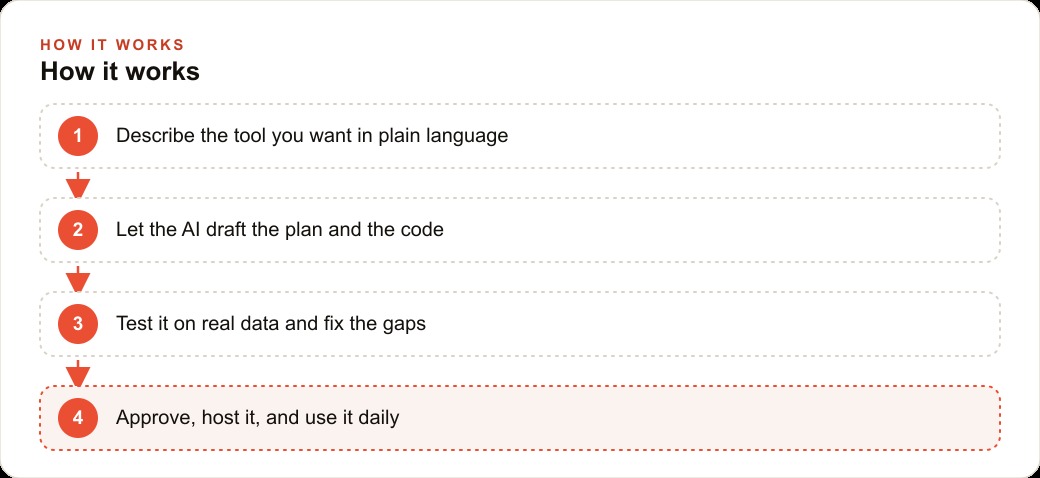
The pattern is always the same. Someone describes what they want in ordinary words. The AI drafts a plan back to them as text. They read it, correct it, go back and forth until the idea is right, and then they give it permission to build. The AI writes the code, sets up the storage, and puts the thing online. One person I read about set up a personal news site this way. He talked through what he wanted, handed the agent access to a code repository and a hosting account, told it to go, and woke up to a live website he had never typed a line of code for. Whether that means the curve is vertical or flat is beside the point. It means the tool exists and it works.
This is the part I find genuinely frustrating about the debate. People who are technically correct about the research can still give you advice that costs you money. If a skeptic convinces you that AI progress has stalled and therefore you should wait, you have just handed a head start to every competitor who ignored the argument and built something.
Why the experts are the worst people to ask
Here is a second unpopular opinion. The more expert someone is, the more likely they are to undersell a new tool, and the reason is structural, not personal. Experts judge a new technology against the best version of the old one they already have. That comparison always makes the newcomer look bad.
The history is almost comically consistent. Serious photographers mocked early digital cameras because the image quality was worse than film. Audiophiles dismissed compressed music because it lost detail a trained ear could catch. Encyclopedia editors laughed at a website anyone could edit. In every case the experts were factually right about the quality gap and completely wrong about what would happen next. They were comparing the new thing to their gold standard. Everyone else was comparing it to having nothing at all, and having something beats having nothing every single time.
That is exactly the frame a small business should use. When you evaluate an AI-built tool, do not measure it against what a large, well-funded software team could produce. Measure it against your actual alternative, which for most small operations is a pile of spreadsheets, a stack of sticky notes, and a job you never got around to automating because custom software cost more than the problem was worth. Against that baseline, a slightly rough tool that works is a massive upgrade.
Calling this a narrow win misses how much runs on code
The strongest argument the skeptics make is that AI is only good at coding, and coding is a narrow domain. I think this gets the economics exactly backwards. Software is not a niche. It is over a trillion dollars of value in the economy, and almost every modern business runs on it whether or not the owner thinks of themselves as running a tech company. The restaurant with an online booking system, the clinic with a reminder tool, the contractor generating quotes from a template, all of them run on code.
So when the cost of building small custom tools collapses, that is not a narrow win confined to one industry. It is a horizontal shift that touches nearly everything, because nearly everything already sits on top of software. The people calling it narrow are technically describing the domain correctly and completely missing how wide that domain actually is. This is the same reason the effect shows up in marketing so quickly. When a business can spin up its own tools, the cost of testing a new offer, a new landing page, or a new tracking setup drops, and that flows straight into how efficiently it can run Facebook and Instagram ad campaigns or measure what a lead is actually worth.
The honest caveat the hype crowd skips
I am arguing against the skeptics, but I am not going to pretend this is magic, because that would be its own kind of dishonesty. The tools are heavily supervised, and they should be. The model gets things wrong often enough that you keep a person in the loop at every important step. You write a clear specification, you test the output on real data, and a human approves anything that touches money or customers before it goes live.
This is where the vertical-curve enthusiasts oversell. The story is not that you type one sentence and receive a flawless product. The story is that the tedious middle of building software, the part that used to take weeks and required a specialist, has compressed into an afternoon of describing, testing, and correcting. That is still a revolution. It is just a supervised one, and treating it as fully autonomous is how people get burned.
The self-improving loop is no longer just theory
There is one more point that quietly settles the argument in my favor. The major labs now say AI writes the large majority of the code behind their own products. Research systems have used AI to improve their own software, their chip designs, and the way their models are trained. The tool is already helping build the next version of itself. You do not have to believe in any dramatic story about the future to notice that this is a compounding process, and compounding processes reward the people who start early over the people who wait for certainty. Certainty never arrives in the middle of a compounding curve. By the time it feels safe, the advantage has already been distributed to whoever moved first.
A worked example that ignores the debate entirely
Let me make this concrete with a pest control company, because it is the kind of business that would never appear in an essay about AI curves and is exactly the kind that benefits most.
The owner loses hours every week to three things: scheduling, writing up treatment notes after each visit, and chasing customers for their quarterly re-service. None of that requires a data scientist. It requires small, boring tools that a custom software budget could never justify. So instead of joining the debate about whether AI is slowing down, the owner just builds.
The first tool is a job logger. The owner describes it in plain words: take the address, the pest type, and a few notes the technician speaks into the phone, and turn that into a clean written service report plus a follow-up reminder dated for the next treatment cycle. The AI builds it, stores the data, and hands back a small dashboard. No spreadsheet wrangling, no monthly software subscription.
The second tool is a quoting assistant. A new customer describes their problem, ants in the kitchen or a wasp nest on the eaves, and the tool drafts a tidy estimate using the company's own pricing. This is the supervised part the skeptics are right about. The technician reviews every quote, fixes anything off, and only then sends it. The model is never trusted to send money-related work unchecked. But even with that human check, a forty-minute evening of admin shrinks to a few minutes.
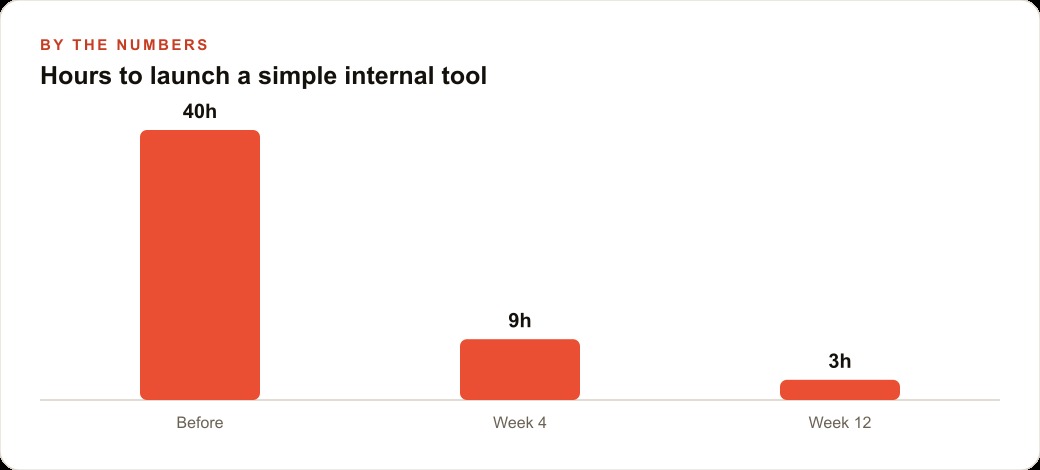
Now put numbers on it, framed as illustrative rather than promised. Say the owner reclaims roughly forty hours in the first build cycle, then settles into saving several hours a week once the tools are running. Those hours go back into booking jobs and answering customers faster. The leads that come in from the company's ads land in the CRM and website stack where the reminder tool handles the next touch automatically, so fewer customers slip through the cracks. And because the job logger quietly builds a clean record of services and neighborhoods served, that same data can later feed SEO and organic search with real, local content instead of generic filler. The owner did not resolve the question of whether AI progress accelerated. The owner just stopped waiting for the answer.
What the argument is really about
Step back and notice what the acceleration debate is actually for. It is a way of deciding whether to feel excited or skeptical. It is a mood, dressed up as an analysis. And moods are a terrible basis for a business decision, because both moods lead to the same mistake, which is inaction. The excited person waits for the tool to get even better before starting. The skeptical person waits because they doubt it works. Both of them wait.
The move I would make instead is to sidestep the mood entirely and run a small test. Pick the single most repetitive job you wish were handled for you. Describe it to an AI coding assistant the way you would explain it to a new hire on their first day. Let it build a first version, test it against a handful of real cases, and tell it what to fix. You will learn more from that one afternoon than from a year of reading essays about the curve, because you will have a working tool or a clear reason why not, and either outcome is worth more than an opinion.
My actual position, stated plainly
So here is where I land. The people arguing about whether AI sped up or slowed down are having a real conversation, and I am not saying they are foolish. I am saying their conversation is not your conversation. Your question is narrower and far more useful: can I get a working tool out of this today, and what is the smallest one worth building first? The answer to the first part is yes, and the answer to the second is whatever wastes the most of your week right now.
The fear of building software disappears the moment you see the first working version come back from a description you typed in plain English. You can run this yourself, one small tool at a time, and I genuinely think you should try it this week rather than waiting for the debate to resolve, because it never will. If you would rather have someone map your workflow, write the specifications, build the tools, and put the human-in-the-loop checks in place so nothing risky ever goes out unreviewed, that is exactly the kind of work I do for clients, and you can bring me in to handle it.
That is exactly what we do at AI DOERS. Book a private 30-minute call with Madhuranjan Kumar and we will map the fastest path to it for your specific business.
Book your call →
Madhuranjan Kumar
Madhuranjan Kumar brings 20 years of performance-marketing experience and has managed over $200 million in Facebook ad spend for brands across the United States and beyond. His expertise spans the full modern marketing stack: Meta, Google Ads, TikTok, email automation, CRM, and the websites that hold it together. At AI DOERS he turns that track record into lead-generation systems for businesses across every industry.