
AI as Your Always-On Assistant: What the Automation Wave Means for Owners
AI agents have started carrying out whole tasks and driving down the cost of getting work done. For small operators the move is to build an always-on assistant that runs the back office while you focus on the floor.

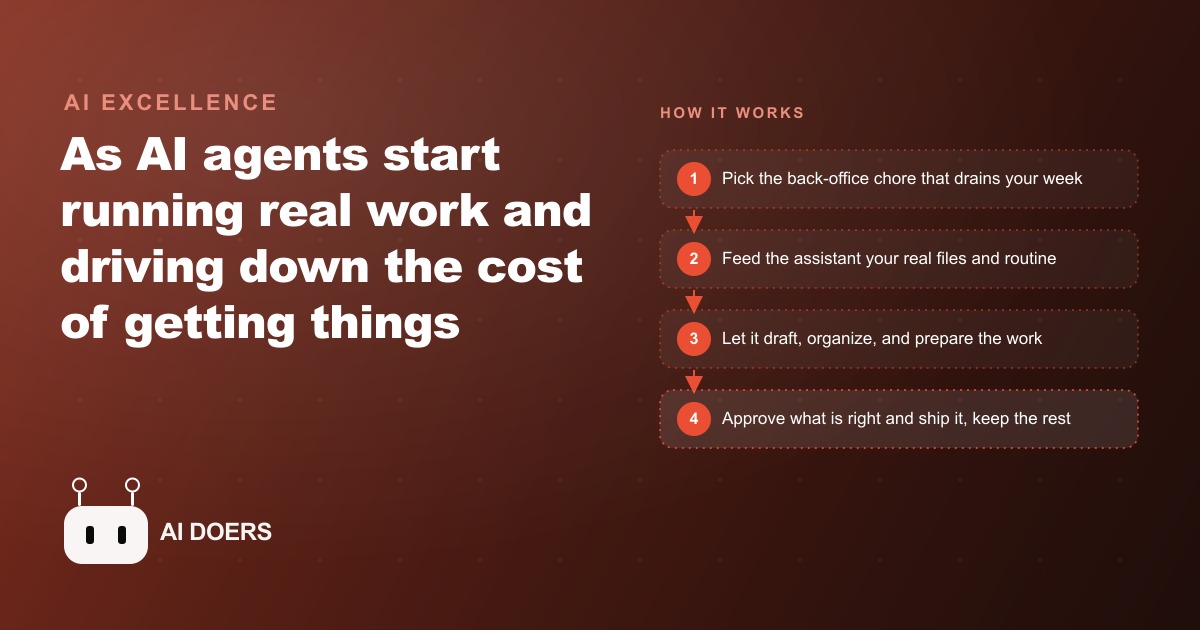
AI agents have crossed a line this year. Not a theoretical line in a research paper but a practical one visible in how people actually describe using them. The most telling signal is not a benchmark. It is the description of someone feeding an agent a pile of messy personal records, including blood work, genetic data, and a supplement routine, and watching it parse the whole set, connect it, and return something genuinely useful. That is not what an AI assistant used to do. That is what a capable human analyst does, and it used to cost hundreds of dollars or hours of your own time.
I am Madhuranjan Kumar, and the question this shift raises for every small business owner is not philosophical. It is operational: if an AI agent can handle the middle of a complex, messy information task, what does your back office look like when you wire one in?
AI agents have crossed from answering questions to completing tasks
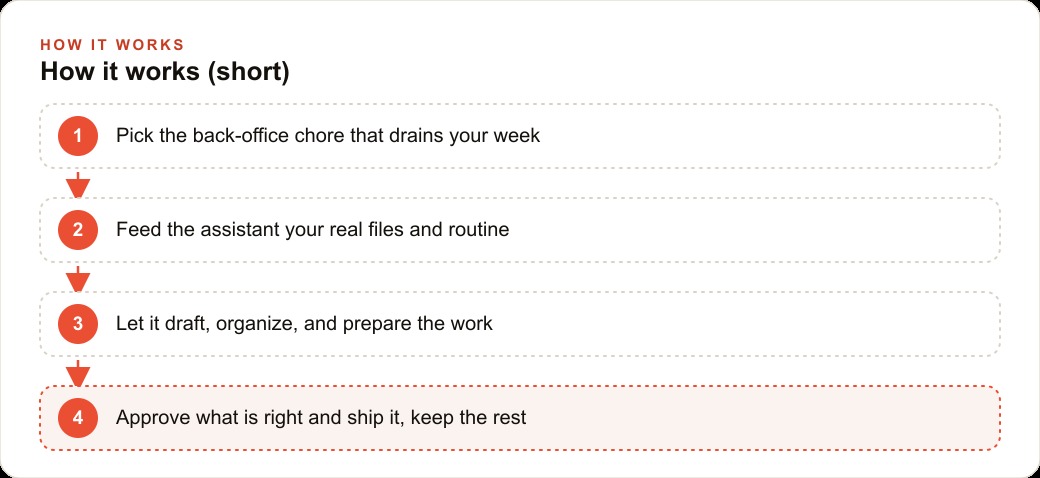
The distinction is more important than it sounds. An AI that answers questions is a better search engine. An AI that completes tasks is an assistant. The difference shows up in what you hand over and what you get back. With a question-answering tool, you describe a situation and receive information. With a task-completing agent, you describe a goal and receive work product: a drafted email, a completed spreadsheet, an organized set of notes from a meeting, a reorder list based on last month's sales.
The technical capability that enables this is the combination of long context windows and action-taking. Agents can now read large, messy files, because they process them by chunking and reassembling the meaning rather than trying to hold the whole thing in a single window. That makes real business records usable rather than just theoretically accessible. And they can act on what they read, drafting, organizing, and preparing outputs that a human reviews and approves rather than starting from scratch.
The clearest example of this shift in practice is Madhuranjan Kumar who built a single back-end tool that handles ideas, scripts, research, and content curation all in one place, tasks that previously required moving between four or five different applications and manually connecting the outputs of each. The agent connects those steps. The human directs and reviews. The four-step workflow that used to take an afternoon completes in under an hour of active attention.
The cost-of-getting-things-done curve just bent permanently downward
The economic argument behind the automation wave is simple: the biggest cost inside most tasks is human labor. When an AI agent absorbs the labor inside a repetitive task, the cost of doing that task falls. Not marginally, and not temporarily. The structure of the cost changes, because the labor component is no longer tied to human hours.
This is the same dynamic that played out when computing got cheaper in the 1980s and 1990s. Tasks that had required an expensive specialist could suddenly be handled by a much cheaper machine, and the result was not that specialists became unemployed. It was that far more tasks were worth doing because the cost per task fell. Businesses that had previously skipped certain analyses, reports, or communications because the cost was not justified started doing them regularly because the cost was now justified. The same mechanism is running now, for knowledge work.
For a local HVAC business spending $500 a month on back-office admin, the agent does not eliminate the need for someone to review and approve the work. It eliminates the need for someone to produce it from scratch, which is where most of the hours go. The cost of producing a first draft of anything falls to nearly zero. The cost of reviewing and improving it stays human, because judgment and domain knowledge cannot be automated. The total cost per deliverable drops, and the business can afford to do more deliverables in the same budget.
The businesses that connect this dynamic to their advertising will see it show up in Google Ads campaign performance as well. More follow-up, more consistent communication, and better organized response times lift conversion rates from the same lead volume, which means the same ad spend produces more booked revenue. The agent does not change the ad. It changes what happens after the lead arrives.
Parsing massive messy files at scale is now standard agent behavior
The capability that genuinely surprised people this year is not the agent's ability to draft a clean email. It is the ability to parse a genuine mess and produce something structured from it. A year of invoices saved in different formats with inconsistent naming conventions. A sales history spread across three different reporting tools with overlapping columns. A customer feedback folder full of screenshots, voice memos, and text notes from thirty different sources. These are the files that exist in every real business and that no one ever gets around to processing because the manual version would take days.
An agent with access to these files, given a clear goal, can work through the mess systematically. It chunks the documents, identifies the relevant signals, and produces a structured output: a report, a summary, a prioritized action list. What changes is not the underlying data but the effort required to extract meaning from it. That cost collapses.
For a business that has been meaning to analyze its customer feedback to identify the top three recurring complaints but has never found the time, this is the task to start with. Give the agent the feedback folder, describe the goal, and review what it produces. The first pass will not be perfect. The second one, refined with specific corrections, will be close enough to act on. The third will be something you can use directly.
For any operation running a CRM and website stack, the messy file problem shows up in contact records that were entered inconsistently, lead notes in different formats from different team members, and follow-up histories that are buried in email threads rather than structured in the system. An agent can work through that backlog, standardize the records, and surface the contacts that are overdue for a follow-up. That work used to take a dedicated afternoon to make a dent in. It is now a task you hand off and review.
Early movers are building an operational lead that compounds each month
The most important dynamic in the automation wave is not the capability of any individual tool. It is the compounding advantage that accumulates for the businesses that start using these tools consistently before their competitors do. The gap is not just about the time saved in any single month. It is about the habits, workflows, and institutional knowledge that build up as a team learns to work with agents effectively.
A team that has been routing its most repetitive tasks through an agent for six months has a refined set of prompts, a clear sense of which outputs need heavy review and which can be lightly scanned, and an intuition about how to frame tasks to get useful results. That knowledge does not exist on the team that starts six months later, and it cannot be acquired instantly. The operational efficiency gap is real, and it compounds.
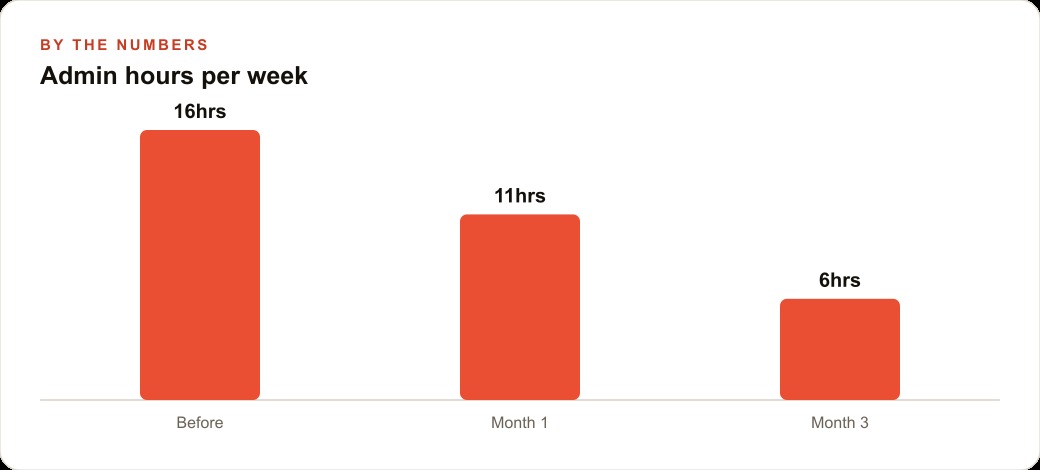
The businesses that navigate this well are the ones that treat the first month not as a pilot but as a foundation. They pick one task, wire it in correctly, build the review habit, and then add the next task. By month three, they have a small operations hub where several recurring tasks run through an agent and arrive as drafts for approval rather than starting as blank pages. By month six, the difference in how much output their team produces from the same payroll is measurable.
The practical Facebook and Instagram ad campaigns insight that connects here is straightforward: an operation that produces more consistent follow-up, better organized client communication, and faster response to leads will convert a higher percentage of the same ad traffic than an operation that is constantly behind on the back-office work. The agent does not replace the ad strategy. It makes the ad strategy more profitable by improving what happens after the ad works.
The framing that makes this actionable for any owner is not to automate everything at once but to start with the one chore that drains the most hours and costs the most real energy per week. Wire that one task through an agent, build the review habit, and let the savings in time and cognitive load become the argument for the next one. The assistant that runs the back office while you focus on the floor is available right now, and the cost of not starting is the compounding head start it gives to the business down the street that already did.
That is exactly what we do at AI DOERS. Book a private 30-minute call with Madhuranjan Kumar and we will map the fastest path to it for your specific business.
Book your call →
Madhuranjan Kumar
Madhuranjan Kumar brings 20 years of performance-marketing experience and has managed over $200 million in Facebook ad spend for brands across the United States and beyond. His expertise spans the full modern marketing stack: Meta, Google Ads, TikTok, email automation, CRM, and the websites that hold it together. At AI DOERS he turns that track record into lead-generation systems for businesses across every industry.