
AI Now Handles Tasks That Take a Human Expert 15 Hours, and the Number Keeps Doubling
The clearest way to track AI progress is the length of task an agent can finish on its own. That horizon has stretched to roughly 15 hours of expert work and keeps doubling. For a small business, that means you can start delegating whole projects, not just questions. Here is how.

The number that just crossed fifteen hours
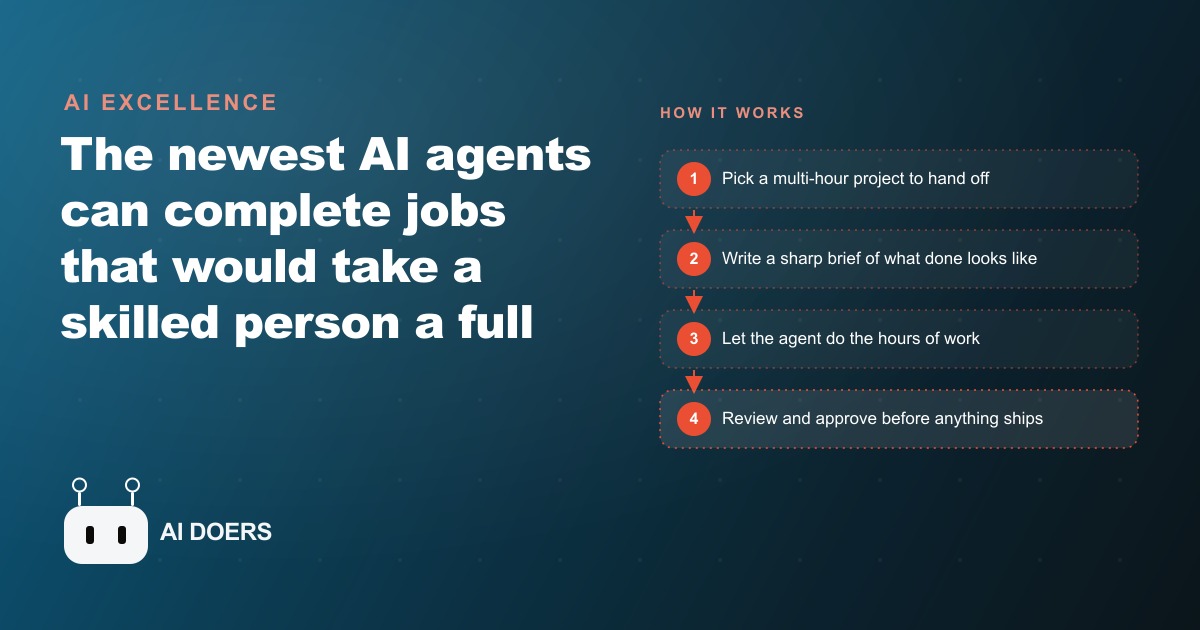
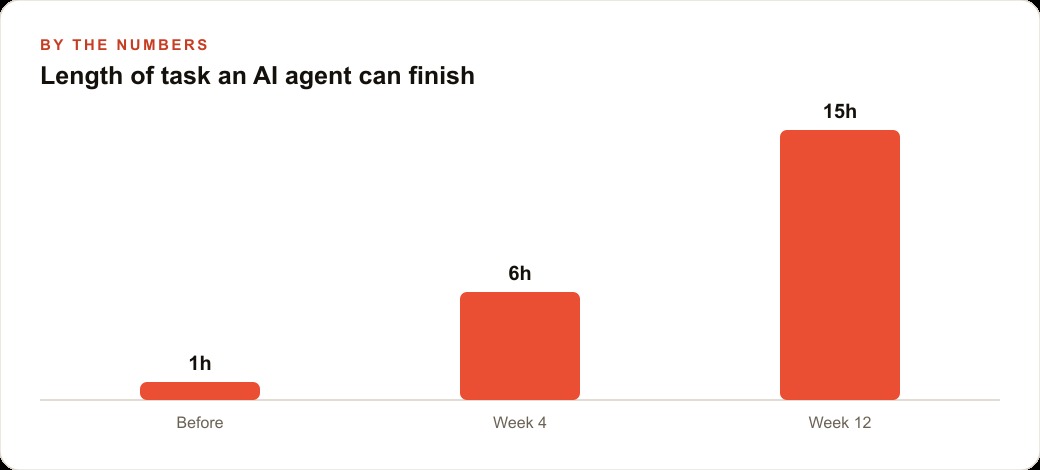
The newest AI agents can now finish a job that would take a skilled human expert roughly 15 hours, working straight through and hitting it at about an even success rate. A year or two ago the same class of tool could barely hold a task together for a couple of minutes. That jump, from minutes to most of a two day workload in one unbroken run, is the real story in AI right now, and it did not arrive with a splashy demo. It showed up quietly in the research that measures how long a task an agent can complete on its own before a person has to step back in.
I am Madhuranjan Kumar, and I pay attention to this one number more than any headline about model names or benchmark scores. It is the most honest way to track progress, because it skips the argument about whether the machine is clever and asks something you can actually plan around: how big a chunk of work can I hand off and walk away from. The answer used to be a paragraph. Then it was an email. Now it is most of a workday. For anyone running a small business, that shift is not abstract. It is the difference between using AI to answer a quick question and using it to clear a project off your desk.
Why the doubling curve is the real headline
The fifteen hour figure is impressive on its own, but it is the shape of the trend behind it that should hold your attention. The length of task these agents can handle is not creeping up. It is doubling, and it is doubling faster than even the people who watch this closely expected. When something doubles on a short cycle, the future arrives in a hurry. A capability that sits at hours today lands at days before long, and credible projections already point toward agents taking on tasks that would cost a human a full month of work within a couple of years.
You do not have to bet on the exact date for that projection to matter. The direction is enough. A doubling curve rewards the people who start early, because the skill you need to use these agents well, which is knowing what to delegate and how to describe it, takes practice to build. If you wait until agents can run a month long project before you learn to hand off an afternoon long one, you will be a beginner at exactly the moment the stakes are highest. The smarter move is to start now, while the tasks are small enough that a mistake costs you an hour and not a quarter.
This is also why the news deserves more than a shrug. It is easy to read a stat like this and file it under things that will matter someday. But someday is being pulled forward every time the curve doubles. The businesses that treat the current fifteen hour mark as a starting line, not a curiosity, are the ones who will be fluent when the horizon stretches to a week and then a month.
From answering prompts to owning projects
The practical meaning of a rising task horizon is a change in what you ask AI to do. The old way of working with these tools was one prompt in, one answer out. You asked a question, you got a paragraph, and you did the rest yourself. That is still useful, but it is not what just changed. What changed is that an agent can now own a whole multi step project. You define the outcome, hand over the entire job, and it works through the steps, checks its own progress, corrects its mistakes, and keeps going until the thing is done.
That is the difference between a helper and a worker. A helper waits for the next instruction. A worker takes the goal and carries it. As the task horizon climbs, the size of project you can responsibly hand to that worker climbs with it. Today that means a job measured in hours: a season of email drafts, a catalog of product copy, a report that pulls scattered numbers into something readable. These are exactly the tasks that never get done because they demand an uninterrupted half day nobody has.
The reason this reframing matters for a small business is simple. Your bottleneck is rarely quick answers. It is the backlog of bigger tasks that keep sliding to next week. Owning projects, not just answering prompts, is what finally clears that backlog. And it applies across the whole business, from the Facebook and Instagram ad campaigns you keep meaning to refresh to the SEO and organic search content that never gets written.
The jobs a small business can finally offload
Every business is sitting on a queue of multi hour projects, and those are precisely the jobs this capability was built to take. Think about the work that keeps getting pushed because it needs a clear block of time: cleaning up a messy customer list, drafting a full season of marketing content, reconciling a stack of receipts, researching suppliers, or rewriting product descriptions across an entire catalog. None of these are hard in the sense of being complicated. They are hard because they are long, and long is exactly what the agents just got good at.
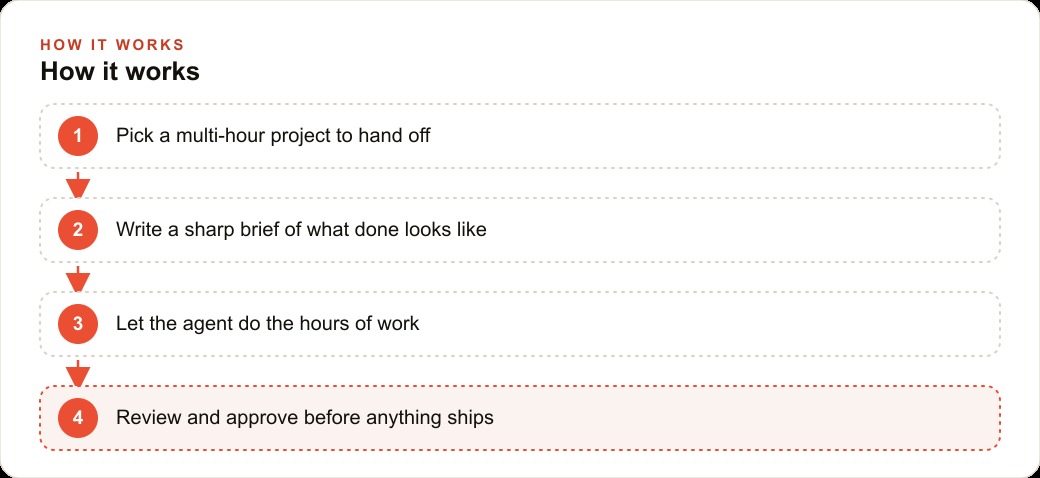
The method is the same no matter the industry. Pick a project. Write a sharp brief that spells out what a finished result looks like. Let the agent do the hours of effort while you serve customers or work on something only you can do. Then review before anything ships. The longer the task, the more the quality of the output depends on the clarity of your instructions, so the skill that pays off fastest is learning to describe the outcome precisely. A vague brief on a fifteen hour task produces fifteen hours of drift. A tight brief produces something you can actually use.
There is a compounding effect here that is easy to miss. The first project you hand off successfully frees an afternoon. You reinvest that afternoon into setting up the next handoff, which frees a day. Each win funds the next one, and the time savings stack rather than staying flat. That is why the businesses that start with one small delegation this month tend to be running several by the end of the quarter. This applies to the operational side too, from tidying your CRM and website stack to organizing the ad reporting that feeds your Google Ads decisions.
A boutique retail store hands off its backlog
Picture a boutique retail store. The owner has a running list of projects that never reach the top of the day. Product descriptions are needed for a hundred new items. A refreshed email series is overdue for the upcoming season. And an inventory report that turns three months of sales into something readable has been on the list since spring. Each of those is roughly a full day of focused work on its own, which is precisely why all three keep slipping.
Here is how I would set it up. I would start with the product descriptions, because a wrong first draft there is cheap and quick to catch. I would write one strong example in the store's voice, hand the agent the whole catalog with a clear brief, and let it draft all one hundred while the owner works the floor. If the store used to spend about six minutes per description writing them by hand, that is roughly ten hours of work. The agent returns the full set in an afternoon, and the owner spends maybe an hour reviewing and fixing the handful that miss the tone. Ten hours of work becomes one hour of review.
Next I would hand off the seasonal email series. The brief defines the theme, the tone, and the call to action, and the agent drafts the full five email sequence. The owner reads them, adjusts a few lines, and approves before anything goes out, keeping a human firmly on the customer facing decision. That is another eight hours of writing traded for perhaps forty minutes of review. Once those two projects prove the workflow, I would move to the inventory and sales report, the kind of multi hour analysis that usually never gets done at all. The agent pulls the patterns together and the owner gets a clear picture of what sold, what stalled, and what to reorder.
Add it up and the store gains polished listings, a ready marketing calendar, and real numbers to plan against, all from projects that had been living permanently on the someday list. The illustrative math is roughly twenty five hours of the owner's work replaced by about three hours of review. But the bigger payoff is not the hours this month. It is that the owner is now practiced at handing off long work, so when the task horizon doubles again, they are ready to hand off something twice as big.
Keep a human on anything that touches money
The limit on all of this is reliability, and it is worth being blunt about it. These agents are powerful, but they are not flawless. They can misread a brief, invent a detail, or carry a small early mistake through fifteen hours of work. That is not a reason to avoid them. It is a reason to design the handoff so a wrong first draft is cheap to catch. You keep a human on the final call for anything that affects money or customers, and you start with tasks where the cost of a bad draft is an hour of review, not a lost sale or a mispriced order.
Product descriptions are a good starting point precisely because a bad one is obvious and easy to fix before it goes live. A pricing change, a refund policy, an email that goes to your entire list, or a report you will make a purchasing decision on all deserve a human read before they ship. The pattern is the same every time: let the agent do the hours, and let a person own the moment where the work touches the outside world. That single rule keeps you getting the leverage without carrying the risk, and it is what separates a business that uses agents well from one that gets burned by them.
The move to make before the horizon hits a month
The curve is not going to slow down to wait for anyone, so the useful response to this news is not to marvel at it but to build a habit around it. Start by writing down the projects you keep postponing because they need a clear half day. Pick the one where a rough first draft is easiest to check. Write a brief that describes, in plain terms, exactly what a finished result looks like. Hand the whole task to an agent. Review what comes back, send it out with notes if it misses, and only ship it once a person has approved it. Then do the next one, and the one after that.
That is the entire discipline. It sounds modest, but it is the same muscle you will use when agents can run a week long job and then a month long one. The businesses that are fluent then will be the ones who started when the horizon was measured in hours, which is right now. You can absolutely run this yourself, and I would encourage you to take one backlog project this week and hand it off just to feel how it works.
If you would rather have someone choose the right tasks to delegate, write the briefs that get strong results, and set up the review steps that keep the quality high, that is the kind of work I do for the businesses I partner with. Either way, the number crossed fifteen hours, it keeps doubling, and the best time to learn how to delegate to it is while the stakes are still small.
That is exactly what we do at AI DOERS. Book a private 30-minute call with Madhuranjan Kumar and we will map the fastest path to it for your specific business.
Book your call →
Madhuranjan Kumar
Madhuranjan Kumar brings 20 years of performance-marketing experience and has managed over $200 million in Facebook ad spend for brands across the United States and beyond. His expertise spans the full modern marketing stack: Meta, Google Ads, TikTok, email automation, CRM, and the websites that hold it together. At AI DOERS he turns that track record into lead-generation systems for businesses across every industry.