
How AI Agent Teams Work, and How to Put Them to Work for Your Business
Agent teams let several specialized AI assistants work in parallel, message each other, and review each other's output. Here is how they work and when to use them.

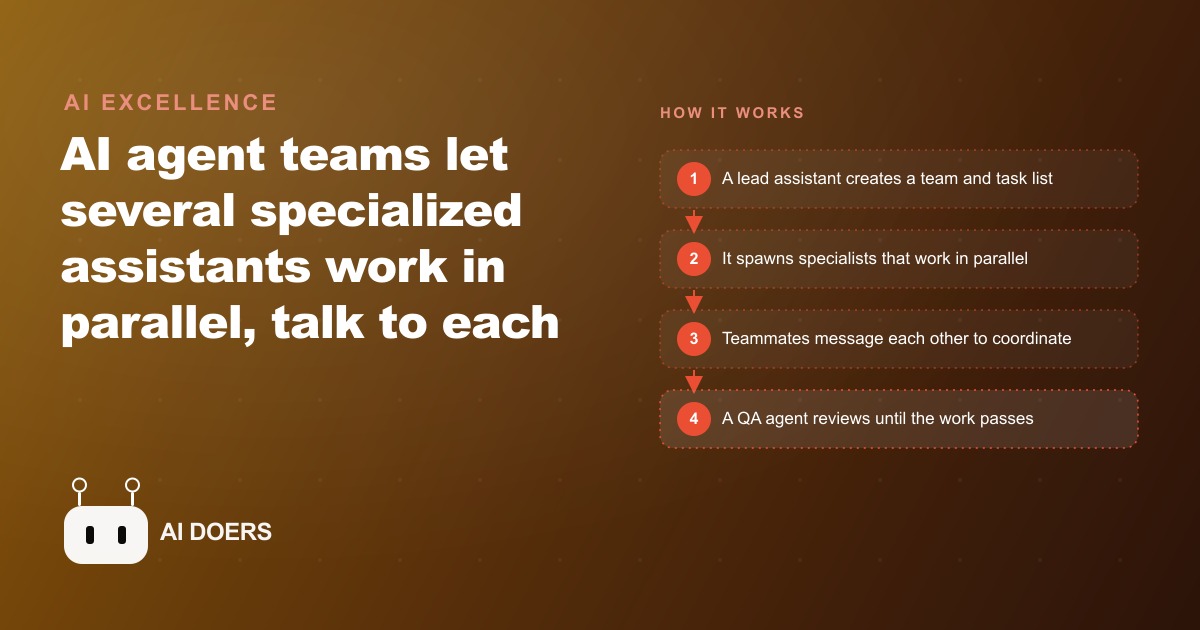
Most people picture AI as a single assistant you chat with, one voice answering one question at a time. Agent teams break that picture entirely. Instead of one helper working alone, you get a lead assistant that spins up several specialists, hands them a shared task list, and lets them work at the same time while messaging each other directly. In one demonstration, a front end agent, a back end agent, and a quality reviewer built a polished landing page, caught their own bugs, and fixed them before delivering anything. I want to take this idea apart carefully, because the mechanism underneath is more interesting, and more useful, than the demo suggests.
I am Madhuranjan Kumar, and my angle here is that an agent team is not just more AI. It is a small organization, with all the coordination problems and advantages that implies, and understanding it as an organization is what tells you when to use one.
The organizational shift: from soloist to crew
The first facet worth examining is what actually changed. An ordinary AI helper works like a soloist. You ask, it thinks, it returns a single result. An agent team works like a crew with a manager. A lead, functioning almost like a project manager, creates the specialists, assigns tasks from a shared list, and holds the whole thing to a standard. That structural difference is the entire story, because it introduces two things a soloist never had: division of labor and internal communication.
Division of labor means each agent can be narrow and deep rather than broad and shallow. One focuses only on the back end, another only on the front end, a third only on quality. Internal communication means they are not sealed off from one another. When one agent needs something from another, it messages it directly, and that changes what becomes possible.
The unlock is peer to peer messaging, not the manager
Here is the facet most explanations get wrong. People assume the value is the lead coordinating everything from the top. It is not. The real unlock is that teammates talk to each other directly, without routing every exchange through the lead. That peer to peer channel is what makes genuine loops possible.
The most valuable loop is quality review. Add a reviewer to the team, and it can send work back and say this is not good enough, and the other agents take another pass. That back and forth, agent to agent, is what produces output a single pass would never reach. A soloist writes something and stops. A team writes, critiques, and rewrites until the reviewer is satisfied. The quality does not come from any one agent being smarter. It comes from the structure forcing a second look before anything ships.
How the machinery runs under the hood
To use this well, you have to understand a subtle mechanical detail. The lead spawns several agents in parallel, and each one wakes up with only the instructions the lead gave it and no prior conversation history. They start cold. That single fact drives everything about how you have to prompt them.
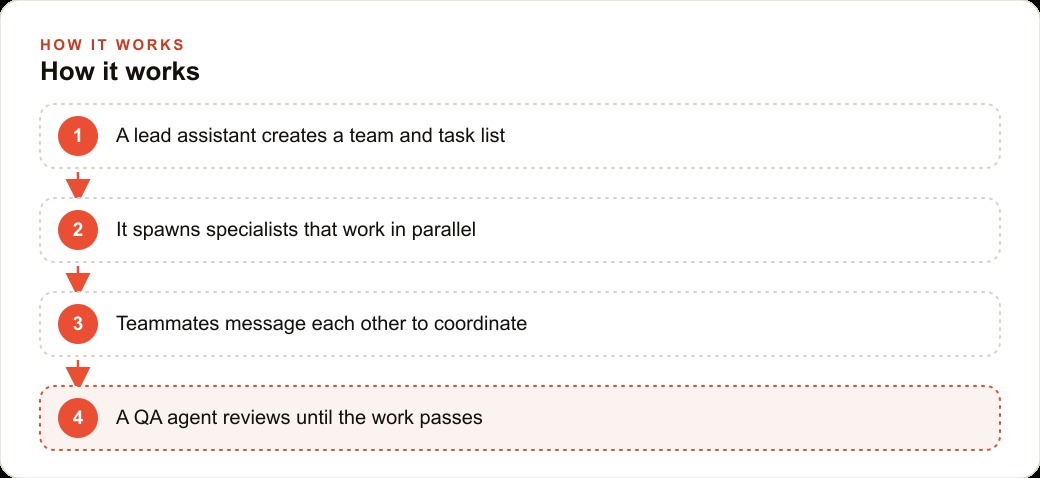
Because each agent begins without context, the setup work is front loaded into the instructions. You establish a clear overall goal, so every agent understands what the whole team is building and why its teammates exist. You define exactly what each agent should produce and who it should hand its work to, because a vague deliverable wastes tokens and produces disjointed output. Then they run in parallel, message each other when there are dependencies, and the reviewer checks the result. If it fails, the work goes back. If it passes, the lead gathers everything and finalizes, and the agents save their work cleanly before shutting down so nothing is lost.
Three rules keep this from collapsing into chaos. Each agent should own its own files, so two agents never overwrite each other's work. They should message each other directly rather than funneling everything through the lead, which is what makes the parallelism real. And the work should genuinely happen at the same time, because if the tasks run strictly one after another, you did not need a team in the first place. That last rule is the honest test, and I will come back to it.
The cost facet: teams are expensive on purpose
No serious explanation of agent teams can skip the price. Every running agent multiplies the cost, because each one is a full model working in parallel. A team of five is roughly five times the spend of a soloist for the same wall clock window, and it is also slower to set up and coordinate. This is not a flaw. It is the trade you are making: you spend more compute to buy specialization, parallel throughput, and a built in quality check.
That trade only pays off under specific conditions. The job has to be complex enough to have distinct areas that each deserve a specialist. One part has to depend on another, so the peer messaging earns its keep. And quality has to matter enough to justify a dedicated reviewer. Keep the team small, three to five agents is the sweet spot, because big swarms cost far more and rarely help. If any of those conditions is missing, the honest move is to use a single assistant, which is cheaper and just as good.
When a team is the wrong tool
The most useful part of understanding agent teams is knowing when not to reach for one. If a task is simple, a soloist wins. If it runs strictly step by step, with no real parallelism, a soloist wins, because you are paying team prices for sequential work. If the whole thing lives in one set of files with no natural division, a soloist wins, because forcing multiple agents onto one file just creates overwrite conflicts. Teams are for projects with several moving parts happening at once, where specialists reacting to each other in real time produces something a single pass cannot. Everywhere else, they are an expensive way to do what one agent already does well.
A coffee shop menu launch, taken apart
Let me ground the theory in one business. A coffee shop wants to roll out a fall menu, and that job happens to have exactly the shape a team is built for. There are distinct areas that run in parallel: the menu copy and descriptions, the social and email promotion, and a quality check that everything, prices, allergens, and brand voice, stays consistent. One part depends on another, and consistency genuinely matters. That is a natural fit.
Here is how I would set it up. The lead creates a three agent team. The first agent owns menu content, writing drink names, descriptions, and pricing into its own file. The second owns promotion, drafting the social posts and the announcement email, and it waits on the menu agent so it pulls the right names and prices. The third is a reviewer that checks everything for consistency, correct allergen notes, and a warm, on brand tone, then sends anything off back for a fix. Crucially, the menu agent and the promo agent message each other directly, so when a drink gets renamed, the email never references the old name.
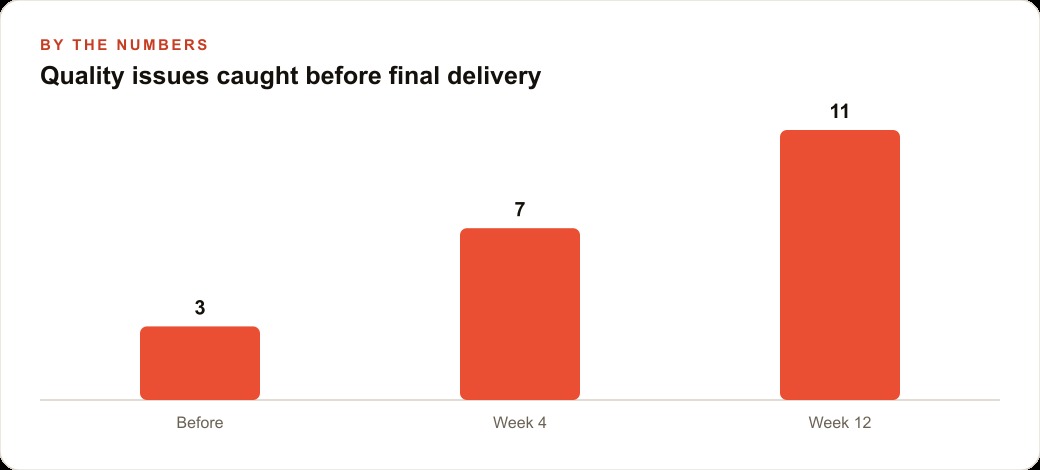
The owner ends up with a finished menu, matching promotion, and a clean review report from a single prompt, instead of a dozen back and forth sessions. Put a rough number on quality: a single pass draft might carry a handful of small mismatches, a wrong price here, a missing allergen note there. The reviewer loop catches those before delivery, so the launch goes out polished. That polished, consistent copy is the same asset that later feeds SEO and organic search on the menu pages and the creative for Facebook and Instagram ad campaigns promoting the launch, which is why getting it right once, cleanly, pays off across channels.
Setting one up, and the pitfalls to plan for
If you want to try this, start by enabling the team feature, then write one strong prompt that names a clear goal, a small number of agents, and exactly what each should produce and hand off. Keep it to three to five agents. Give each its own files, name the recipient for every handoff, and define concrete deliverables rather than vague ones. Plan around the common failure modes. If agents keep stopping to ask permission, pre approve the commands they need. If the output feels disjointed, tighten the file ownership and per agent instructions. If the token bill climbs too fast, use fewer agents. And consider having the team plan first and get your approval before executing, so everyone is aimed at the right outcome. When the work is done, let them save cleanly before shutting down. The finished output should land somewhere durable, like your CRM and website stack, so it is ready to use rather than trapped in a chat log.
The parallel work test is the honest gatekeeper
If you take one diagnostic away from this, make it the parallel work test. Before spinning up a team, ask whether the tasks genuinely happen at the same time or merely feel like they should. Draft the menu, then write the email that depends on it, then review both: that is largely sequential, and a soloist can do it in order for a fraction of the cost. But draft the menu while a second agent independently builds the email template and a third prepares the review checklist, all at once, with messages flying between them when a detail changes: that is real parallelism, and it is the only thing that justifies the multiplied spend.
The trap businesses fall into is using a team because it sounds sophisticated, not because the work demands it. A team applied to sequential work is pure overhead. You pay several agents to mostly wait on each other, and you get the same result a single assistant would have produced more cheaply. The sophistication is not in having a team. It is in knowing that most tasks do not need one, and reserving the crew for the genuinely tangled jobs where specialists reacting to each other in real time produces something a soloist structurally cannot.
Why the reviewer is the agent you should never cut
When budgets get tight, the reviewer is the first agent people are tempted to remove, and that is exactly backwards. The reviewer is the reason a team beats a soloist in the first place. Strip it out and you have paid team prices for a group of specialists who each produce a first draft and nobody checks the seams between them. That is the worst of both worlds: high cost and no quality guarantee. The whole justification for the structure was the loop where work gets sent back until it passes, and the reviewer is what closes that loop.
So if you are trimming a team to control cost, cut a specialist and fold its work into another before you ever touch the reviewer. A three agent team of two builders and a reviewer is far more valuable than a four agent team of builders with no check, because the review loop is where the quality actually comes from. Protect it, and the team earns its price. Remove it, and you have just bought an expensive way to skip the one step that made the whole approach worthwhile.
You can absolutely learn this yourself once you get comfortable with the prompting pattern, and the coffee shop example is a fine first project. If you would rather have someone design the team, write the orchestration prompt, and tune it for your specific workflow, that is the kind of setup an expert can build so it runs reliably instead of expensively. Either way, the core lesson holds: an agent team is a small organization, and like any organization, it is powerful when the work truly needs one and wasteful when it does not.
That is exactly what we do at AI DOERS. Book a private 30-minute call with Madhuranjan Kumar and we will map the fastest path to it for your specific business.
Book your call →
Madhuranjan Kumar
Madhuranjan Kumar brings 20 years of performance-marketing experience and has managed over $200 million in Facebook ad spend for brands across the United States and beyond. His expertise spans the full modern marketing stack: Meta, Google Ads, TikTok, email automation, CRM, and the websites that hold it together. At AI DOERS he turns that track record into lead-generation systems for businesses across every industry.