
Ads Are Coming to AI Chat: What OpenAI's Pivot Means for Your Business
OpenAI is leaning into cheaper plans and advertising while every major model starts to look the same. Here is what that shift really means for a small business, with a worked example for a med spa.

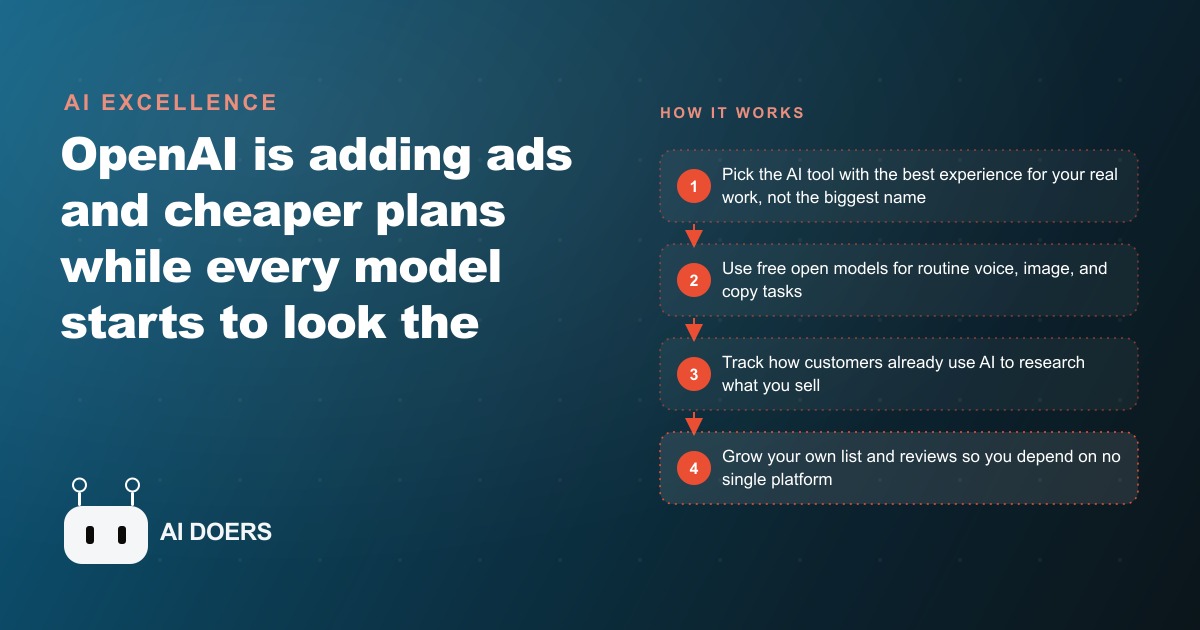
OpenAI adding advertising to its free and lower-cost plans is not a user experience decision. It is a signal that the economics of AI-powered discovery are about to follow the same path as search advertising, and every business owner who waited too long to build a position in search paid for that delay in higher acquisition costs for years afterward. The window between "this just launched" and "everyone is competing for placement" is where the advantage gets built. You are in that window right now for AI chat discovery.
This is the playbook. Five steps, each buildable in a week or less, each one compounding into a position that gets harder to displace with every month you hold it. I am Madhuranjan Kumar, and what follows is the practical path from where you are now to where you need to be before AI chat advertising matures in your category.
What OpenAI's ad announcement actually means for every local business with a website
The mechanism matters here. When someone asks an AI assistant which med spa in their city does the best laser resurfacing, or which contractor has the best reviews for kitchen renovations, or which accountant specializes in small business filings, the assistant pulls its answer from somewhere. It reads what is publicly accessible: text on websites, reviews on indexed platforms, structured information it can parse and reason about. There is no version of this where the business with more complete, more question-answering, more clearly organized web presence does not surface more favorably.
The advertising layer being added to OpenAI's plans means there will eventually be a paid placement option sitting on top of that organic presence. The sequence is identical to what happened with search. Google had organic results before it had ads. The businesses that built strong organic positions before the ad market developed were able to compete on paid terms more efficiently because their pages already answered the right questions, their conversion rates were already refined, and their brand recognition was already established with the audience.
The businesses that came in late, after the auction was mature and competitive, paid more per click for worse positions and converted at lower rates because their underlying content had not been built around the questions that mattered to the people arriving through ads.
That same sequence is coming in AI chat. The businesses that build the right content infrastructure now, before the ad auction in their category is established, will enter that auction from a stronger foundation. The businesses that wait until the ad placement is unavoidable before they engage with the underlying content quality will pay more to compete against businesses that already have the infrastructure doing the work.
The other thing worth understanding is that AI models are converging in quality. The output from a top-tier model and a mid-tier model for most business tasks, drafting a response to an email, summarizing a document, answering a factual question, is increasingly difficult to distinguish. What they compete on instead is pricing and the experience of the surrounding product. Open-source models for text generation, image creation, and speech synthesis now run on hardware that a small business could afford to own. The premium that closed-model providers can charge is compressing. That has direct implications for your subscription spending.
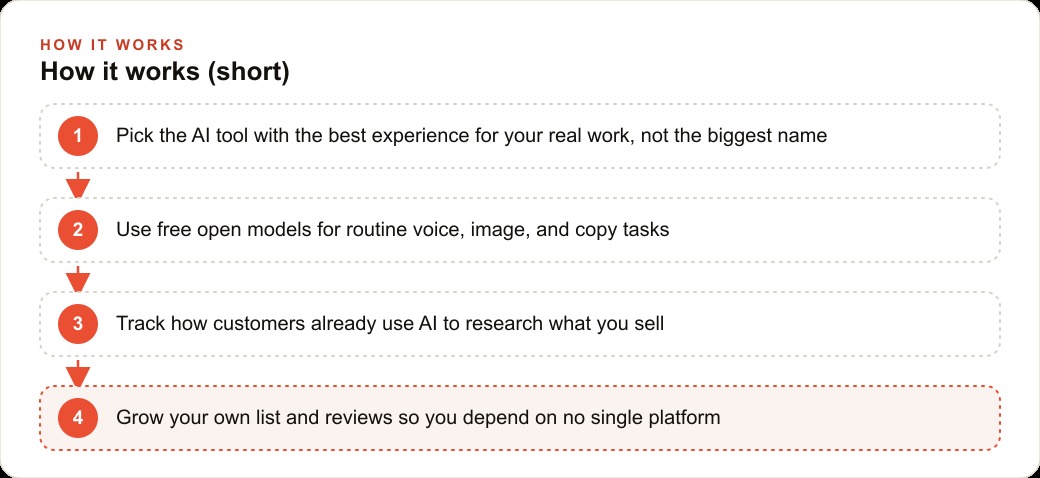
Step one: audit your AI tool subscriptions this week and cut the redundant ones
Sit down with your credit card statement and list every AI-adjacent subscription currently running. This includes writing assistants, image generation tools, research platforms, customer communication tools with AI features, chatbots, scheduling tools with AI-enhanced features, and any assistant or productivity tool you bought access to separately from the main product it was supposed to enhance.
For each line, answer one question: when did I last use this, and is there a free or lower-cost equivalent that handles the same task adequately?
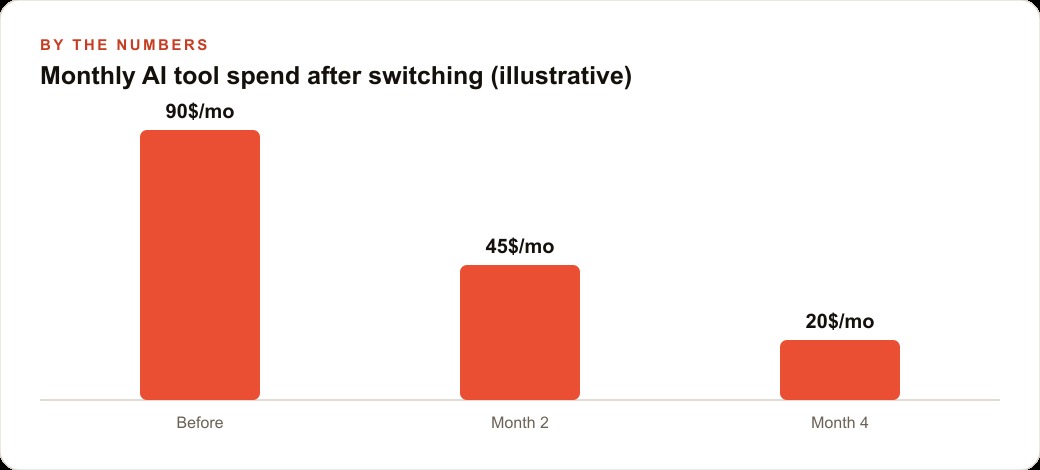
Most business owners who complete this exercise find between $50 and $70 per month in redundant or underused subscriptions. A $20/month writing assistant and a $15/month content tool and a $25/month AI research subscription that gets opened twice a month and a $30/month scheduling platform with AI features you have never configured: the total reaches $90 before you add the primary assistant subscription.
The subscription audit also forces an honest accounting of how you actually use AI versus how you intended to use it. A tool that costs $25/month and has not been opened in three weeks is not an investment; it is a payment for an intention. Cut the intentions, keep the habits.
Free open-source models for text generation have improved to the point where they run adequately on consumer hardware for most everyday business tasks. Before renewing any paid AI subscription, spend a few hours testing a free alternative against your actual workflow. Not to replace everything with free tools necessarily, but to verify that you know specifically what you are paying the premium for. If the free model handles your actual use case at acceptable quality, the decision to keep paying the premium should be deliberate.
For the med spa that went through this process, monthly AI spending dropped from $90 to $20. Four subscriptions became two: the one used daily for drafting and summarizing, and the one used for analyzing client data. Everything else was redundant to those two or addressed by free alternatives.
Step two: map every question a customer asks before booking and answer it on your site
This is the highest-leverage step for AI-assisted discovery, and it requires no technical expertise. It requires listening to what your customers have already been telling you.
Think about the last twenty conversations you had with prospective customers before they became customers. Not what you wish they had asked, not what your FAQ page currently answers, but what actually came up in the conversation that preceded the commitment. Write those questions down.
For a med spa, they cluster predictably: what should I expect during a specific treatment, how long is recovery, whether a particular treatment works for a specific skin type or concern, what the price range looks like and whether it is worth it, how the results compare to what they have seen in before-and-after content, whether their particular situation is a good candidate for treatment. There are usually eight to fifteen questions that cover eighty percent of the pre-booking conversation.
Every one of those questions is a page or substantive section that should exist on your website, and it should answer the question directly, honestly, and completely. Not a brief FAQ entry that gestures at the topic. A real answer: two hundred to four hundred words that addresses the question in the way you would address it in a consultation, without hedging so much that the answer becomes useless.
When an AI assistant composes an answer to "what should I expect from laser resurfacing at a med spa," it is reading something. The businesses whose pages are comprehensive enough to be read, clear enough to be parsed, and specific enough to answer the actual question are the ones whose information gets incorporated into those answers. The businesses with thin content, or no content addressing the question, are invisible to that process.
This step compounds in two directions simultaneously. Each page you build captures organic search traffic from people asking that question directly in a search engine. It also contributes to the content base that AI assistants draw from when composing discovery responses to people who never open a search engine and go straight to an AI chat interface. The effort is identical for both outcomes.
Step three: treat your review base and email list as infrastructure, not marketing
Most business owners have been told that reviews matter and email lists are valuable, and most treat both as outputs of their marketing effort: things that grow as a side effect of doing other marketing activities. The reframe that matters in the current context is treating both as infrastructure assets, the same way you treat your website or your customer database.
Reviews serve two distinct functions in the AI discovery context. First, they are content. A detailed, genuine review of a specific treatment describes the experience in natural language that AI assistants can index and draw from. A hundred detailed reviews of a specific procedure at a specific clinic create a content base about that clinic's outcomes and experience quality that informs AI-assisted research. Second, reviews generate trust signals that influence both human decision-making and the weighting applied to competing results in AI-composed recommendations.
The review strategy is straightforward: ask at the moment of highest satisfaction, immediately after a successful outcome, and ask specifically. "If you have a few minutes, a review describing what the treatment was like would be incredibly helpful for other people trying to decide whether to book" produces more useful reviews than "please leave us a five-star review."
The email list serves a different function. Whatever happens with AI assistants, whatever ad platforms emerge in the next three years, whatever shifts occur in search traffic patterns, the email list is a direct channel to people who explicitly chose to receive communication from you. No algorithm decides whether your message reaches them. No platform can inflate the cost of reaching them by introducing an auction. The list is yours in a way that your social following, your search rankings, and your AI chat prominence are not.
For a business starting from a small list, the path to 400 subscribers in six months is consistent across industries: a capture mechanism at the point of maximum satisfaction and trust, a monthly communication that includes genuinely useful information rather than promotional announcements, and an organic referral mechanism that gives existing subscribers a reason to recommend the list. The open rate benchmark for a list built this way, at a small business without brand recognition from a mass audience, runs consistently above 35 percent because the people who subscribed did so with intent, not in response to a pop-up they clicked to close.
Step four: test one free open model before renewing any paid AI subscription
The open-source AI ecosystem moved significantly faster in the past eighteen months than most people outside the AI development community have processed. Text generation models that now run on a standard consumer laptop produce output that eighteen months ago required expensive API calls to frontier models. Text-to-speech models generate voice narration at quality levels that would have cost several hundred dollars per hour of output through professional voice talent.
Before renewing any paid AI tool subscription, spend two focused hours with a free alternative running the actual tasks you use the paid tool for. Use your real workflow. Draft the kinds of emails you draft. Summarize the kinds of documents you summarize. Generate the kinds of content you generate. Evaluate the output quality against your actual standard, not against an abstract quality ceiling.
The goal is not necessarily to replace paid tools with free ones. Some paid tools will justify their cost clearly. The goal is to ensure that every subscription you carry is paid for deliberately, with full awareness of what it is doing that a free alternative does not do as well. Business owners who have never tested the free alternatives are, in most cases, over-spending on AI tooling by assuming the premium tools are necessary without having verified it.
For the med spa in this example, the image generation subscription was cut after testing a free text-to-image model against the actual use case, which was social media content rather than high-resolution print. The output quality difference was not meaningful for that specific application. The $20/month freed up is not significant by itself; the significance is the discipline of knowing specifically what each tool is doing and whether it is doing it at a cost that reflects actual value received.
Step five: set one calendar alert so you notice when AI chat ad placement reaches your category
This step is explicitly about monitoring rather than acting immediately. The AI chat advertising market is not yet mature. The ad formats are not standardized. The targeting mechanisms are still being defined. The optimization best practices have not been established through enough campaign history to be reliable. Moving on AI chat ads right now, before the placement options are clearly defined for your specific business category, is premature and likely to produce learning costs rather than results.
What is not premature is watching. Set one calendar alert for thirty days from today. On that date, spend fifteen minutes searching for news about AI ad placements in your category specifically. Repeat monthly. When the format becomes available in your industry, you will be positioned to move quickly rather than discovering it months after your competitors have already started building campaign history.
The businesses that will move fastest when AI chat ad placement opens in their category are the businesses that completed steps one through four. Their content already answers the pre-booking questions AI assistants are drawing from. Their review base is already generating signal. Their email list is already a distribution asset that does not depend on any ad platform performing correctly. When the paid placement layer appears, they slot into it cleanly rather than scrambling to build the content foundation while simultaneously running a paid campaign on top of nothing.
How a med spa turned subscription chaos into a $20/month AI stack and 400 email subscribers
The med spa that completed this process had been operating with $90/month in AI subscription spending across four tools. A writing assistant at $20/month. An image generation tool at $15/month. An AI-enhanced scheduling platform at $30/month with features that had never been configured. A chatbot at $25/month that had been integrated with their website but generated responses that were generic enough that most visitors were clicking away rather than engaging.
After the subscription audit, they cut to two tools: the writing assistant they used daily for drafting consultation follow-ups, treatment plan summaries, and monthly email content, and a free image generation tool that handled their social media content adequately. Monthly AI spending dropped from $90 to $20.
The content build took six weeks. Twelve questions from pre-booking consultations became twelve updated treatment pages. Each page was rewritten by the owner to answer the specific question comprehensively, drawing on their actual clinical experience rather than generic information available elsewhere. Organic search traffic to those pages increased within two months of the rewrites. Prospective clients arriving through search were more informed and required less consultation time to reach a booking decision.
The email capture was added to the intake process at the point where clients were scheduling their first appointment, after they had already decided to come in. The ask was simple and framed around value: a monthly email with answers to the questions clients commonly asked before and after treatments. Within six months, 400 subscribers. The monthly email, written in the owner's own voice, carried an open rate above 40 percent consistently.
None of these steps required a developer or a marketing agency. None required more than an afternoon of focused work to implement. The cumulative position, lower AI tooling cost, better-positioned content for AI discovery, owned distribution channel with 400 engaged subscribers, took six months to build and will become more valuable with every month it continues.
The first-party data gap that will separate businesses that grow from businesses that get replaced
The honest version of what is coming in AI-powered discovery is that businesses with strong first-party data assets will compound their advantages over businesses that do not. An email list grows more valuable the longer it exists and the more consistently it is tended. A review base grows more useful the more detailed and specific the reviews it contains. Content that answers the right questions becomes more entrenched as AI assistants rely on it more heavily.
The gap between businesses that started building these assets before the AI discovery market matured and businesses that waited will not close easily. Infrastructure gaps compound in the wrong direction for the businesses that are behind. The businesses that move through the five steps in this playbook are building infrastructure that compounds. The businesses waiting for AI trends to become undeniable before they act are building nothing while the gap widens.
The cost of waiting is not obvious yet. That is the nature of infrastructure gaps. They are invisible until the moment they are not. By then, the businesses that are well-positioned are operating from an advantage that took months to build and cannot be replicated in a week. The window for building it before it becomes urgent is the window you are in right now.
That is exactly what we do at AI DOERS. Book a private 30-minute call with Madhuranjan Kumar and we will map the fastest path to it for your specific business.
Book your call →
Madhuranjan Kumar
Madhuranjan Kumar brings 20 years of performance-marketing experience and has managed over $200 million in Facebook ad spend for brands across the United States and beyond. His expertise spans the full modern marketing stack: Meta, Google Ads, TikTok, email automation, CRM, and the websites that hold it together. At AI DOERS he turns that track record into lead-generation systems for businesses across every industry.