
Agentic Workflows Explained Simply: Tell the System the Goal, Not the Steps
Agentic workflows let you describe the result you want while the AI works out the steps, fixes its own errors, and gets smarter each run. Here is the idea in plain terms and how a small shop can use it.

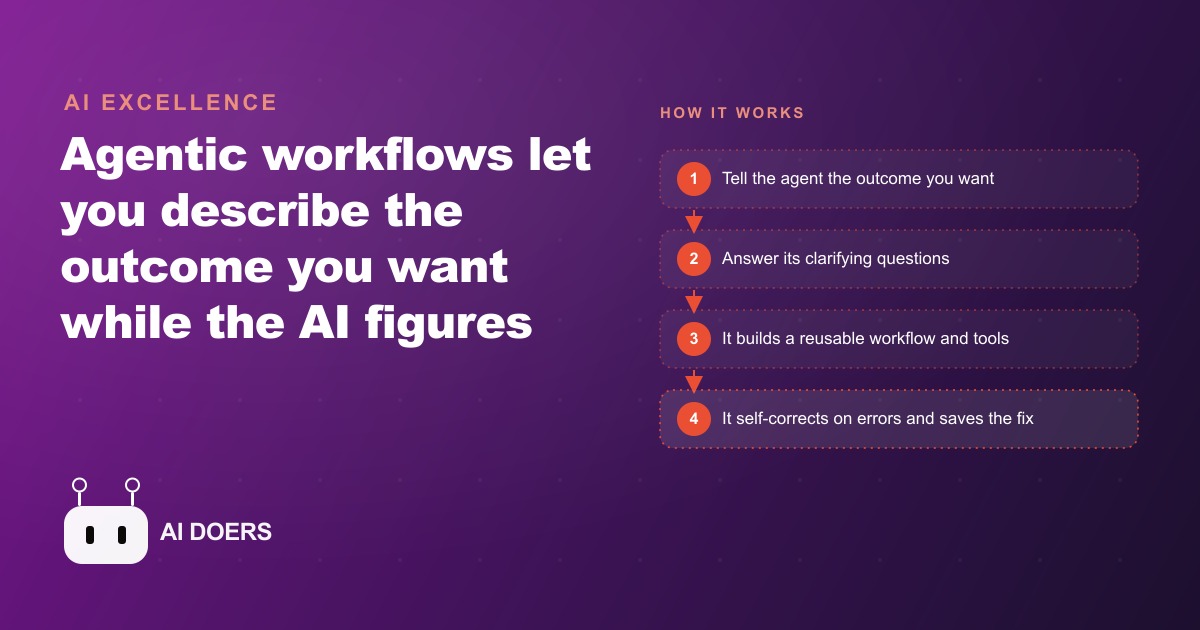
The clearest way to understand an agentic workflow is to notice what you are no longer doing when you use one: you stop describing steps and start describing outcomes, and the agent works out the difference.
I, Madhuranjan Kumar, want to explain this from first principles rather than from a demonstration, because the demonstrations that circulate are usually impressive but not explanatory. They show what an agent can do without explaining the architecture that makes it do it. Understanding the architecture is what lets you design workflows that actually compound over time rather than workflows that work once and then require rebuilding, because you understand why they work rather than just what they do.
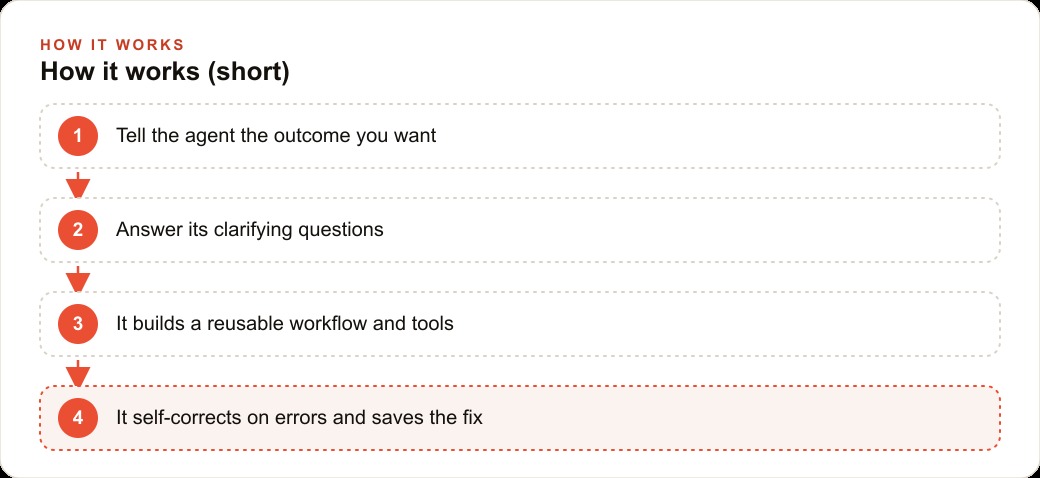
The goal statement starts the agent, the clarifying questions calibrate it
Every agentic workflow begins with a goal statement. This is the description of the outcome you want: not the steps to achieve it, not the tools to use, not the sequence of actions, but the end state. "Find all commercial properties in this neighborhood with a vacancy listed in the last thirty days and return a table with address, square footage, and asking rent."
The goal statement is necessary but not sufficient. A goal statement alone leaves too much unspecified, and an agent working with underspecified inputs will either make assumptions that do not match your actual needs or ask clarifying questions partway through a run, which interrupts the process and requires human intervention at the worst possible moment.
The clarifying questions happen before the agent runs, not during it. This is the design discipline that most people skip. Before triggering the workflow, you define the parameters the agent needs to do the job without interruption: what counts as success, what sources it should use, what format the output should take, what to do if it encounters ambiguous data, and what the boundaries of its authority are. These specifications are not a burden. They are the mechanism by which the agent produces useful output rather than technically-correct-but-practically-useless output.
A well-specified goal plus a clear set of pre-run parameters is the combination that produces output worth using. The time spent on specification before a run saves significantly more time in reviewing and correcting output after it. Most operators who find agentic workflows frustrating have skipped this step or treated it as optional.
Workflows and tools are different abstractions and keeping them separate matters for maintenance
There is a conceptual distinction that matters enormously for building agentic systems that remain useful over time: workflows and tools are different things and should be treated differently in your design.
A workflow is the sequence of actions and decision logic that converts an input into an output. It defines what happens, in what order, under what conditions. A tool is a capability the workflow invokes: searching a database, reading a web page, writing to a spreadsheet, sending a message. The workflow calls the tool. The tool does not define the workflow.
Keeping these separate matters for maintenance because the world changes tools more frequently than it changes workflows. The search tool you are using today might be replaced by a better one next year. The spreadsheet integration might get a new API version. If your workflow logic is entangled with your tool implementations, every tool change requires rebuilding the workflow from scratch.
If your workflow is written as a description of the logic and the tools are referenced as interchangeable components, updating a tool is a one-step swap rather than a rebuild. The workflow says "search for commercial listings using the available search tool." When the search tool changes, you update the tool reference. The workflow logic stays intact. This separation is the difference between maintaining a system and rebuilding it repeatedly.
The distinction also affects how you debug problems. When an agentic run produces wrong output, you need to know whether the problem is in the workflow logic, the goal specification, or the tool performance. If these are entangled, debugging requires unpicking the whole thing at once. If they are separate, you can isolate the source of error and fix it specifically without touching the parts that are working.
The self-healing loop is the difference between a one-run script and a system that compounds
A one-run script takes an input, produces an output, and stops. If something goes wrong, it stops with an error or with wrong output. You fix the problem manually and run it again from the beginning.
An agentic workflow with a self-healing loop does something different. It checks its own output against the success criteria before returning the result. If the output does not meet those criteria, it identifies what went wrong, adjusts its approach, and runs again. This might happen multiple times within a single execution, and the entire process is invisible to the operator: they see the final result, not the iteration.
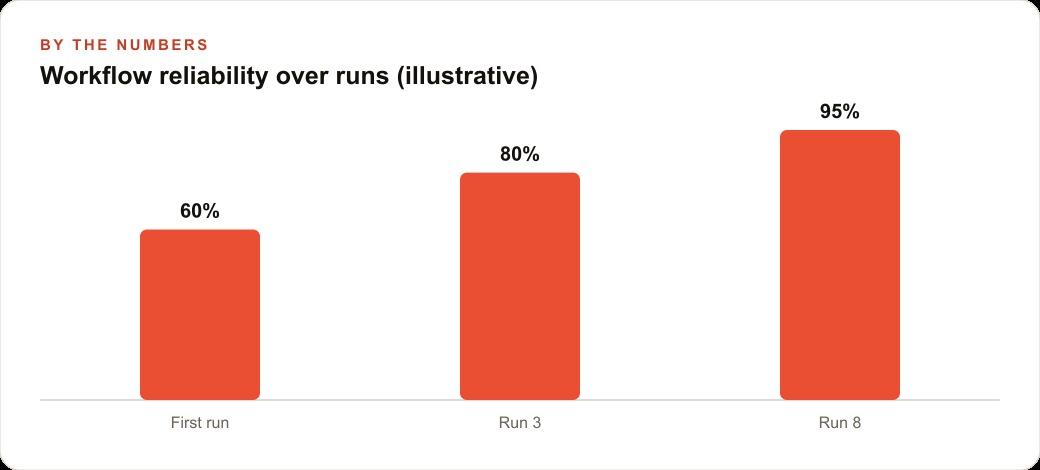
The self-healing loop is what makes an agentic workflow a system rather than a script. It is also what makes it compound over time: each run that surfaces a new failure mode and adds a correction to the loop improves the system's reliability for every subsequent run. The system gets better from use without requiring additional setup work.
Building the self-healing loop requires defining success criteria precisely enough that the agent can evaluate its own output against them. "Return a list of commercial vacancies" is not a success criterion an agent can evaluate against. "Return a list of at least fifteen commercial vacancies with complete entries for address, square footage, asking rent, and listing date, sourced from the three specified directories, with no entries older than thirty days" is an evaluable success criterion. The agent can check whether its output meets that specification and retry if it does not.
This is where the investment in precise goal specification from the first section pays a second dividend. The specification you write before the run is also the success criterion the agent uses to evaluate its own output. Good specification at the start means the self-healing loop has something real to check against and something specific to correct toward.
Being specific about done is the single skill that determines output quality
Of all the skills involved in building agentic workflows, specifying what done looks like is the one that most directly determines output quality. More than prompt quality, more than tool selection, more than workflow design, the precision of the done specification controls whether you get output worth using or output that requires significant human revision before it is useful.
The reason is structural. An agent optimizes for the success criterion it is given. If the criterion is vague, the agent will produce output that satisfies the vague criterion at the minimum viable level. If the criterion is precise and demanding, the agent produces output that meets the precise standard. The effort the agent applies and the thoroughness of its self-correction are both calibrated to the specificity of what you have told it done means.
Most operators who find agentic workflows disappointing have specified done at the vague level: "find some options," "summarize the main points," "generate a list." Most operators who find them transformative have specified done at the precise level: "find ten options meeting these specific criteria and return them in this format with these fields populated," "summarize the four main arguments and the specific evidence cited for each, in a table with argument and evidence as column headers."
The practical discipline is to write the done specification before you think about the workflow architecture. Start by describing the output document you want to receive: what it looks like, what it contains, what format it uses, what quality level it achieves. Then design the workflow to produce that document. Most people do this in reverse: they design the workflow and hope the output is what they need. Specifying the output first and designing backward eliminates most of the iteration.
A concrete example: a florist shop looking for commercial accounts, specifically offices, hotels, and event venues that might need regular arrangements. The manual approach: one afternoon building a list of fifty contacts with inconsistent formatting, missing phone numbers in some entries, and no clear indication of which contacts already have floral vendors. An agentic approach: specify the outcome (two hundred to three hundred contacts in the target category, with name, address, phone, estimated staff count, and venue type, consistently formatted, sourced from three named directory types), answer three clarifying questions about geography and business size thresholds, and let the agent run. Output: two hundred and forty contacts, consistently formatted, returned in approximately twenty minutes. The saved workflow means that the next neighborhood update takes five minutes rather than an afternoon. The precision of the done specification, the specific fields, the specific count, the specific sources and format, is what produced output the florist could use directly rather than spend time cleaning up.
Why the agent architecture scales your judgment instead of replacing it
A common misunderstanding about agentic workflows is that they replace human judgment. The accurate framing is that they scale it.
The judgment you exercise in an agentic workflow is the judgment about what to look for, how to define success, what sources to trust, how to evaluate the output, and what to do with it. Those are judgment calls that require domain knowledge and business context. An agent cannot make them better than an experienced operator in the domain. What the agent does is execute on those judgment calls at a scale and speed that no individual human can match without mechanical assistance.
You decide that commercial properties with a specific vacancy profile are worth contacting. The agent finds all of them in a given geography. You decide that a competitive pricing comparison should use specific sources weighted in a specific order. The agent builds that comparison across all relevant listings simultaneously. Your judgment determines what is worth doing. The agent determines how much of it gets done per unit of your time.
This framing matters for how you design the workflows. The highest-value agentic systems are not the ones that maximize automation across the board. They are the ones that identify exactly where human judgment is the limiting factor and automate everything around it, so that human judgment can be applied more frequently to the decisions that require it.
How each run makes the next one faster without you doing anything
The compounding property of a well-designed agentic workflow is that each run improves the system's efficiency for the next one, often without requiring any manual intervention from the operator.
The mechanism is the saved workflow. When a run produces good output, the specification used to produce that output becomes a reusable template. The next time you need the same category of output, even with different parameters, you start from the saved template rather than from scratch.
For the florist: the first run builds the contact list for the central business district. The specification is saved. The second run applies the same specification to an adjacent neighborhood. The third run to another. Each subsequent run takes five minutes to configure rather than the time the first run required, because the thinking about what done looks like, what sources to use, and how to format the output was done once and is now reusable.
The compounding is also in the operator's growing understanding of where the workflow produces reliable output and where it needs refinement. Each run surfaces the edge cases: the types of listings the agent cannot reliably categorize, the sources that return inconsistent data, the fields that are sometimes incomplete. Each resolution makes every subsequent run more reliable. Over three to six months of consistent use, a well-maintained agentic workflow produces outputs that a new workflow of the same design cannot, because the history of refinements is embedded in the specification. That history is the compound value, and it accrues automatically from use rather than from additional setup investment.
The important implication for how you invest time is this: the highest-leverage work in an agentic system is the upfront specification, not the ongoing operation. An hour spent writing a precise done specification before the first run of a workflow returns that hour many times over across subsequent runs. An hour spent refining a vague specification after poor output does not. Design first, run second, and the system compounds on its own.
That is exactly what we do at AI DOERS. Book a private 30-minute call with Madhuranjan Kumar and we will map the fastest path to it for your specific business.
Book your call →
Madhuranjan Kumar
Madhuranjan Kumar brings 20 years of performance-marketing experience and has managed over $200 million in Facebook ad spend for brands across the United States and beyond. His expertise spans the full modern marketing stack: Meta, Google Ads, TikTok, email automation, CRM, and the websites that hold it together. At AI DOERS he turns that track record into lead-generation systems for businesses across every industry.