
Adobe Is Defaulting to Google's AI, Perplexity Is Paying Publishers, and What All of This Means If You Create Content for a Living
A week of AI news reveals a pattern: the platforms creators depend on are making foundational changes to how AI is integrated, compensated, and deployed, and the implications for businesses that produce visual or written content are significant.

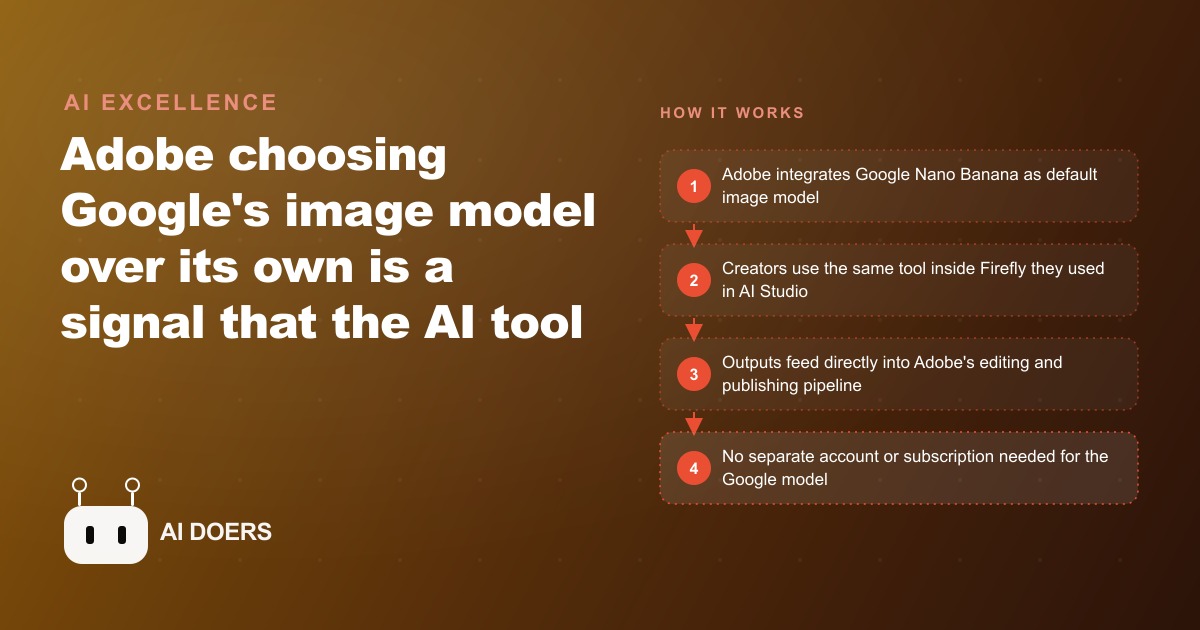
Something quiet happened in Adobe Firefly this week that tells you more about where the AI market is going than any benchmark announcement. Adobe made Google's image model the default option inside its own creative platform, placing it above Adobe's own models in the list. I am Madhuranjan Kumar, and I want to follow that decision through what it actually means for creators, because the throughline connecting this to Perplexity's publisher revenue sharing, Cling's video model, and the YouTube upscaling controversy is not obvious but it is real.
The week Adobe stopped building its own model
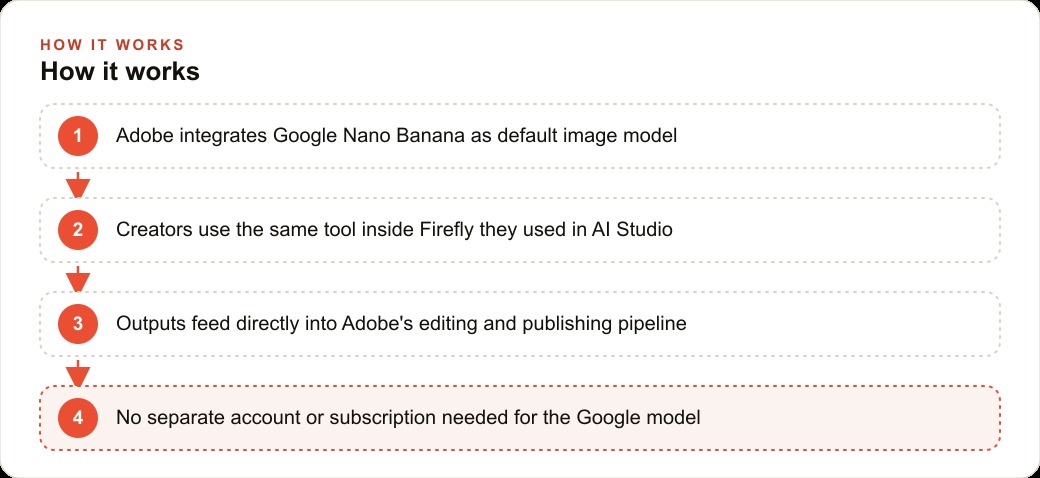
The default model in a creative tool is not a minor UI decision. It is the product team's explicit statement about which experience they believe is best for the majority of their users. When Adobe placed Google's Nano Banana model above its own Firefly models in the default list for Firefly image editing, the implicit message was: for the most common editing tasks our users attempt, the external model performs better than what we built.
Adobe is not a company short on engineering resources or AI research investment. They have been building Firefly models for years and have positioned them as the content-safe, commercially licensed alternative to models that train on unlicensed imagery. Walking back from that positioning by defaulting to an external model is a meaningful product decision, not a casual one.
The likely reasoning follows a pattern becoming visible across the software industry. Building a competitive foundation model is extraordinarily expensive. Maintaining it at the frontier against labs that do nothing but train models is even more expensive. And the quality ceiling keeps rising, which means the investment required to stay competitive keeps rising with it. For a company whose core competency is the creative workflow, not the model itself, licensing the best available model and building the best workflow around it may simply be more economically rational than continuing to build models that are perpetually one product cycle behind the frontier.
Adobe did something similar with video. They integrated Runway's V3 video model into Firefly for video generation before this latest image model decision. The pattern is becoming clear: Adobe is positioning itself as the premier creative workflow platform that integrates the best available models, rather than as a foundation model builder that also has workflow tools. These are different businesses with different cost structures and different competitive moats.
The throughline: platform versus model, and why it matters for creators
The distinction matters for creators because it determines where the value sits in the production chain. If the valuable thing is the model, then the company that builds the best model captures most of the value. If the valuable thing is the workflow, the integrations, the familiar keyboard shortcuts, the layered history, and the ability to move work between Photoshop, Illustrator, and InDesign seamlessly, then the model is a commodity input and the workflow is the product.
Adobe is betting on the workflow. Google is betting on the model. The Nano Banana integration inside Firefly is, from Google's perspective, a distribution deal. Every Adobe Creative Cloud subscriber who uses Firefly is now using Nano Banana, building familiarity with Google's model inside a professional context. From Adobe's perspective, it is a quality improvement for their users that they did not have to build themselves.
What this means for a creator or a marketing team depends on how they use the tools. A team that lives inside Adobe's workflow, that has years of muscle memory with Creative Cloud and produces work through Adobe's production pipelines, gains access to Nano Banana's editing capabilities without learning a new tool or signing up for a new service. The integration removes the friction of switching between applications for the editing tasks where Nano Banana excels.
A creator who uses Adobe tools intermittently and was considering adopting a separate AI image editing workflow can now simplify that workflow. The capability is already inside the tool they pay for. The only requirement is learning the prompting patterns that produce reliable edits, which is a skill worth developing once rather than separately for every new tool that adds similar capability.
For businesses running paid social campaigns that depend on high volumes of creative assets, this integration changes the cost structure of creative production. Photo retouching, background removal, style transfer, and object editing, tasks that previously required either manual skilled work or separate AI tools, are now available inside the professional environment most creative teams already work in. The marginal cost per edited asset drops. The volume of testable creative variations per campaign can increase proportionally.
What Perplexity's 80 percent publisher split means for the content side
The Perplexity Comet Plus compensation model is the week's second significant signal, and it points in the same direction as the Adobe story. Perplexity is sharing 80 percent of Comet Plus subscription revenue with publishers whose content is cited in AI search results. The 20 percent retained covers compute costs. This is the first serious attempt by an AI search platform to create an economic return for the publishers whose content makes the AI's answers useful.
The model arrives at a moment when the relationship between AI platforms and content producers has been increasingly adversarial. Publishers have argued, with reasonable basis, that AI search products extract value from their content without returning value to them. Users get synthesized answers from AI, click through to the publisher less often than they did before AI search existed, and the publisher's ad revenue drops as a consequence. The zero-sum framing of this conflict has produced legal action, content blocking, and growing tension.
Perplexity's 80 percent model is a bet that the zero-sum framing is wrong, that AI search and content publishers can be in a positive-sum relationship where the AI platform's quality depends on publisher content quality and the publisher's sustainability depends on the AI platform's success in attracting subscribers. If enough publishers participate and the revenue is meaningful relative to what direct traffic was generating, the model could create an incentive structure where publishers produce better content because AI search rewards quality with citation and citation produces revenue.
For a business that produces written content as part of its organic search strategy, the Perplexity development is worth monitoring closely. The early-mover advantage in AI search citation may follow similar patterns to early SEO: the producers who optimize for the format early establish citation patterns that persist as the format matures. Understanding what makes a piece of content worth citing in an AI-generated answer is a different skill set from traditional search optimization, and building that understanding now has a potential first-mover advantage over competitors who wait until the format is settled.
The question every creator should ask right now
The YouTube AI enhancement story that also landed this week is the clearest illustration of what goes wrong when a platform applies AI processing without creator consent or transparency. YouTube tested automatic AI upscaling on uploaded video without informing the creators whose content was being processed. The result was that authentic footage of real events began appearing to look artificially generated, and viewers accused creators of faking footage they had actually shot.
The reputational damage was disproportionate to the technical intervention. A processing algorithm that was supposed to improve video quality instead undermined creator credibility by making real footage look fake. The lesson is not specific to YouTube. It applies to any platform that applies AI processing to creator output without clear disclosure and creator control.
For a business that produces content for its own channels and relies on organic search and content discovery to attract customers, the question is: do you know what AI processing is being applied to your content by the platforms where you publish it? The answer for most businesses is no, because this information is not prominently disclosed by most platforms. The YouTube story is a preview of the kinds of complications that arise when the answer to that question is unknown.
The week's events collectively describe a creative industry in the middle of a platform reorganization. Foundation models are consolidating toward fewer, more capable systems. Workflows are being built around those models rather than building models to support workflows. Revenue sharing between AI platforms and content producers is being experimented with for the first time. And the risks of AI processing applied to authentic content without disclosure are becoming visible through incidents that damage creator trust.
The businesses that navigate this transition well are the ones that stay alert to where the leverage is moving, build competency in the tools that are winning access to creative workflows, engage with revenue-sharing opportunities before they become crowded, and maintain explicit awareness of what AI processing is being applied to their content and under what terms. None of that requires a large team or a large budget. It requires paying attention to the platform-level decisions that the week's news made visible.
That is exactly what we do at AI DOERS. Book a private 30-minute call with Madhuranjan Kumar and we will map the fastest path to it for your specific business.
Book your call →
Madhuranjan Kumar
Madhuranjan Kumar brings 20 years of performance-marketing experience and has managed over $200 million in Facebook ad spend for brands across the United States and beyond. His expertise spans the full modern marketing stack: Meta, Google Ads, TikTok, email automation, CRM, and the websites that hold it together. At AI DOERS he turns that track record into lead-generation systems for businesses across every industry.