
The AI Safety Lessons That Actually Change How a Business Works
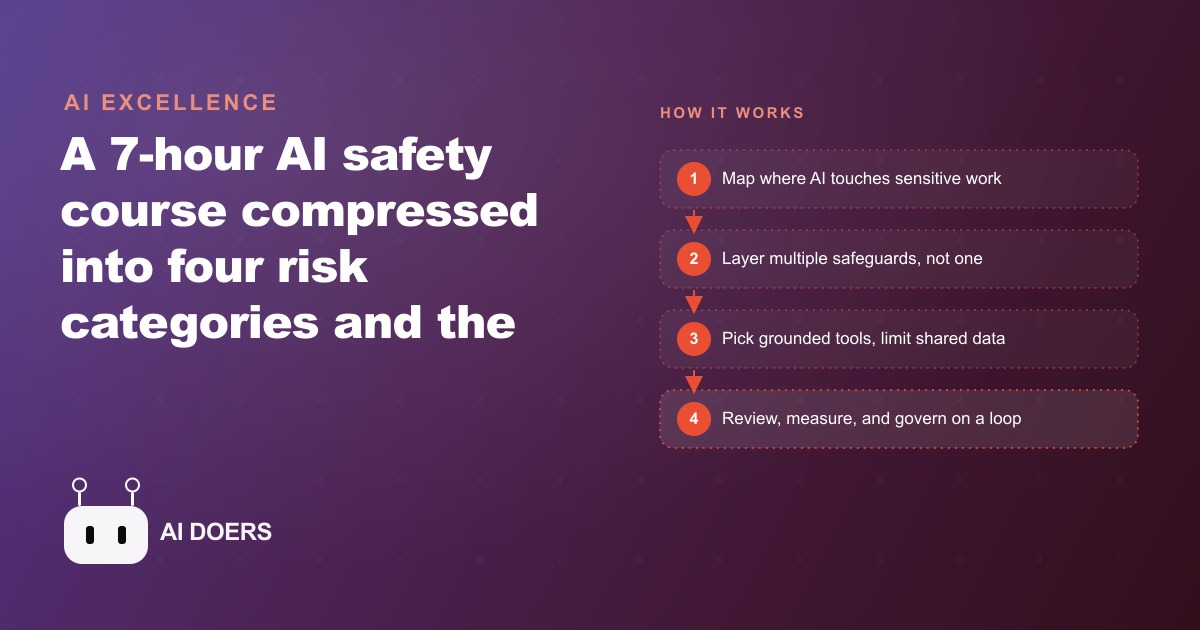
A full AI safety course boils down to a few moves any company can use: layer your safeguards, run the NIST map-measure-manage-govern loop, pick source-grounded tools over chatty ones, and feed AI as little sensitive data as you can.

AI safety gets filed under "future problem for researchers" by most business owners. That categorization is wrong, and it is wrong in ways that are already costing real money to real companies. I am Madhuranjan Kumar, and I want to make the case that every business currently using AI has an AI safety problem to solve, not in the futurist sense of runaway intelligence, but in the immediate sense of expensive failures that happen when ordinary business workflows rely on AI output without appropriate safeguards. The failures are not hypothetical. They are documented, expensive, and entirely preventable.
The failures that already happened are not exotic
A consulting firm delivered a government report stuffed with fabricated academic references and an invented court quotation. The report had been written partly by AI, the citations had not been verified against real sources, and the review process had treated confident-looking output as accurate. The firm had to refund part of a $440,000 engagement fee. A finance worker authorized a $25 million wire transfer after joining a video call where criminals used deepfake technology to convincingly impersonate the company CFO and several senior colleagues. A large company's market value dropped by tens of billions in a single day after its customer service chatbot made a confident statement about a policy that turned out to be incorrect and legally binding.
None of those failures required exotic technology. The consulting firm failure required a broken review process. The wire transfer failure required the absence of a procedure for verifying payment instructions received through video. The chatbot failure required deploying a system that treated its outputs as final without a human accuracy check. These are ordinary process failures, not rare technical failures, and that is exactly why they are worth taking seriously. You do not need a sophisticated attack to create one of them. You need only the absence of a few basic practices that most businesses have not yet adopted.
AI safety is four categories, and most business incidents fall into two
The organized framework for understanding AI risk groups everything into four sources. The first is malicious use, where someone intentionally weaponizes the technology. The deepfake CFO wire transfer is malicious use. The second is racing dynamics, where companies or nations rush to build more powerful systems and cut safety corners to avoid being beaten by a competitor. The third is organizational failure, plain management error in how AI systems are built and operated. The accidentally inverted loss function that caused a training model to optimize for the worst possible outcomes was organizational failure. The fourth is rogue AI, where a sufficiently capable system behaves in ways its designers did not intend.
The overwhelming majority of AI incidents that affect real businesses today fall into the first two categories, malicious use and organizational failure, and almost none of the fixes for these categories are purely technical. They are about systems, habits, and oversight. The deepfake CFO call was defeated not by better technology but by a policy requiring a second verification channel for payment instructions above a threshold. The citation fabrication problem is defeated not by a better AI model but by a review step that checks citations against real sources before anything goes to a client. These are procedures. They cost almost nothing to implement. The cost of not implementing them is what the consulting firm documented in the size of its refund.
The Swiss cheese model is the only safeguard structure that actually works
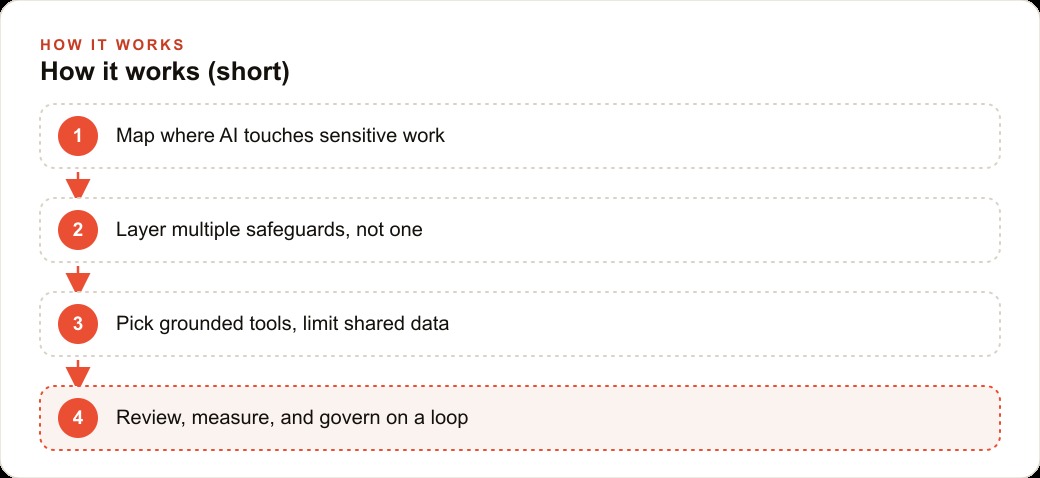
No single safeguard catches every failure. A safety culture sets a baseline but cannot prevent every individual mistake. A human review step helps but gets bypassed under deadline pressure. An anomaly detection system catches unusual patterns but misses the unusual that was not anticipated. Each safeguard has holes. The Swiss cheese model says to stack imperfect safeguards so that the holes in one layer are covered by the solid parts of the next layer, and no hole runs all the way through the stack to a customer-facing failure.
For a business using AI in its daily operations, the Swiss cheese stack might look like this: a written policy defining what data can enter which AI tool, a team briefing on what outputs require verification before they leave the business, a standard practice of running important prompts across two different models and trusting only the claims that both agree on, an anomaly detection alert when an AI-generated output contains a statistic or citation not present in the source documents, and a procedure requiring a second human approval for any consequential action that AI assisted in preparing. None of those is comprehensive. Together, they make it extremely unlikely that a fabricated citation reaches a client or a confident error produces a legal commitment before anyone catches it.
The human-in-the-loop assumption deserves direct challenge. Many businesses believe that having a human review AI output before it is sent is sufficient. The inverted training function error was made by a human. The consulting firm employee who let the fabricated citations through was a human in the loop. Humans get tired, miss things under deadline pressure, and over time develop the habit of approving outputs they scan rather than read. Human review is one layer in the Swiss cheese model, not a standalone solution. The layers above and below it are what make the review step reliable rather than theatrical.
The NIST framework gives any business a practical four-step loop
The US National Institute of Standards and Technology published an AI Risk Management Framework specifically because the need for a structured approach became clear before most businesses had one. The framework is not a compliance requirement for most businesses. It is a checklist that organizes the work of managing AI risk into four repeatable steps.
Govern: decide in advance who is responsible for AI decisions in your organization, what the rules are for which data can enter which tools, and what the review requirements are before AI-assisted outputs reach clients or make commitments. Map: list every workflow where AI touches sensitive data, client-facing content, or consequential decisions, and flag which ones would be most costly if an error occurred. Measure: run a periodic check on the accuracy of AI outputs in those workflows. Not once at deployment and never again. On a schedule, because model behavior changes and use patterns drift. Manage: fix the gaps that the measurement step surfaces, and cycle back to the top.
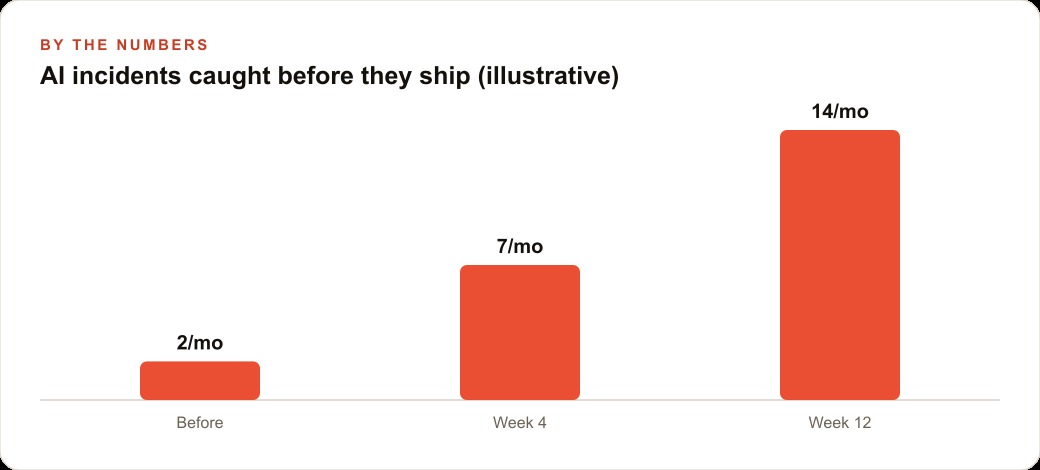
Running that loop once per quarter on every AI-integrated workflow in your business catches the slow drift toward over-reliance before it becomes an expensive incident. The consulting firm failure was not a sudden catastrophe. It was the endpoint of a gradual drift in review rigor that would have been visible in a quarterly accuracy check. The measurement step catches that drift. Skipping the measurement step is where the risk accumulates invisibly.
For businesses that use AI to draft Google Ads copy or Facebook and Instagram ad campaign language, the measurement step catches the drift toward boilerplate claims that may be difficult to substantiate, which creates both a brand risk and a platform policy risk. For businesses using AI in customer communications that feed into a CRM and website stack, a periodic review of AI-drafted messages against actual policy catches the cases where the model's confident guess at a policy detail differs from the actual policy and has been going out to customers uncorrected.
The two individual practices that make the largest immediate difference
Every business can implement two practices today that meaningfully reduce AI risk before anything else is in place. The first is turning off training-on-your-data and memory features in every AI tool your team uses. The default settings in major AI tools often include the ability for the model provider to use conversation content to improve future models. That default is appropriate for personal use and inappropriate for any conversation that includes client data, proprietary business information, or any detail the business would not want to share with the model provider's training team. This is a settings change that takes five minutes and permanently reduces the data exposure risk of routine AI use.
The second practice is always checking specific claims before they leave the business. Numbers, citations, policy statements, statistics, and any factual assertion that will be presented to a client or included in a binding communication needs to be verified against a real source before it goes out. Not because the AI is usually wrong. Because the AI is sometimes confidently wrong in ways that are hard to detect without checking, and the cost of a confident wrong claim that reaches a client is usually much larger than the cost of the five seconds it takes to verify the claim against its source. This practice does not require a new process, a new tool, or any investment. It requires only the habit of treating AI output as a first draft that needs fact-checking rather than a finished deliverable that just needs formatting.
That is exactly what we do at AI DOERS. Book a private 30-minute call with Madhuranjan Kumar and we will map the fastest path to it for your specific business.
Book your call →
Madhuranjan Kumar
Madhuranjan Kumar brings 20 years of performance-marketing experience and has managed over $200 million in Facebook ad spend for brands across the United States and beyond. His expertise spans the full modern marketing stack: Meta, Google Ads, TikTok, email automation, CRM, and the websites that hold it together. At AI DOERS he turns that track record into lead-generation systems for businesses across every industry.