
50 AI Use Cases From a 7-Figure Founder, Distilled Into a Workflow You Can Copy
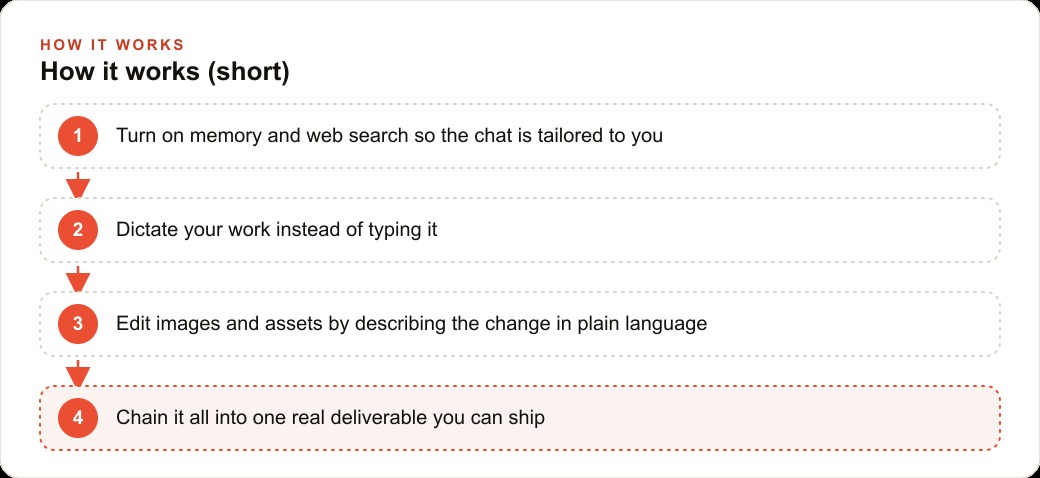
The real leverage is not one clever trick but a chain: chat with memory and web search, dictate instead of type, edit images by talking, score with Suno, and ship a paywalled app, all in a single week.


Somewhere between the fortieth and the fiftieth item on the founder's list, the pattern becomes impossible to ignore. A seven-figure operator has built a working life in which memory-enabled chat hands off to voice dictation, voice dictation hands off to image editing, image editing hands off to video generation, video generation hands off to a paywalled product page, and the entire sequence moves faster than most small businesses draft a single email. Madhuranjan Kumar has spent months mapping how people actually earn from AI, and this list of fifty use cases is one of the clearest demonstrations he has encountered of a principle that almost every productivity article reverses: the tools are not the point. The chain is.
This observation sounds obvious until you examine what building a working chain actually requires. It requires resolving every handoff before you encounter it in practice. It requires knowing what format the next tool expects, what quality threshold makes an output worth passing forward, and what the person running the sequence should do when one station produces something below that threshold. These are not tool-selection problems. They are systems-design problems. The people who have solved them are visibly separated from the people who are still browsing lists of what is possible.
Most People Treat AI Tool Lists Like Recipe Books They Never Cook From
There is a recognizable pattern among knowledge workers who describe themselves as exploring AI. They find a compilation like this founder's fifty items. They open a browser tab for each item that sounds promising. They test two or three over the following week. By the Tuesday after that, they have returned to their existing workflow. The list joins a bookmarks folder alongside forty others from the past eighteen months. Nothing ships. Nothing earns.
Madhuranjan is not diagnosing a motivation failure here. The people following this pattern are often genuinely curious and genuinely capable. The problem is structural. A list of tools presents each item as a self-contained destination, a place to visit rather than a station to pass through. When you evaluate a tool as a destination, you measure it in isolation: does it save me time, is the output acceptable, is it better than the last option I tried? These are valid questions. They are also the wrong unit of analysis when the real value is systemic rather than individual.
The analogy to recipe books is more precise than it sounds. You can read every recipe in a regional cuisine's definitive volume, understand how the flavors interact, follow the cultural logic, and still be unable to produce a meal from whatever is actually in your kitchen on a Thursday evening. The gap between knowing the recipes and feeding yourself is execution under constraint. The gap between knowing fifty AI tools and earning from them is the same kind of gap. It closes not through additional discovery but through a shift in the unit of work: from tool to handoff.
The founder in this video has made that shift completely. Consider how memory-enabled chat appears on the list. Taken alone, it is a quality-of-life improvement. Sessions remember context from previous conversations, so the tool does not need to be re-briefed every morning about the project, the brand voice, or the prior decisions. That is genuinely useful. But the founder values the memory primarily because it eliminates rework at the beginning of each chain run. Every chain needs a starting point that is already oriented to the project, the audience, and the decisions made last week. The memory layer provides that orientation automatically. Remove it and the chain starts slower. Keep it and every subsequent step begins from an informed position.
This is the only lens through which an effective chain-builder evaluates a new tool: does it reduce friction at the handoff to the next step? The benchmark performance of the tool, its social media traction, its popularity in developer communities; none of that is relevant. The only relevant question is whether the tool receives the previous step's output cleanly and delivers its own output in a form the next step can use without manual intervention.
When Madhuranjan first began mapping revenue-generating AI workflows across operators in different business categories, he expected to find that the most profitable ones were using the most advanced models. What he found instead was that the most profitable chains were often using mid-tier tools assembled into sequences with no unnecessary gaps. Sophistication at individual nodes was far less important than the completeness and smoothness of the full path from raw input to finished, sellable deliverable.
The Chain Is What Earns, Not Any Individual Tool in It
To make this concrete, take two people who encounter ElevenLabs voice cloning on the same day. The first person clones their voice, produces a sample audio clip, shares it on social media as a demonstration of the technology, and returns to their existing content creation workflow the following morning. The second person asks one question before touching the tool: what does this output become next?
For the second person, the answer arrives quickly. The cloned voice produces narration. Narration needs a script. A script needs a source. The source is a research session in a memory-enabled chat interface that already knows the brand positioning, the audience's main questions, and the product being sold. The narration feeds a short-form video. This breakdown drives traffic to a no-code page behind a paywall. The entire sequence from research session to live product can run inside a single working afternoon. The first person spent an afternoon demonstrating a technology. The second person spent an afternoon building a revenue path.
Both people used the same tool. One of them built a chain.
Madhuranjan raises this not to discourage individual exploration of new tools but to reframe what that exploration is actually for. When you test a new AI capability in isolation, the most valuable question is not whether the output impresses you. The most valuable question is where this output could go. If you cannot answer that question concretely, for a specific project, with a specific next step, then the tool has not yet entered your chain. It is still a bookmark waiting for a system.
VEO video generation from a start frame illustrates the same principle. The start frame is an image. In the founder's workflow, that image came from a conversational image editing step: the founder described a scene in natural language and the AI constructed it. The VEO step takes that image and extrapolates motion, producing a video clip. The clip is not the final product. It becomes a visual hook for social content, a trailer for a course module, a product preview. Individually, this breakdown generation tool is impressive. Inside a production chain, it replaces a video shoot that would have required location, equipment, crew time, and a half-day of post-production editing.
Consider what this means for cost structure at a small business scale. A company that produces three to four pieces of video content per week through traditional means spends somewhere between 800 and 2,000 dollars per week depending on whether they use in-house staff or a contractor. A chain that generates those pieces at approximately the cost of a software subscription is not merely more efficient. It is a structurally different business model. The chain is not a productivity hack. It is a change in what the business can afford to sustain at volume.
Suno for music scoring illustrates the principle at a smaller scale. A founder who uses Suno to score background audio for their videos has eliminated a licensing cost and a contractor coordination step. That is genuinely useful as a standalone improvement. But the founder in this video integrates the scoring step into a production sequence where it is as systematic as the transcription step or the caption editing step. It is not a creative adventure. It is a station that receives something and sends something forward. The creative adventure was building the sequence. The individual steps are execution.
Earning From AI Is a Skill of Transitions, Not Discoveries
The AI productivity conversation has built a discovery incentive into its structure. Every week brings a new model release, a new benchmark result, a new capability that did not exist the previous month. The conversation rewards the people who find new things first and penalizes those who are still working with last month's releases. This creates a system that focuses collective attention almost entirely on discovering new tools and very little attention on connecting the tools already found.
Madhuranjan has tracked this pattern closely because it explains why the population of AI enthusiasts and the population of AI earners overlap so little. Enthusiasts are exceptional discoverers. They are often the first people in any network to know about a new capability, the first to write about it, the first to produce tutorials. They have tested more tools than almost anyone around them. And yet most of them have not built a reliable chain that produces sellable output on a consistent schedule.
The earners have almost always traded breadth for depth. They have found three to six tools that pass output between each other, and they have run that sequence enough times that every transition is automatic. The decisions that slow down a new user, what format does this tool expect, how long should this output be before it moves forward, what do I do when the output is not quite right, have all been resolved and encoded into system prompts, templates, or personal protocols. The chain runs. The income follows.
A transition is the moment when one tool's output becomes another tool's input. Every transition in a chain is a potential stall point. You might not know what format the next tool prefers. You might not be confident that the output quality is high enough to be worth passing forward. You might simply lose momentum by the time you reach the fourth step in a six-step sequence. The founder who documented fifty use cases has passed through enough transitions in enough different sequences that the friction is nearly zero. That is not a tool advantage. It is a skill advantage, and it is the skill that actually converts to revenue.
There is a useful thought experiment for identifying where to start building your own chain. Take the last five things you produced for work: a report, a content piece, a client proposal, a product description, a sales email. Trace each one back to its raw material. Now trace each one forward to its eventual effect. The points where you had to make an active effort to carry the output forward, to translate, reformat, rethink, or start over, are your current bottlenecks. Those are the handoffs where a well-chosen AI tool would eliminate friction. Build from those bottlenecks, not from a list of fifty.
The founder in this video built something that looks from the outside like a collection of tools. From the inside, it is a collection of solved transitions. Each item on the list represents a handoff that works. The list is evidence of the architecture, not the architecture itself. Reading the list as fifty separate tools misses the structure entirely. The tools are materials. The chain is the craft. And the chain, specifically the completeness of it and the smoothness of it, is what earns.
The people who will be building reliable income from AI in three years are resolving transitions right now. They may be using fewer tools than the enthusiasts around them. They are almost certainly running those tools in sequence rather than side by side. The list is a starting point. The work is in the connections.
The founder's list is not a checklist. It is a diagnostic. When you read it with an honest eye toward your own workflow, the items that stand out are not the ones that sound most impressive. They are the ones where you immediately picture the handoff they would replace. That specificity is the signal. A tool that solves a real handoff problem in your current sequence is worth more than a tool that adds a capability you have never needed. Build the short chain that solves your real handoffs. The fifty items will look different once the first chain is running.
That is exactly what we do at AI DOERS. Book a private 30-minute call with Madhuranjan Kumar and we will map the fastest path to it for your specific business.
Book your call →
Madhuranjan Kumar
Madhuranjan Kumar brings 20 years of performance-marketing experience and has managed over $200 million in Facebook ad spend for brands across the United States and beyond. His expertise spans the full modern marketing stack: Meta, Google Ads, TikTok, email automation, CRM, and the websites that hold it together. At AI DOERS he turns that track record into lead-generation systems for businesses across every industry.