
5 AI Tools That Cut Content Creation From Hours to Minutes in 2026
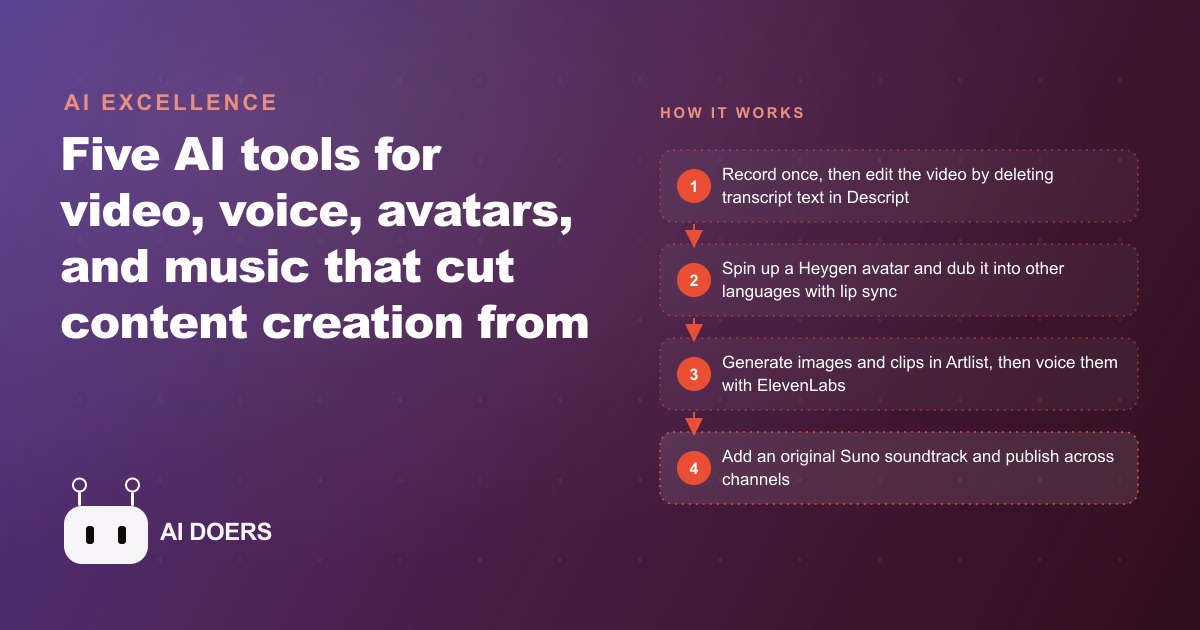
Descript, Heygen, Artlist, ElevenLabs, and Suno collapse video, avatar, voice, and music work that used to need a whole team into a few minutes each. Here is what each one does and how I would put them to work for a business.

The specialist content creator charging $300 to $800 per video, or $500 per month for a social media retainer, is pricing itself out of the market. Most of them have not noticed yet. The tools driving this are not experimental or in limited access. They are production-ready today, several of them free, and the businesses that have already adopted them are not producing inferior content. They are producing more content, faster, at a fraction of the cost, and in most use cases the output is indistinguishable from what a dedicated production team delivers.
Madhuranjan has watched this play out across multiple client types over the past year. The conclusion keeps being the same: the content agency model is not being disrupted slowly. It is being disrupted completely and quickly in specific categories, and the businesses still writing monthly retainer checks for those categories are paying a convenience tax on information they do not yet have.
Five tools are driving this shift. They are not gimmicks and they are not demos. They are production tools already being used by businesses that have done the math.
Descript makes the editing bottleneck disappear, and with it the editor's hourly rate
Video editing has always had a structural cost problem for small businesses: filming takes an hour, editing takes four to six, and editing requires either a skilled employee or a contractor charging $50 to $150 per hour for that time. This math has been fixed for years as simply the cost of producing video content.
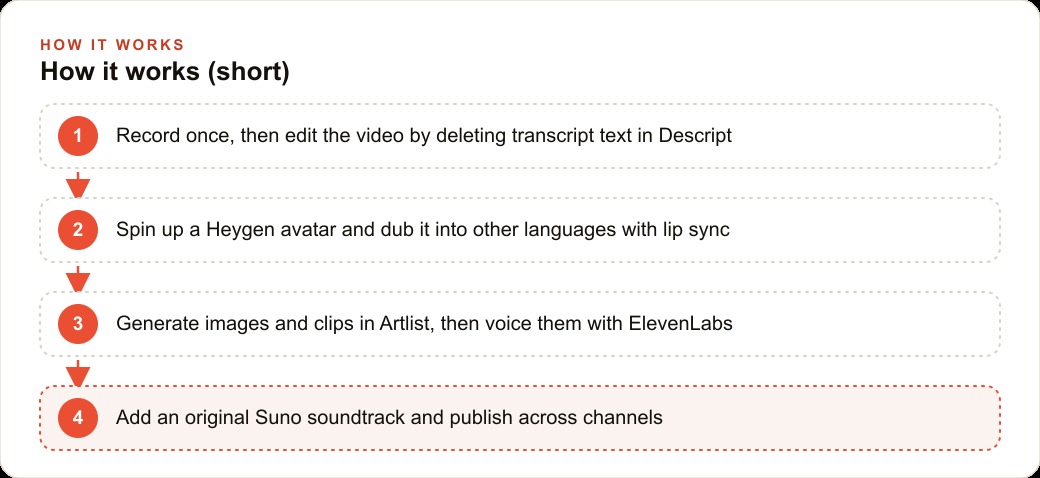
Descript eliminates this equation. It transcribes a recorded video and displays the transcript alongside the timeline. To cut a section, you delete the corresponding text. This breakdown cut happens automatically. To remove filler words, you select the cleanup option and the tool identifies and removes every "um," "uh," and false start across the entire recording in under a minute. To enhance audio quality, you press one button. The result is a cleanly edited video from a raw recording, produced by someone with no editing experience, in roughly the same amount of time it took to film.
Descript also supports multi-language export. A video produced in English can be dubbed into Spanish, French, Hindi, or Portuguese, with synchronized audio and adjusted lip movement, in minutes. For a business targeting multiple language markets, this previously required either separate production in each language or a dubbing workflow that cost hundreds of dollars per video.
The practical consequence is that this breakdown editor's role in the standard content production workflow has been structurally removed for everything except high-end creative work. If the value was "I edit video," that value is now delivered by a software subscription. The editor who brings genuine creative judgment to pacing, storytelling, and visual narrative still has a role. The one whose primary value was technical execution does not.
A Heygen avatar does not just save the cost of being on camera: it removes the filming calendar entirely
The second largest constraint in video content production for small businesses is not editing time. It is scheduling. The business owner who appears on camera needs to find a slot, set up the recording environment, do multiple takes, and repeat this for every piece of content. At two to three pieces per week, this is a material time commitment that competes directly with running the business.
Heygen removes the scheduling constraint by separating the person from the recording. You create an AI avatar of yourself once. From that point, any script you provide is rendered as a video of you presenting it, with accurate lip sync and natural delivery, without any filming session. The avatar can present in any language the platform supports, using your voice, translated and dubbed automatically.
Heygen also includes a video agent that takes a topic or a URL and generates a complete short-form video: it writes a script, selects relevant B-roll from a library, and produces an edited video ready for upload. For businesses that want to post daily short-form content but do not have the capacity to film or script daily, this is a complete production pipeline for that specific content type.
The implications for the content retainer model are direct. A significant portion of what many social media agencies charge for, specifically the production of talking-head or scripted video content with a consistent presenter, is now reproducible by the business owner without any agency involvement. The creative direction and strategy still require judgment. The production does not.
Artlist consolidates what was previously four separate agency subscriptions into one tab
Content agencies that produce visual content at scale typically maintain several tool subscriptions: one for AI image generation, one for AI video generation, one for stock imagery, and one for licensed music. Each serves a specific production step, each costs between $20 and $80 per month, and managing them as separate workflows adds coordination overhead to every project.
Artlist now consolidates the most capable models in each of these categories into a single workspace. From one interface, a creator or business owner can generate images using Flux 2.0 Pro or comparable models, generate short-form video using VEO or Sora, access stock footage and licensed music for use in final production, and move between these tools within the same project without switching accounts or interfaces.
For a business doing its own content production, Artlist's pricing makes this consolidation financially straightforward: a single subscription replaces multiple separate ones and provides access to the best-in-class model in each category rather than whatever a single-provider platform has built in-house.
For content agencies, the picture is more complicated. The agencies that were charging clients for access to a multi-tool workflow, and for the expertise to operate several separate platforms, now face a situation where that same access is available to the client directly, in a single product, without the coordination cost. The value that lived in knowing which tools to use and how to move between them has been absorbed into the interface design.
This consolidation also changes the economics of content production at the project level. An agency that was billing for four separate tool subscriptions as part of its overhead structure, plus the coordination time to manage them, now faces a client who can access the same tools directly at a single subscription price. The overhead justification weakens. The only remaining justification is the expertise to use the tools well, which is a real and meaningful value, but it is a much narrower one than the previous model required.
The real estate agency that produces three listings a week is now indistinguishable from one with a production team
Before these tools reached their current capability level, there was a visible gap between the content produced by a real estate agency with a dedicated video production team and one without. The team produced listing videos with professional editing, clean audio, branded lower thirds, and consistent visual quality. The agent without a team either skipped video content or produced something that looked like it was filmed on a phone with minimal post-production.
That gap has closed.
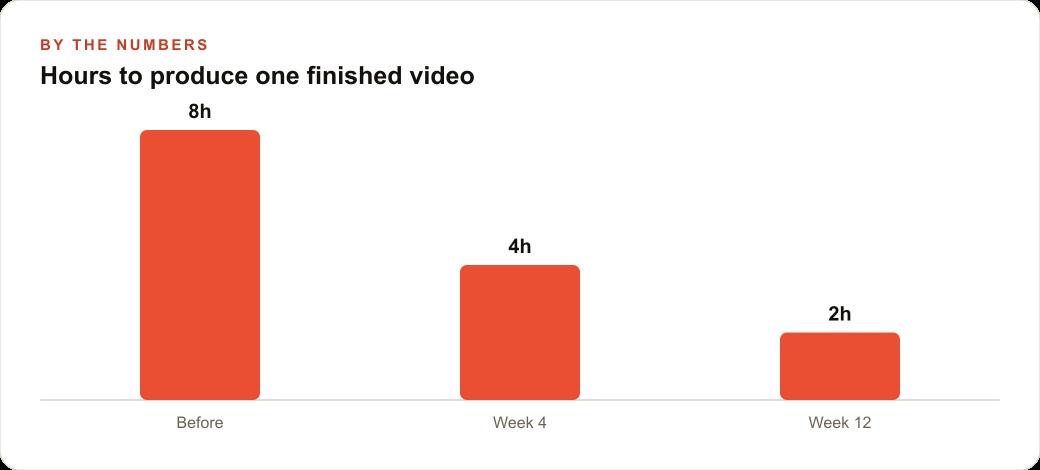
A real estate agency that replaced its video production retainer with the stack described above, specifically Descript for editing, Heygen for scripted content when the agent cannot film, Artlist for supplemental imagery and music, and ElevenLabs for voiceover narration on property tours, now produces three to four listing videos per week with a per-video time investment of thirty to forty-five minutes.
The previous workflow, with a production retainer, produced two listing videos per week at a retainer cost of $1,400 per month, or $700 per video. The current workflow produces three to four videos per week at a combined subscription cost of approximately $120 per month across all tools, plus forty minutes of the agent's time per video.
That is a cost reduction from $700 per video to approximately $30 in subscription cost plus the agent's time. At three listings per week over fifty weeks, the annual saving is approximately $95,000. The content volume has increased by fifty to one hundred percent. The visual quality is comparable in every dimension a homeowner or buyer would evaluate.
The agency that made this switch is not distinguishable from one with a dedicated production team by any metric that matters commercially. This breakdown looks professional, it publishes on schedule, and it appears in the same feeds as videos that cost ten times as much to produce.
The question is not whether to use these tools but how fast competitors are already using them
The conversation Madhuranjan keeps having with business owners about these tools goes through a predictable sequence. First: skepticism that the output quality is sufficient for professional use. Then: a demo that resolves the skepticism. Then: the recognition that the tools are already in use, and that some of the content the business owner has seen in the wild and considered high quality was produced with them.
The last stage is the one that matters strategically. These tools are not in early adoption. They are in active deployment across the competitive landscape. The real estate agency, the service business producing educational content for lead generation, the retail brand running product videos for paid social: all of these are producing content with this stack right now. The ones who got there first are not announcing it. They are simply producing more, at lower cost, and compounding the volume advantage month by month.
Suno is worth addressing separately because the music licensing problem for business content is rarely discussed. Every piece of content that uses background music technically requires a license. Most businesses either ignore this and accept the copyright risk, pay a music licensing platform $15 to $30 per month, or produce content with no music and accept that it sounds flat. Suno resolves this by generating original music from a text description. The generated track is original, not a sample of existing recorded music, which means the licensing question does not arise. A roofing company can specify "upbeat acoustic guitar, motivational feel, no lyrics, 90 seconds" and receive a track that sounds professional and is fully available for commercial use. The free V4.5 tier covers the volume most businesses need for social content.
ElevenLabs and Suno complete the stack for audio needs. ElevenLabs produces near-human voice narration from text, handles full audiobook-length narration without a recording session, and generates two-host AI podcasts from a URL or a document. Suno generates original licensed music from a text description, with a free tier that covers most business content volumes. Neither requires a recording session, a voice actor, or a music licensing negotiation.
The complete stack runs at a combined monthly cost lower than a single mid-tier content retainer. The output volume is higher than most agencies produce for that same retainer price.
For any business currently paying a content retainer for the types of production these tools cover, the decision is not whether to investigate them. The decision is how quickly to run the comparison and make the call.
The specialist content creators who will survive this shift are the ones who have already separated their value from the technical production layer. They are selling strategy, creative direction, audience understanding, and brand voice. The ones whose primary value was the technical execution are already facing a client base that can see the math clearly.
The relevant test is a direct production audit: take a piece of content currently being produced by an agency or contractor, reproduce it using the tools described above, and compare the output, cost, and production time side by side. If the output is equivalent and the cost is lower, the retainer is a candidate for restructuring. If the output requires a level of creative input that the tools cannot provide, the retainer has a defensible scope. Most businesses that run this test will find the answer is different for different deliverables on the same retainer, which means the audit does not necessarily end the agency relationship. It clarifies which parts of it are still earning their price.
That is exactly what we do at AI DOERS. Book a private 30-minute call with Madhuranjan Kumar and we will map the fastest path to it for your specific business.
Book your call →
Madhuranjan Kumar
Madhuranjan Kumar brings 20 years of performance-marketing experience and has managed over $200 million in Facebook ad spend for brands across the United States and beyond. His expertise spans the full modern marketing stack: Meta, Google Ads, TikTok, email automation, CRM, and the websites that hold it together. At AI DOERS he turns that track record into lead-generation systems for businesses across every industry.