
32 Claude Code Tricks That Take You From Beginner to Power User
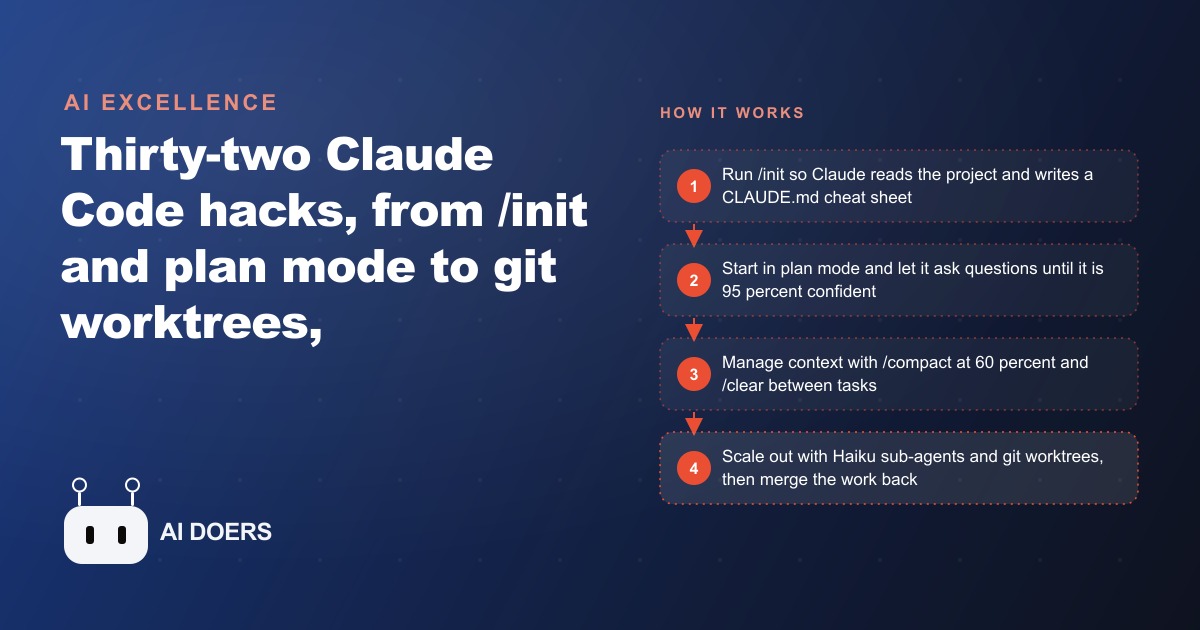
The highest-leverage Claude Code habits are to run /init for an auto-generated project cheat sheet, default to plan mode so Claude researches before it edits, manage context with /compact and /clear, and scale up with parallel sub-agents, git worktrees, and the Context 7 MCP for current documentation.

People who use Claude Code every day tend to fall into two very different groups, and the gap between them is not about knowing more commands. It is about three habits that run underneath everything else: managing context deliberately, planning before any code gets written, and routing expensive model calls to cheaper models wherever the task allows it. I am Madhuranjan Kumar, and what I want to do here is trace how those three habits actually work in practice, and show what they produce for a business that runs on software it needs to maintain and improve without a full engineering team.
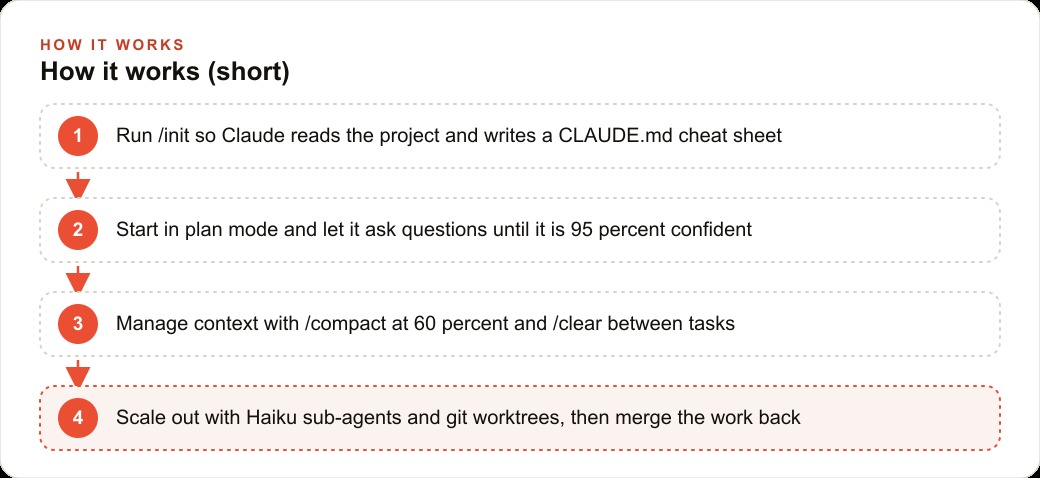
The first habit starts before any session begins, and it is the one most people skip. Running `/init` on any existing project scans the codebase and writes a CLAUDE.md file that functions as a memory document, an explanation of the folder structure, the naming conventions, the architecture, and the key decisions already made. Every session after that starts with the assistant already knowing the project. On a project I have never touched, the first twenty minutes of a session used to go toward re-explaining context that was already there but not captured anywhere. After /init, those twenty minutes become actual work. On a new project, I describe the goal, the stack, the team conventions, and the key rules I want enforced, and have Claude draft the CLAUDE.md from that description. The document grows as the project does, and it means no one on the team, human or AI, starts from zero.
The CLAUDE.md itself has a discipline to it. Keep it between a hundred and fifty and two hundred lines. Longer than that and it starts loading context that every session pays for but only specialized sessions actually use. Route the long detail, the data schema, the API reference, the content standards, into separate files that the CLAUDE.md points to rather than repeats. The assistant knows where to look when it needs the detail. The main context window pays only for the summary.
Plan mode and the 95 percent rule change the revision arithmetic
The second habit is plan mode, which is activated by pressing shift-tab, and it changes the cost structure of a session by preventing the most expensive kind of rework. In plan mode, the assistant can read and research but cannot change anything. It drafts a plan, asks questions, identifies ambiguities, and maps the approach before a single file is touched. The moment code starts being written before the approach is clearly right, you are in correction territory, which means you are paying twice, once to build the wrong thing and again to fix it.
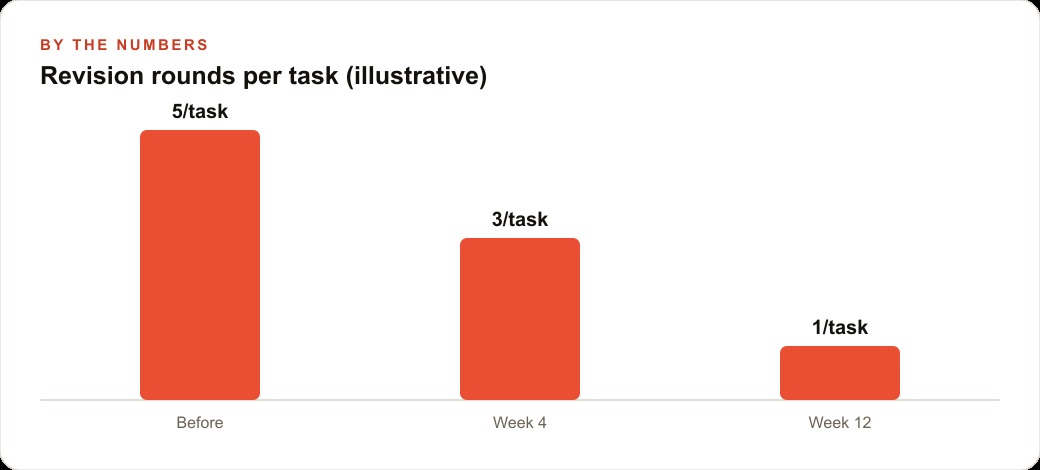
The instruction I add to plan mode sessions is explicit: keep asking questions until you are ninety-five percent confident you understand exactly what is needed. Not eighty percent. Not confident enough to start. Ninety-five. That instruction forces the alignment that removes three or four rounds of revision from the other end of the session. The questions are cheap. The corrections are not.
The verification habit that pairs with plan mode is baking self-checks into the task list rather than reviewing at the end. For any build that produces a visible output, I include a step to screenshot the result and open the browser developer tools to confirm there are no errors, and I specify that Claude should not proceed to the next step until it is ninety-five percent confident the current one is correct. This sounds like over-engineering until you have watched a session produce a technically complete but practically wrong output three steps back and silently build on top of it. The verification steps catch those drifts while the context window still remembers why the decision was made.
For businesses building SEO-driven content systems with programmatic pages at scale, this discipline is the difference between a pipeline that runs reliably and one that requires someone to monitor every run. A plan-mode session that maps out the data flow, the template logic, the edge cases, and the error handling before any code is written produces a pipeline that actually handles those edge cases. A session that skips straight to building produces one that works on the happy path and fails quietly on everything else.
Context is a finite resource and treating it like one changes everything
The third discipline is context management, and it is the one that most separates experienced Claude Code users from new ones. The context window has a size, and every token in it competes with every other token for the model's attention. Sessions that run without any hygiene accumulate history, old drafts, failed approaches, and intermediate states that consume space and dilute the model's focus on what actually matters now.
Running `/context` shows what is in the window and what percentage it occupies, broken down by source. That visibility makes decisions deliberate rather than reactive. At around sixty percent, I run `/compact` with an explicit instruction about what to preserve, the API decisions, the database schema, the current working approach, and let it compress the rest. Between tasks that are genuinely unrelated, `/clear` is the right move, a clean slate that does not carry baggage from the previous session.
The scaling layer is where the three habits multiply. Sub-agents let the main session spin up parallel workers, each with their own context window and their own model, running independent tasks simultaneously and reporting back to the main thread. The key routing decision is which model each worker runs on. Haiku handles bulk reading, simple extraction, and high-volume repetitive tasks at a fraction of the cost of the main model. An Opus or Sonnet session that would take hours reading a quarter of messy CSV exports and spend most of its budget on that reading assigns the reading to a Haiku sub-agent, receives only the flagged exceptions and structured summary back, and applies its capability to the judgment the cheap model cannot provide.
For a business that maintains an internal CRM and automated workflow system, this architecture means that a session analyzing a year of customer interaction records, identifying patterns, flagging anomalies, and producing a structured report does not need to process every record through an expensive model. The reading and classification go to Haiku. The synthesis, the pattern identification, and the actionable recommendations come from the main thread. The quality of the final output is the same or better. The cost is a fraction.
Git worktrees extend this parallelism to the build layer. When two features need to be developed concurrently, two separate working directories built from the same repository allow both to be built simultaneously without overwriting each other. One session builds the reporting module while a second session builds the intake form, each with its own clean branch, and the merge happens through normal version control when both are complete. The pattern that used to require two developers working on separate machines now runs in two terminal windows on the same machine.
The Context 7 MCP server addresses a gap that costs real time on every project that uses any library: Claude has a training cutoff, and libraries change. A suggestion to use a function that was renamed two major versions ago, or a configuration option that was deprecated, means a round of debugging before the real work can continue. The Context 7 MCP pulls current, version-specific documentation from thousands of libraries and injects it before Claude writes code that touches those libraries. The difference between working with a model that has current documentation and one that does not shows up in the first few debugging cycles on any modern framework.
What this looks like in a real operation
Put together, these habits produce something qualitatively different from a session that skips them. A project with a solid CLAUDE.md and a history of plan-mode sessions starts from a much higher base of shared knowledge. The assistant knows the architecture, knows the conventions, knows the decisions already made and why. A session that starts in plan mode and clears its verification steps before proceeding produces work that is right at the end rather than right after several rounds of corrections. A session that routes expensive reading to Haiku and runs two builds in parallel through worktrees finishes in a fraction of the time the same work would take sequentially on one model.
For a business that uses software to manage its operations but does not have engineering staff to maintain it, the practical value of these habits is that work actually completes without requiring an expert to monitor every step. The /init file carries institutional knowledge forward. Plan mode prevents the expensive mistakes. Context hygiene keeps the sessions productive rather than bogged down in their own history. Sub-agents on cheaper models handle the bulk work. Worktrees allow parallel progress. Context 7 keeps the documentation current.
None of this requires a software background to implement. It requires setting up the foundation once, correctly, and then letting the habits run. The investment is a few hours to run /init, draft a solid CLAUDE.md, and build the plan-mode habit. The return is a tool that behaves reliably rather than like a coin flip.
That is exactly what we do at AI DOERS. Book a private 30-minute call with Madhuranjan Kumar and we will map the fastest path to it for your specific business.
Book your call →
Madhuranjan Kumar
Madhuranjan Kumar brings 20 years of performance-marketing experience and has managed over $200 million in Facebook ad spend for brands across the United States and beyond. His expertise spans the full modern marketing stack: Meta, Google Ads, TikTok, email automation, CRM, and the websites that hold it together. At AI DOERS he turns that track record into lead-generation systems for businesses across every industry.