
11 AI Business Models You Can Start From Home in 2026
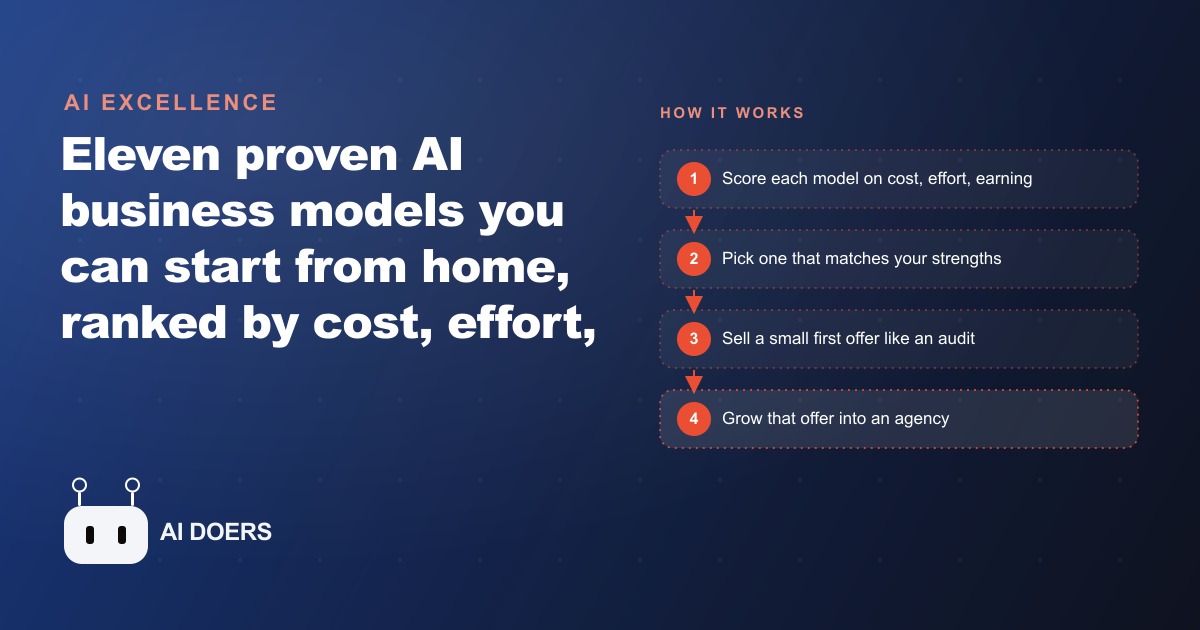
A full map of the eleven AI business models actually working right now, each ranked by cost, effort, and earning potential, so you can pick the one that fits you and start from your laptop.

I'm Madhuranjan Kumar, and I want to make an argument that will probably frustrate you before it helps you.
There are 11 legitimate AI business models you can start from home right now. The filmmaker, the consultant, the freelancer, the automation agency owner, the creative studio, the content creator, the influencer, the consumer educator, the business educator, the SaaS builder, the transformation partner. Each of these is real, and I could spend a paragraph on every one of them explaining the costs, the earning potential, and the skills required. That is what most content on this topic does, and it leaves people paralyzed in the exact same place they started.
The reason is that presenting 11 models as a menu of equal options is misleading. They are not a menu. They are a progression, and most of them are destinations you arrive at rather than starting points you can step into. Treating them as equivalent choices is the reason people research for three months and then start nothing.
My argument is this: for the vast majority of people reading this, there is one correct on-ramp, and it is the audit model. Everything else flows from there if you do it right.
Let me tell you why.
The Models That Look Easy Are Actually the Hardest to Enter
The filmmaker sounds accessible. You have a phone, you have AI video tools, you have ideas. The problem is that the filming model requires an audience to generate revenue, and audiences take a year or more of consistent output to build to meaningful size. You are not selling the film, you are accumulating an asset, which means you need runway and patience before the model pays. Starting here from zero means working for months without income to prove the concept.
The influencer has the same structure. The content creator, the consumer educator, all of them require the audience asset first. Without that asset already built, you are in the position of spending money on tools and time on content before a single dollar comes back. That is fine if you have existing runway. It is a trap if you need the business to fund itself from the early stages.
The SaaS builder sounds scalable and is, eventually. But building even a simple AI-powered SaaS product requires significant upfront development time, a marketing motion, and enough users to validate the premise before you invest in the next version. If you have an engineering background, this can be your path. If you do not, the learning curve means you are running two parallel projects, building the skill and building the product, and both require sustained attention before either pays.
The transformation partner, the highest-value model on the list, is the most sophisticated offering. You are embedding with an organization and transforming how they use AI across multiple functions. The fees are substantial because the scope is substantial. But this model requires the credibility to walk into a business at that level of authority, which takes time to establish, and usually comes from having done the simpler models first.
The automation agency is closer to accessible. You build automations that save clients time and charge for the outcome. But most automation agency operators will tell you that the first six months are consumed by education: learning the client's processes well enough to automate them, learning the tools well enough to build reliably, and learning the sales motion well enough to close deals. It is a fantastic model. It is not the fastest path to your first dollar.
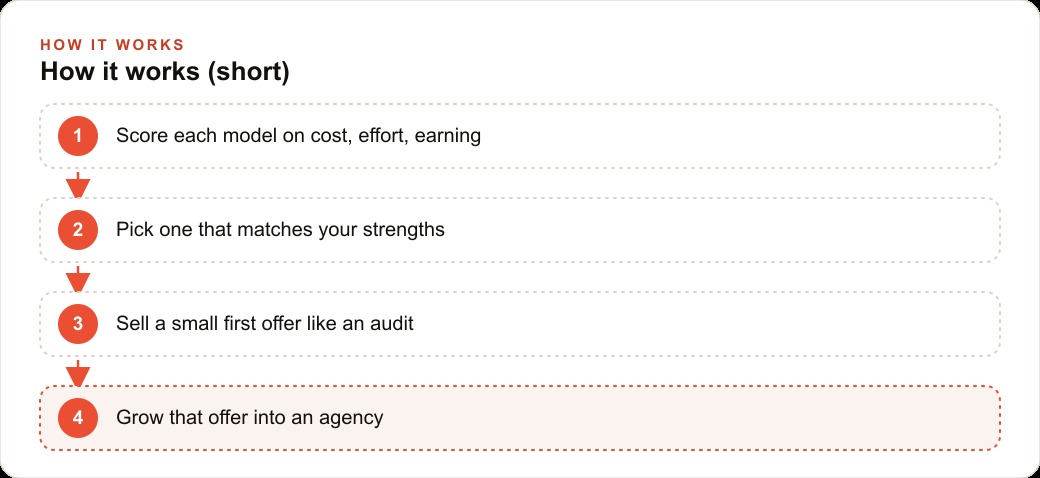
The Audit Model Is the On-Ramp Because It Charges for Thinking, Not Building
The consultant model and the freelancer model are structurally similar at the entry level: you offer expert judgment, charge for your time, and deliver a recommendation or an execution. The fastest version of this for someone new to the space is the AI tool audit.
A small or medium-sized business today is drowning in AI tool decisions. Every week there are new platforms promising to automate their invoicing, their customer service, their content, their scheduling, their hiring. They do not have the time or expertise to evaluate them. They do not know what they actually need versus what a sales pitch made them think they needed. They are paying for subscriptions they barely use and ignoring workflows that could actually save them hours every week.
You can charge to solve that problem. Not by being the world's foremost AI expert, but by knowing enough to ask the right questions, map the actual workflow, identify the three or four places where AI could genuinely save time, and give them a clear written recommendation.
The economics of this are immediate and do not require building anything. You need a questionnaire, a note-taking system, a basic framework for evaluating fit between a tool and a workflow, and the ability to write a clear document. The first audit takes longer because you are building the process. The second is faster. The third starts to feel like something you could scale.
One Path That Shows the Progression in Real Terms
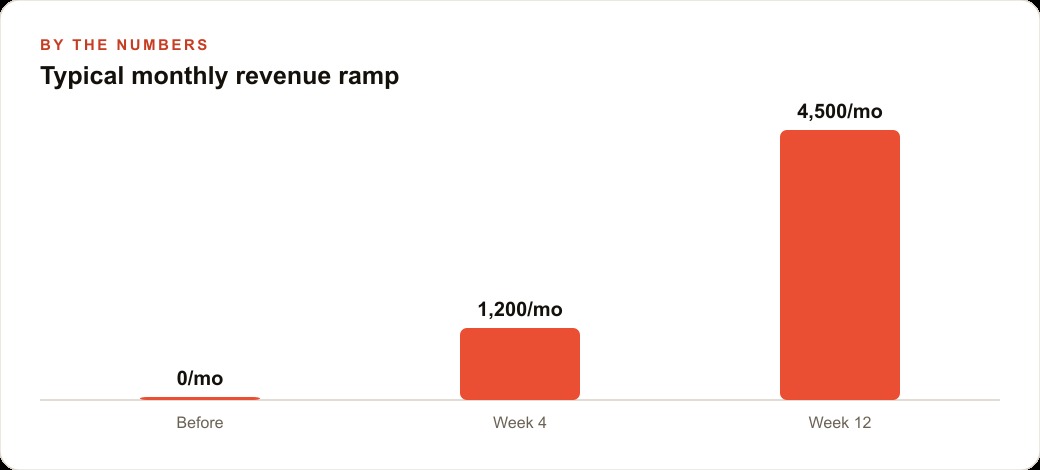
Let me trace a specific sequence that shows how the models connect, using numbers that are representative of what this market currently supports.
Someone new to the AI space takes their professional background, whatever it is, and frames it as domain knowledge the AI audit requires. They approach three businesses in their existing network, not cold outreach, existing contacts, and offer an AI workflow audit for $800 each. They complete all three over six weeks, spending roughly 8 to 12 hours on each including the initial conversation, the documentation of current processes, the tool evaluation, and the written deliverable.
At $800 per audit, three completed engagements generate $2,400 in revenue before any tool subscription, any website, any formal business registration. The costs are zero beyond their time. That $2,400 is the proof of concept.
Now the third client receives their recommendation. The recommendation includes three tools to adopt and two workflow changes to make. The client looks at this document and says the obvious thing: can you help us implement this? That is the moment the model advances. The implementation is not an audit. It is an automation build, a series of connected workflows using the recommended tools, configured and tested and handed over with documentation. That engagement is worth $3,200.
Total revenue from one sequence of four engagements with three clients: $5,600, without a website, without a social audience, without a paid tool stack, without any team. The third client spent $4,000 with the same operator across two engagements and would be more likely to refer than any cold outreach target.
That is the audit model as on-ramp. And it is the precondition for every more sophisticated model that follows.
Why the Agency Model Is a Destination, Not a Starting Point
The automation agency model is where many operators eventually arrive after the consultant and freelancer phase. The distinction is that an agency has systems, not just skills. You are not selling your time on a per-project basis. You are selling a repeatable service, delivered by a process that could eventually be delivered by someone you hire.
Getting to the agency model requires having done enough individual client work to understand what the repeatable unit of value actually is. That is not obvious in advance. You discover it through client engagements, noticing which problems recur, which solutions hold up across different business contexts, which components of delivery can be systematized versus which require custom judgment every time.
Operators who try to launch as an automation agency on day one, without the prior client experience, usually spend months building infrastructure for a service offering they have not yet validated. They build proposal templates for services nobody has bought. They hire before they have the volume to support the cost. They build a brand around a positioning they discover is wrong after six months of market feedback.
The freelancer phase, even if it lasts only six months, produces the market knowledge the agency needs to launch properly. The consultant phase, the audit work, produces the domain positioning that makes the agency's service offering specific enough to be credible.
The Educator Models Require Proof of Practice
The consumer educator and business educator models share a common prerequisite: you need to have done something before you teach it at a level that earns sustained attention.
The business educator, specifically the one who teaches other businesses how to use AI, is a lucrative position at scale. The people doing this well have case studies from client work. They have specific before-and-after numbers. They have the credibility that comes from having navigated real implementations with real budgets and real constraints.
A new entrant who tries to build an education business around AI without any client implementation history produces generic content that competes on volume rather than insight. That is a difficult competitive position because the volume game is dominated by people with larger existing audiences and larger content production budgets.
The sequence that produces a sustainable educator position almost always runs through consulting or agency work first. You do the implementations. You document what you learn. You turn that documentation into educational content that is actually differentiated because it comes from real experience in specific contexts. Then the audience builds around the specificity of your knowledge, not around the breadth of your coverage.
The SaaS and Transformation Models at the Far End
The SaaS builder and the transformation partner are the two models at the far end of the progression, and they represent the highest potential upside for exactly the reason that makes them inaccessible at the start.
The SaaS builder is building a product, not selling a service, which means the revenue model is recurring and scalable in a way that service models are not. But the product has to be discovered, validated, built, maintained, marketed, and sold. Each of those is a full-time challenge. The operators who succeed at AI SaaS almost always come from either a technical background that makes the build tractable or a client services background that surfaced the problem the product solves.
The transformation partner is essentially a senior consultant with deep organizational change management capability applied to AI adoption. The fees are high because the scope is broad and the credibility requirements are steep. Businesses only invite this kind of engagement from someone whose track record justifies the trust. That track record is built through years of the earlier models.
Why the On-Ramp Matters More Than the Destination
I want to be direct about why I am emphasizing the on-ramp rather than celebrating all eleven models equally.
Most people who discover these models spend their limited energy trying to evaluate which destination is most appealing rather than choosing the best starting motion. They optimize for the model that looks most exciting or most scalable on paper, and underestimate how much runway, existing credibility, and accumulated client knowledge is required to make any of the advanced models work.
The audit model is the correct on-ramp for most people because it requires the fewest preconditions. It charges for thinking, not building, which means the tooling cost is near zero. It validates your ability to communicate value to a client before you invest months in building a service or product. It generates cash flow that funds the next stage of development. And critically, it produces real client relationships that are the fastest path to the higher-value engagements that make the agency, educator, and transformation models economically compelling.
Every model on the list is real and viable at the right stage. The question is not which one is best in the abstract. The question is which one you can actually start from exactly where you are today, with the resources and relationships you have right now. For most people, that is the audit, and the other ten models are what the audit unlocks over time. I'm Madhuranjan Kumar, and I think that is the most useful framing of this list you will find.
That is exactly what we do at AI DOERS. Book a private 30-minute call with Madhuranjan Kumar and we will map the fastest path to it for your specific business.
Book your call →
Madhuranjan Kumar
Madhuranjan Kumar brings 20 years of performance-marketing experience and has managed over $200 million in Facebook ad spend for brands across the United States and beyond. His expertise spans the full modern marketing stack: Meta, Google Ads, TikTok, email automation, CRM, and the websites that hold it together. At AI DOERS he turns that track record into lead-generation systems for businesses across every industry.